
Scores for all instruments: 16,000+ (active and growing), over 236,000 pages.
All genres and levels: Jazz & Blues, Rock & Pop, Classical & Contemporary, Film & Musicals;
books & biographies; methods, études, play-along tracks (MP3) for Jazz & Rock.
Access & benefits: US$15.99 one-time payment, valid for lifetime, full Library access.
Table of Contents
Berkovich Concerto No. 2, Op. 44 Full Orchestral Score with Parts
Isaak Berkovich: Second Concerto for Piano and String Orchestra, Opus 44 (Allegro, Andante con moto, Allegro assai)
The best sheet music download from our Library.
Recorded on 07/11/2010 at Abbaye de Neumünster (Salle Robert Krieps), Luxembourg City; closing concert of the International Composition Competition; chamber orchestra conducted by Martin Elmquist.
Please, subscribe to our Sheet Music Library. Sheet music should be accessible and affordable for all musicians, from professionals to absolute beginners.
Search your favorite sheet music in the Sheet Music Library Catalog
Browse in the Sheet Music Library:
Or browse in the categories menus & download the Library Catalog PDF:
Isaak Berkovich: The Quiet Architect of Ukrainian Piano Pedagogy
In the vast landscape of twentieth-century Soviet music, certain figures loom large—Shostakovich, Prokofiev, Khachaturian—while others, equally consequential in their own spheres, remain unjustly obscured. Isaak Yakovlevich Berkovich (1902–1972) belongs firmly to the latter category. A Ukrainian composer, pianist, and pedagogue, Berkovich spent nearly five decades shaping the musical education of generations of Soviet pianists, all the while composing a substantial body of work that bridged late Romanticism and twentieth-century harmonic practice. His pedagogical magnum opus, The School of Piano Playing, became a foundational text in the Soviet Union, and his 24 Preludes and Variations on a Theme of Paganini remain staples of the intermediate piano repertoire. Yet outside of Ukraine and the former Soviet states, his name is rarely spoken. This article seeks to correct that omission, offering a comprehensive examination of Berkovich's life, musical language, principal compositions, pedagogical contributions, and enduring legacy.
Biography
Early Life and Education
Isaak Yakovlevich Berkovich was born on December 28, 1902, in Kyiv, then part of the Russian Empire, into the family of a watchmaker. The city, with its rich musical traditions and vibrant Jewish cultural life, would remain his home for nearly his entire life. At the age of eighteen, in 1920, Berkovich entered the Kyiv Conservatory (now the Petro Tchaikovsky National Music Academy of Ukraine), where he studied piano under Professor Vladimir Pukhalsky and, concurrently, music theory and composition under Professor Boris Lyatoshynsky. Lyatoshynsky, himself a major figure in Ukrainian music, was a crucial early influence; his own style—a synthesis of late Romantic expressiveness with Ukrainian folk idioms and modernist harmonic experiments—left an indelible mark on the young Berkovich. Berkovich graduated from the conservatory in 1925, having already begun to compose prolifically, particularly works for young pianists.
Pedagogical Career
Berkovich's pedagogical vocation began remarkably early. At just twenty years old, while still a student, he started teaching. From 1925 to 1930, he worked at Kyiv Music School No. 6. In the period 1925–1941, he served as a teacher at the Kyiv Music College and as a lecturer at the Kyiv Evening Conservatory. His ascent through the academic ranks was steady: from 1933 to 1941 he was an assistant at the Kyiv Conservatory; in 1947 he became an associate professor; and in 1969 he was appointed professor. In 1938, he was admitted to the National Union of Ukrainian Composers. Throughout his career, Berkovich maintained a dual identity as composer and educator, with his compositional energies increasingly directed toward the creation of pedagogical repertoire.
Musical Style and Technique
A Late Romantic in a Modern Age
Berkovich's compositional style is best understood as a continuation of the late Romantic tradition, filtered through the distinctive lens of Ukrainian musical culture. A Czech academic study of his 24 Preludes explicitly compares his compositional style to "the work of the giants of the Russian era of late Romanticism". This is not to suggest that Berkovich was merely derivative; rather, he absorbed the harmonic language of Tchaikovsky, Rachmaninoff, and early Scriabin, and adapted it to the practical demands of pedagogical music. His harmonic palette is predominantly tonal, enriched by chromaticism, modal inflections, and occasional borrowings from Ukrainian folk music.
Miniature as Genre
Berkovich's natural métier was the miniature. As one study notes, "preferably, the composer refers to the genre of miniatures, which is the bulk of his creative works". This preference was not merely a concession to pedagogical utility; it reflects a genuine artistic disposition. Like Chopin and Schumann before him, Berkovich understood that the character piece could be as expressive and formally sophisticated as larger forms. His miniatures—preludes, etudes, mazurkas, album leaves, and programmatic pieces—display a remarkable economy of means, achieving maximum expressive effect with minimal technical demands.
Texture and Pianism
Berkovich's piano writing is idiomatic and grateful to the hand. He favors clear textures, with melody frequently assigned to the right hand and accompaniment patterns that lie comfortably under the fingers. In more advanced works, such as the 24 Preludes, he employs a wider range of textures, including contrapuntal writing, chordal declamation, and flowing arpeggiated accompaniments. His harmonic language in these works is richer, with occasional forays into extended tonality and modal harmony. A Japanese piano encyclopedia entry analyzing one of his pieces describes his use of a "borrowed chord" on the IV degree to heighten emotional expression at a climactic moment—a technique emblematic of his Romantic inheritance.
Harmony
Tonal Foundations with Chromatic Enrichment
Berkovich's harmonic language operates squarely within the tonal system, but it is a tonality enriched by chromatic alteration, modal mixture, and judicious use of non-chord tones. His music rarely ventures into atonality or serialism; instead, he explores the expressive possibilities of extended tonality. In the 24 Preludes, each prelude is written in a different key, following the circle of fifths with alternating major and parallel minor relationships, directly modeled on Chopin's Op. 28. This structure demonstrates both his reverence for the Romantic tradition and his systematic approach to pedagogical organization.
Borrowed Chords and Modal Inflections
A characteristic feature of Berkovich's harmonic vocabulary is the strategic use of borrowed chords—particularly the minor subdominant in major keys, or the major subdominant in minor keys—to create moments of expressive depth. The Japanese analysis cited above notes that in one of his pieces, a borrowed IV-degree chord appears precisely at the structural climax, "pinpointing" the emotional peak. This technique, derived from the Romantic tradition, allows him to achieve considerable expressive intensity within a fundamentally tonal framework.
Ukrainian Folk Idioms
Berkovich frequently incorporated Ukrainian folk songs into his works, either as direct quotations or as stylistic models. His Polyphonic Pieces Based on Ukrainian Folk Songs and Variations on Folk Themes demonstrate his engagement with the folk tradition. These works employ modal scales, irregular phrase structures, and characteristic melodic contours that distinguish Ukrainian folk music from its Russian counterpart. In this respect, Berkovich aligns himself with a broader nationalist current in Ukrainian music, though his nationalism is subtle and integrated rather than overtly programmatic.
Best Songs and Compositions
The 24 Preludes, Op. 46
Berkovich's 24 Preludes (1965) stands as his most significant contribution to the piano repertoire. The cycle follows the Chopin model, with each prelude in a different key, arranged by fifths with alternating major and parallel minor. Unlike Chopin, however, Berkovich wrote his preludes explicitly for pedagogical purposes, with each piece addressing specific technical and interpretive challenges. The preludes range from simple, lyrical miniatures to more complex character pieces, and together they form a comprehensive survey of intermediate piano technique. A Czech dissertation devoted to the cycle notes that it has been the subject of "pedagogical-interpretative analysis," underscoring its enduring value in music education.
Variations on a Theme by Paganini
Composed in 1967, Berkovich's Variations on a Theme by Paganini is based on the famous theme from Paganini's 24th Caprice—the same theme used by Rachmaninoff, Brahms, and Lutosławski. Berkovich's set comprises nine variations and a finale, and it has become a favorite in piano competitions and festivals. A graduate thesis from the University of Georgia examines Berkovich's variations alongside those of Hambourg and Labunski, noting that Berkovich "contributed more as a piano teacher than as a performer". The work is technically accessible to advanced intermediate students, yet it offers ample opportunity for virtuosic display. Its inclusion in the National Federation of Music Clubs festival bulletin from 2008 to 2010 testifies to its continued pedagogical currency.
Piano Concertos
Berkovich composed three concertos for piano and string orchestra (1961, 1963, 1968), as well as a Piano Concerto, Op. 44, specifically designated "for student and teacher". The Op. 44 concerto is arranged for piano four hands (or two pianos, four hands), allowing a teacher to accompany a student in a collaborative performance setting. This pedagogical innovation reflects Berkovich's lifelong commitment to making serious music accessible to young players. The concerto is published by G. Schirmer and remains in print.
Other Notable Works
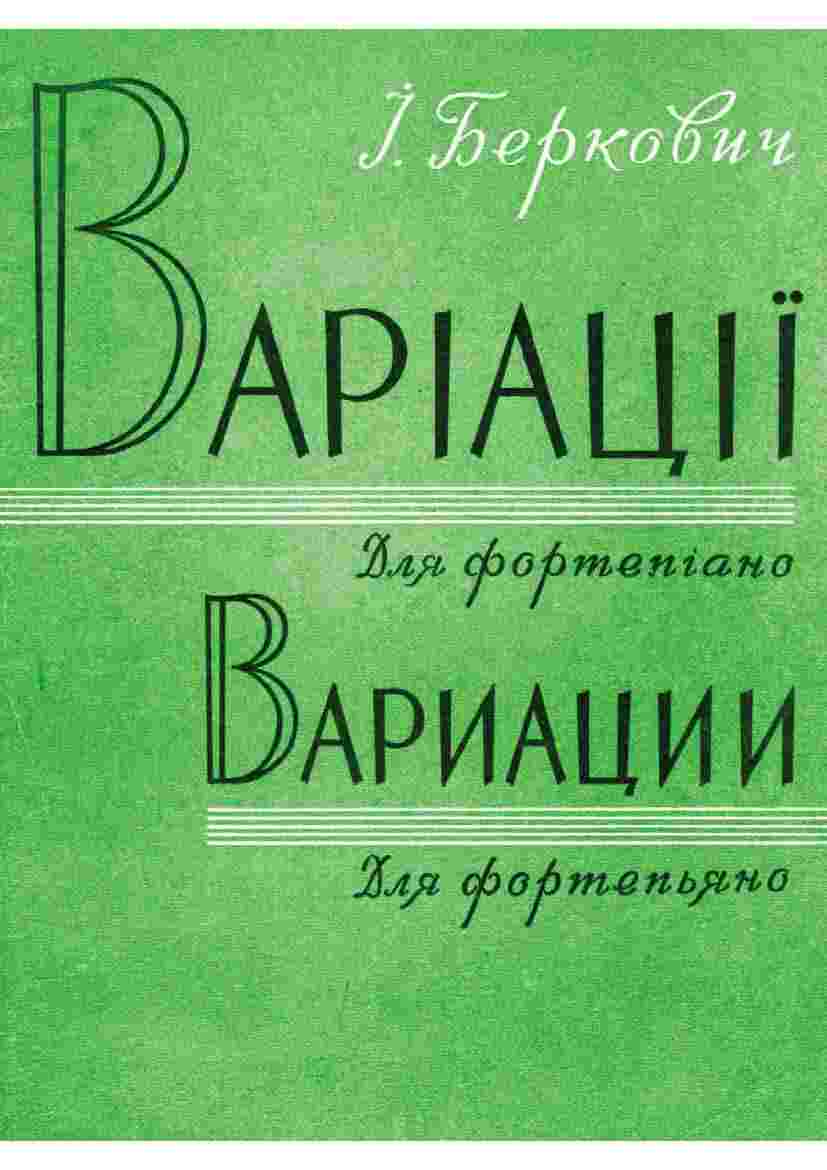
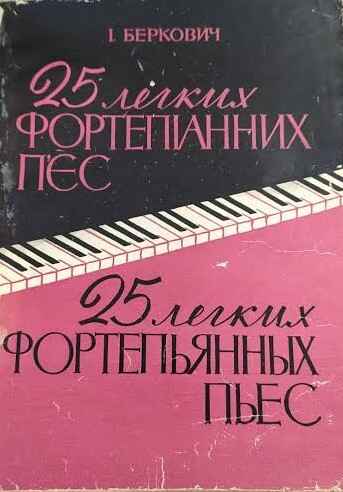
Berkovich's catalog also includes two piano sonatas (1922, 1941), three sonatinas (1952), Thirty Easy Pieces (1938), Thirty-Five Etudes (1950), a collection of polyphonic pieces (1950), and numerous cycles of pedagogical pieces and ensembles. He also wrote works for violin and cello, for folk instruments orchestra (a suite, 1964), and for domra ensembles, as well as romances and children's songs. His setting of Taras Shevchenko's poem Duma for voice and piano represents his engagement with Ukrainian literary culture.
Current Use for Pedagogy
The School of Piano Playing
Berkovich's most enduring legacy is undoubtedly his School of Piano Playing, first published in 1960 with a second edition in 1968. This comprehensive method book, designated Op. 35, became a standard text in Soviet music schools and has been used by "more than one generation of musicians". The School is organized systematically, progressing from elementary to intermediate levels, and includes a wide variety of pieces—etudes, arrangements of folk songs, polyphonic works, and original compositions. A scholarly study notes that the manual is "more focused [on] teacher than student" because it lacks detailed methodological explanations addressed directly to the learner; it assumes a competent teacher guiding the student through the material.
The 24 Preludes in Contemporary Pedagogy
The 24 Preludes continue to be studied and performed in music schools and conservatories across the former Soviet Union and beyond. A Czech dissertation from the Janáček Academy of Music in Brno is devoted entirely to a pedagogical-interpretative analysis of selected preludes from the cycle, demonstrating its ongoing relevance in European piano pedagogy. The preludes are particularly valued for their systematic coverage of keys and their graded technical demands, making them an ideal introduction to the Romantic character piece.
Pedagogical Principles
Berkovich's pedagogical approach, as reflected in his compositions and method books, emphasizes several key principles. First, technical development should always be in service of musical expression; exercises and etudes are never merely mechanical. Second, students should be exposed to a variety of styles and genres from the earliest stages, including folk music, polyphony, and classical forms. Third, the repertoire should be engaging and musically satisfying, even at the elementary level—a principle that distinguishes Berkovich's pedagogical works from the dry exercises of some of his contemporaries.
Collaborations with Other Musicians
Documented collaborations between Berkovich and other musicians are relatively sparse, reflecting his primary identity as a solo composer-educator rather than a performer or collaborative artist. However, one significant collaboration is noted in the literature: Berkovich compiled some of his piano albums for young musicians "in collaboration with Ye. Tolpinym". This partnership suggests that Berkovich was open to working with other pedagogues in developing teaching materials. Additionally, his works have been performed and recorded by pianists such as Irina Berkovich (no relation) and Eitan Globerson, who have championed his 24 Preludes and Piano Sonata No. 2. More recently, pianists Ernest So and Nancy Su have recorded Berkovich's Ten Lyrical Pieces as part of a series pairing his music with that of Sergei Bortkiewicz, another underappreciated Ukrainian composer.
Influences and Legacy
Musical Influences
Berkovich's musical lineage is clear: he studied with Boris Lyatoshynsky, a composer who himself bridged the worlds of late Romanticism and early modernism. Through Lyatoshynsky, Berkovich inherited the tradition of Ukrainian musical nationalism pioneered by Mykola Lysenko, as well as the broader Russian Romantic tradition of Tchaikovsky and Rachmaninoff. His piano writing also shows the influence of Chopin, particularly in the 24 Preludes, and of Schumann in his character pieces. The harmonic language of his more advanced works occasionally gestures toward Scriabin, though Berkovich never abandoned tonality.
Legacy in Ukrainian Music
Berkovich's legacy is inseparable from the history of Ukrainian piano pedagogy. A 2022 scholarly article commemorating the 120th anniversary of his birth concludes that his work made a significant contribution to "the development of Ukrainian music-pedagogical culture," and that his compositions and teaching aids continue to offer "projective opportunities for the development of national music culture". His School of Piano Playing is regarded as a foundational text, and his 24 Preludes are considered a major contribution to the Ukrainian piano repertoire. More than one generation of Ukrainian pianists learned their craft through Berkovich's materials, and his influence persists in the curricula of music schools throughout the country.
International Reception
Outside of Ukraine and the former Soviet Union, Berkovich's music remains relatively unknown, though there are signs of growing interest. His Variations on a Theme by Paganini are available through major sheet music retailers, and his Piano Concerto, Op. 44, is published by G. Schirmer and distributed by Hal Leonard. Recordings of his Ten Lyrical Pieces have been released by the Ernest So Piano Library, and academic studies of his work have appeared in Czech, Ukrainian, and English-language publications. The 2025 IGI Global volume Piano Work of Isaac Bercovich: Genre-Stylistic, Performing, Pedagogical Aspects represents the most substantial English-language treatment of his music to date.
A Universal Creative Personality
A recent scholarly framework categorizes "universal musicians" into seven types based on their leading activities. Berkovich is identified as a pianist-composer-teacher, exemplifying the integration of performance, composition, and pedagogy that characterized the ideal Soviet musician. This tripartite identity shaped every aspect of his work: his compositions were informed by his practical experience as a teacher, his teaching was enriched by his creative work as a composer, and his piano playing—though not his primary professional activity—informed his understanding of the instrument's capabilities.
Archival Sources
Significant archival materials related to Berkovich are held in Kyiv, including documents in the State Archive-Museum of Literature and Art of Kyiv and the archive of the National Academy of Music named after P. Tchaikovsky. The personal archives of Berkovich and his colleague M. Silvansky contain manuscripts, correspondence, and pedagogical materials that have only recently begun to be studied by scholars. The IGI Global chapter draws on interviews with Berkovich's colleagues and students, providing valuable firsthand perspectives on his teaching methods and personality.
Discography
Berkovich's music has been recorded sporadically. The Ernest So Piano Library's Première series, released in 2021, features his Ten Lyrical Pieces alongside works by Bortkiewicz. His Variations on a Theme by Paganini appear in the ALLEGRO piano anthology series, a widely used collection of intermediate repertoire. The 24 Preludes have been recorded by Ukrainian and Israeli pianists, though a definitive complete recording remains a desideratum. The Koyama Piano channel on YouTube features a performance of the Paganini Variations, indicating ongoing amateur and student interest.
Berkovich
Isaak Berkovich occupies a distinctive position in twentieth-century music history. He was not a revolutionary; he did not seek to dismantle tonality or reinvent the piano. Instead, he worked quietly and persistently within a tradition he loved, producing a body of work that served the practical needs of piano students while never sacrificing musical quality. His School of Piano Playing taught generations of children to play the piano; his 24 Preludes and Variations on a Theme by Paganini gave them music of genuine artistic merit to study and perform. In an era when composers often wrote pedagogical music as a sideline, Berkovich made it his central vocation.
His legacy is not measured in grand gestures or avant-garde manifestos, but in the thousands of pianists who learned from his method books, the students who discovered the expressive possibilities of Romantic harmony through his preludes, and the continuing scholarly attention to his work in Ukraine, the Czech Republic, and beyond. As the 2025 IGI Global volume demonstrates, there is still much to discover about this quiet architect of Ukrainian piano pedagogy. His music, like his teaching, was designed to bring out the best in those who encountered it—and in that, it succeeded beautifully.