
Community Musicians, building a worldwide Community Music.
Scores for all instruments: 16,000+ (active and growing), over 236,000 pages.
All genres and levels: Jazz & Blues, Rock & Pop, Classical & Contemporary, Film & Musicals;
books & biographies; methods, études, play-along tracks (MP3) for Jazz & Rock.
Access & benefits: US$15.99 one-time payment, valid for lifetime, full Library access.
Scores for all instruments: 16,000+ (active and growing), over 236,000 pages.
All genres and levels: Jazz & Blues, Rock & Pop, Classical & Contemporary, Film & Musicals;
books & biographies; methods, études, play-along tracks (MP3) for Jazz & Rock.
Access & benefits: US$15.99 one-time payment, valid for lifetime, full Library access.
Table of Contents
Bill Evans - I Love You, Porgy (Gershwin) with sheet music
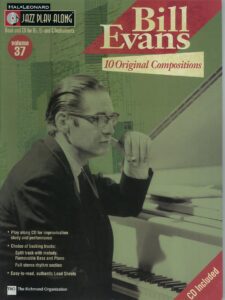
The best sheet music download from our Library.
Browse in the Sheet Music Library:
Or browse in the categories menus & download the Library Catalog PDF:
Harmonic Language and Voicings
Bill Evans' rendition of George Gershwin's "I Loves You, Porgy" is a masterclass in jazz balladry, characterized by lush, impressionistic voicings, a fluid sense of inner voice leading, and a deep emotional connection that transforms the operatic duet into an intimate piano soliloquy.

Please, subscribe to our Sheet Music Library.
Bill Evans reimagines the standard harmony with sophisticated alterations and extensions that create a "cloud-like" texture.
- Suspended and Extended Harmony: His arrangements are rich with suspended chords and upper structure triads, which add color without fully resolving the tension.
- Chromaticism and Substitutions: Evans frequently employs tritone substitutions and secondary dominants. For example, in his solo versions, he often uses a sequence of secondary dominants (like B7–E7–A7) or their chromatic counterparts (B7–Bb7–A7) to create a sense of forward motion.
- Altered Dominants: He typically modifies dominant chords to include #11 or altered tones (e.g., turning a Bb chord into a Bb7(#11)), heightening the dramatic tension of the original Gershwin melody.
- Modal Influence: There is a clear influence of impressionist composers like Debussy and Ravel in how Evans spreads out the tune "like a map," using wide, resonant voicings that emphasize the piano's overtones.
Musical Structure and Phrasing
- Elastic Phrasing: Evans treats the melody with spacious, almost vocal phrasing. He frequently plays slightly behind or ahead of the beat, a technique that gives the performance a "living" quality—as if he is protecting the vulnerable nature of the song's character, Bess.
- Inner Voice Leading: One of his signatures is the movement of middle voices within a static chord. He might move a single note within a dense voicing to lead the ear toward the next harmonic change smoothly.
- Solo vs. Trio Context: While he recorded it with his trio at the Village Vanguard, Evans increasingly chose to perform the piece as a solo piano work in later years (notably at Montreux and Paris) to maximize the "raw, unguarded expression" of the melody.
- Dynamic Range: His touch is famously “singing” and delicate, yet he uses powerful low-register root notes or pedaled flourishes to ground the more ethereal upper-register melodies.
Key Harmonic Moments
| Section | Harmonic Feature | Description |
|---|---|---|
| A Section | ii-V-I Lead-ins | Frequent use of Cm7–F7 leading to the IV chord (Bb) to add momentum. |
| B Section | Diatonic Shifts | Unexpected shifts, such as moving to D major instead of the relative D minor, accommodated by an unaltered A7. |
| Cadences | Passing Chords | Insertion of chromatic passing chords like Db7 between standard ii-V progressions (Gm7–C7). |