
Table of Contents
Who was Chet Atkins (1924-2001)?
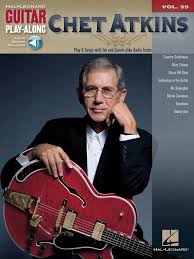
The best Sheet Music download from our Library.
Scores for all instruments: 16,000+ (active and growing), over 236,000 pages.
All genres and levels: Jazz & Blues, Rock & Pop, Classical & Contemporary, Film & Musicals;
books & biographies; methods, études, play-along tracks (MP3) for Jazz & Rock.
Access & benefits: US$15.99 one-time payment, valid for lifetime, full Library access.
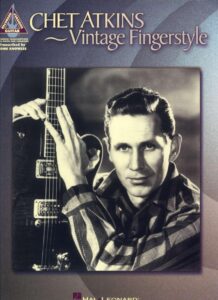
Please, subscribe to our Sheet Music Library.
If you are already a subscriber, please, check our NEW SCORES' page every month for new sheet music. THANK YOU!
Search your favorite sheet music in the Sheet Music Catalog
Chet Atkins: The Man Who Shaped the Sound of Nashville
Early Life
Chester Burton Atkins was born on June 20, 1924, in Luttrell, a small rural community in Union County, Tennessee. He grew up in poverty during the Great Depression, the son of James Arley Atkins, a music teacher and piano tuner, and Ida Sharp Atkins. His parents divorced when he was young, and Chet spent much of his childhood with his father in Georgia.

From an early age, Atkins suffered from severe asthma, which kept him indoors and drew him toward music as both a comfort and a pastime. He taught himself to play guitar as a child, inspired initially by his older half-brother, Lowell Atkins, who was already an accomplished guitarist. He also drew deep inspiration from the recordings of Django Reinhardt and Merle Travis, whose thumb-and-finger picking style would become foundational to Chet's own technique.
Early Career
Atkins began his professional radio career as a fiddler in the early 1940s, working at WNOX in Knoxville, Tennessee. His guitar playing quickly overshadowed his fiddling, however, and he began performing and recording as a guitarist. He bounced between several radio stations in the late 1940s — in Cincinnati, Denver, and Springfield, Missouri — often getting fired because station managers felt his guitar style was too unconventional and not country enough for their audiences.
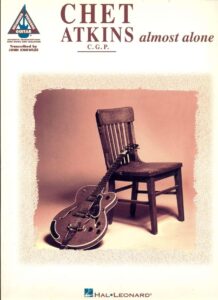
His persistence eventually paid off. He secured a spot on the Grand Ole Opry in Nashville in 1946, and the city would become his permanent home and the stage for his greatest achievements.
Rise to Prominence at RCA Victor
Atkins signed with RCA Victor in 1947, beginning one of the longest and most fruitful relationships between an artist and a record label in music history. His early recordings showcased his extraordinary fingerpicking technique and began building his reputation as one of the most gifted guitarists in America.
By the early 1950s, he was not only recording his own albums but also playing as a session guitarist on countless records for other artists. His tasteful, versatile playing made him one of the most sought-after studio musicians in Nashville.

The Nashville Sound and His Role as a Producer
In 1957, Atkins was appointed head of RCA Victor's Nashville division, a role that transformed not just his own career but the entire direction of country music. Alongside producer Owen Bradley, Atkins is widely credited as the architect of the Nashville Sound — a smoother, more polished approach to country music that replaced the rougher honky-tonk and Western styles of the early 1950s.
The Nashville Sound incorporated lush string arrangements, background vocal choruses, and a cleaner production aesthetic designed to broaden country music's appeal to mainstream pop audiences. Atkins produced records for an extraordinary roster of artists, including:
- Elvis Presley — Atkins played on and helped produce some of Elvis's early RCA sessions
- Eddy Arnold
- Don Gibson
- Jim Reeves
- Waylon Jennings
- Dolly Parton
- Perry Como
His production work made RCA Nashville one of the most commercially successful operations in the music industry through the 1960s and into the 1970s.
Musical Style
Chet Atkins is most celebrated for perfecting and popularizing fingerstyle guitar — specifically the Travis picking technique, named after Merle Travis, which Atkins expanded into something entirely his own. The technique involves using the thumb (often with a thumb pick) to play alternating bass notes on the lower strings while the index and middle fingers pick the melody and harmony on the higher strings, creating the impression that two guitarists are playing simultaneously.
His playing was distinguished by several hallmarks:
- Extraordinary cleanliness and precision — every note was deliberate and perfectly articulated
- A warm, rounded tone — achieved through his touch, his choice of guitars (he had a long association with Gretsch and later Gibson), and subtle use of studio technology
- Musical versatility — he moved fluidly between country, pop, jazz, classical, and even bossa nova influences
- Melodic inventiveness — his solos and arrangements always served the song, emphasizing melody above showmanship
Though rooted in country music, Atkins had deep jazz sensibilities. He recorded duet albums with jazz guitarist Les Paul and later with Mark Knopfler of Dire Straits, demonstrating his ability to converse musically across genres. His collaborations with classical guitarist John Williams further underlined his technical legitimacy beyond the country world.
Later Career and Legacy
In 1973, Atkins stepped back from his executive role at RCA to focus more on performing and recording. Freed from administrative duties, he entered one of the most creatively rich periods of his life, recording adventurous albums that leaned further into jazz and classical territory.
He won 14 Grammy Awards over his career — an astonishing total — and received the Grammy Lifetime Achievement Award in 1993. He was inducted into the Country Music Hall of Fame in 1973 and the Rock and Roll Hall of Fame in 2002, one of the very few artists honored by both institutions.
He also received the honorary title "C.G.P." (Certified Guitar Player) — a tongue-in-cheek designation he invented himself, but one that the guitar world embraced as a mark of the highest respect.
Among the legions of guitarists who have cited Atkins as a defining influence are Mark Knopfler, George Harrison, Jerry Reed, Tommy Emmanuel, and Brad Paisley. His fingerpicking approach essentially defined a whole school of guitar playing that continues to thrive today.
Personal Life
Atkins married Leona Johnson in 1946, and the couple remained together until his death. He was known throughout his life as a modest, self-deprecating, and deeply generous man who was always willing to mentor younger musicians.
Despite his fame, he retained a quiet humility about his gifts. He once reportedly said, "I still can't believe I get paid for this."
Death
Chet Atkins passed away on June 30, 2001, at his home in Nashville, Tennessee, after a long battle with brain cancer. He was 77 years old. Nashville's Music Row fell silent in tribute, and the city mourned the loss of one of its most important figures.
So, who was Chet Atkins?
Chet Atkins was far more than a gifted guitarist — he was a visionary who shaped the commercial and artistic direction of country music for decades, a producer of rare sensitivity, and a musician whose technical mastery and musical taste placed him among the greatest guitarists of the 20th century. His influence on how the guitar is played, and on how Nashville sounds, is felt to this day.
Browse in the Library:
Or browse in the categories menus & download the Library Catalog PDF: