
Scores for all instruments: 16,000+ (active and growing), over 236,000 pages.
All genres and levels: Jazz & Blues, Rock & Pop, Classical & Contemporary, Film & Musicals;
books & biographies; methods, études, play-along tracks (MP3) for Jazz & Rock.
Access & benefits: US$15.99 one-time payment, valid for lifetime, full Library access.
Table of Contents
Remembering Leandro Gato Barbieri (1932-2016), born on this day.
Please, subscribe to our Sheet Music Library. Sheet music should be accessible and affordable for all musicians, from professionals to absolute beginners.
Gato Barbieri - Club Jamaica (Buenos Aires) en vivo 1961 (full album)
Gato Barbieri - Club Jamaica (Buenos Aires) en vivo 1961 (full album)
- Impressions (John Coltrane) 0:00
- Round Midnight (Thelonious Monk, Cootie Williams) 7:21
- Village Blues (John Coltrane) 14:26
- My shining hour (Johnny Mercer, Harold Arlen) 21:37
- You say you care (Jule Stein, Leo Robbins) 29:06
- What is this thing called love? (Cole Porter) 36:50
Grabado en vivo en noviembre de 1961 en el Club Jamaica, Buenos Aires.

Leandro “Gato” Barbieri: saxo tenor
Rubén “Baby” López Furst: piano
Jorge González: contrabajo
Antonio “Tony” Harris: batería
The best sheet music download from our Library.
For the price of a single songbook, get a full Sheet Music Library!
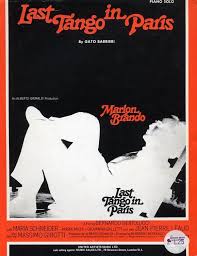
Gato Barbieri - Last Tango in Paris
Search your favorite sheet music in the Sheet Music Library Catalog
Gato Barbieri: The Cat Who Bridged Free Jazz and the Soul of Latin America
Born Leandro Barbieri on November 28, 1932, in Rosario, Argentina —the same provincial capital that gave the world Che Guevara— Gato Barbieri became one of the most distinctive and emotionally direct voices in the history of the tenor saxophone. Over a career that spanned more than half a century, he moved from the fiery outer edges of 1960s free jazz to the sensual, Grammy-winning lyricism of Last Tango in Paris, and then to a polished Latin-jazz-pop hybrid that made him an international star. His sound—a hoarse, guttural cry that could dissolve into a tender whisper—was instantly recognizable, and his lifelong project of welding avant-garde improvisation to the rhythms and melodies of South America made him a pioneer of what is now called Latin jazz. He died on April 2, 2016, in a New York hospital from pneumonia, at the age of 83.
Early Life and Formative Years
Barbieri grew up in a family steeped in music. His father was a carpenter who played the violin by ear, an uncle was a professional saxophonist, and an older brother was a popular musician in Buenos Aires. Yet the young Leandro did not take up an instrument until he was twelve, when he heard Charlie Parker’s recording of “Now’s the Time.” That encounter changed everything: he began studying the clarinet, and after his family moved to Buenos Aires in 1947, he switched to the alto saxophone. In Buenos Aires he played in Lalo Schifrin’s orchestra—the same Schifrin who would later become famous for the Mission: Impossible theme—and he also had the opportunity to perform with visiting giants such as Perez Prado, Coleman Hawkins, Dizzy Gillespie, and João Gilberto.
It was during the 1950s that he earned the nickname “El Gato,” or “The Cat,” because of the way he scampered from one Buenos Aires nightclub to another with his saxophone to make his next gig. By the late 1950s he had switched to the tenor saxophone, the instrument with which he would become identified, and he was leading his own quartet. The political atmosphere of Peronist Argentina also left its mark: jazz was restricted, and musicians were required to include traditional forms such as tango and carnavalito in their sets, an early lesson in the power of popular and folkloric material that would later become central to his art.
The Avant-Garde Years: Rome, Don Cherry, and Free Jazz
In 1962 Barbieri moved to Rome with his Italian-born first wife, Michelle, who would remain his closest musical confidant and manager until her death in 1995. The move proved decisive. In Rome he met the American trumpeter Don Cherry, a former collaborator of Ornette Coleman, and the two began a partnership that produced some of the most important recordings of the 1960s avant-garde. Their Blue Note albums Complete Communion and Symphony for Improvisers are now considered classics of free group improvisation. Barbieri also recorded with the American expatriate soprano saxophonist Steve Lacy and the South African pianist Abdullah Ibrahim (then known as Dollar Brand), and he became a member of Charlie Haden’s Liberation Music Orchestra and Carla Bley’s Escalator over the Hill project.
During this period Barbieri was often described as “Argentina’s Coltrane,” and the comparison was apt. Like John Coltrane, he was drawn to the tenor saxophone as a vehicle for spiritual and emotional exploration, and he shared Coltrane’s fascination with dense harmonic inquiry and the ecstatic possibilities of the upper register. But even in his freest playing, there was a lyrical impulse—a sense of melody and narrative that distinguished him from some of his more abstract contemporaries. His 1967 album In Search of the Mystery captures this duality: the music is searching, angular, and often abrasive, yet Barbieri’s lines are shaped with a vocalist’s sense of breath and phrase. As one critic put it, he was “probing, poking the tones of the tenor and searching madly for a timbral key to unlock a hidden route to harmonic peace”.
The Latin America Series and the “Third World” Concept
By the late 1960s Barbieri had begun to feel that free jazz alone could not express the totality of his experience. He wanted to make music that spoke directly to and about South America—its landscapes, its political struggles, its popular melodies, and its rhythmic traditions. The result was a series of albums for the Flying Dutchman and Impulse! labels that remain his most ambitious and personal statements. The Third World (1969) was the first full flowering of this idea: as AllMusic noted, it was “the initial session that mixed Gato Barbieri’s free jazz tenor playing with Latin and Brazilian influences, creating a danceable yet fiery combination of South American rhythms and free jazz forcefulness”.
The idea reached its fullest expression in the four “Chapter” albums he recorded for Impulse! between 1973 and 1975: Chapter One: Latin America, Chapter Two: Hasta Siempre, Chapter Three: Viva Emiliano Zapata, and Chapter Four: Alive in New York. These records found Barbieri “rediscovering his South American roots and displaying his intense tone in melodic settings where his energy would be better focused than it had been on his earlier avant-garde albums”. Chapter One is often singled out as the masterpiece of the series. Recorded in Buenos Aires and Rio de Janeiro, it features a large ensemble playing traditional instruments alongside jazz musicians, and it includes the haunting “India” and the four-part suite “La China Leoncia Arreo la Correntinada Trajo Entre la Muchachada la Flor de la Juventud”. AllMusic has called it “one of the great all but forgotten masterpieces in 1970s jazz”. Chapter Three: Viva Emiliano Zapata, with arrangements by Chico O’Farrill, is arguably the most accessible of the four, a stellar recording that wraps Barbieri’s impassioned tenor in rich Afro-Cuban rhythms and brass.
Musical Style and Harmony: The Scream and the Song
Barbieri’s style was built on a paradox. On one hand, he was a child of the free jazz revolution, influenced by Coltrane, Pharoah Sanders, and Albert Ayler, and capable of producing a sound that was raw, overdriven, and almost violent. On the other hand, he was a melodist at heart, a musician who loved tango, bolero, and the folk songs of the pampas, and who believed that a single beautiful phrase could carry more meaning than a hundred chromatic excursions. This tension—between the scream and the song, between abstraction and directness—is the key to his art.
His tone was the most immediately identifiable element of his style. It was guttural, raspy, and huge, with a gritty edge that many saxophonists use only for occasional emphasis but that Barbieri made the default texture of his sound. He would often begin a phrase with a growl or a honk and then resolve it into a pure, lyrical line, as if the instrument were clearing its throat before it began to sing. He was also a master of the altissimo register, and his playing was punctuated by shrieks, squeals, and vocalized cries that seemed to bypass language altogether. The Chicago Reader described his most famous work as “ardent, guttural saxophone screams—musical cries encompassing universal passions”.
Harmonically, Barbieri’s approach was less system-building than that of Coltrane or Sanders. He was not a theoretician of chord substitutions or modal exploration in the way that Coltrane was; instead, he used harmony as a coloristic and dramatic resource. In his Latin American period he often favored simple, repetitive harmonic frameworks—a single minor mode, a descending bass line, a cyclical sequence of two or three chords—over which he could improvise with maximum emotional freedom. This gave his music a ritualistic, almost incantatory quality, and it allowed the rhythmic dimension to carry much of the structural weight. The groove was often built on Afro-Cuban or South American patterns—claves, rumbas, milongas, and carnivals—and Barbieri’s tenor would ride over the top, sometimes floating, sometimes cutting against the grain.
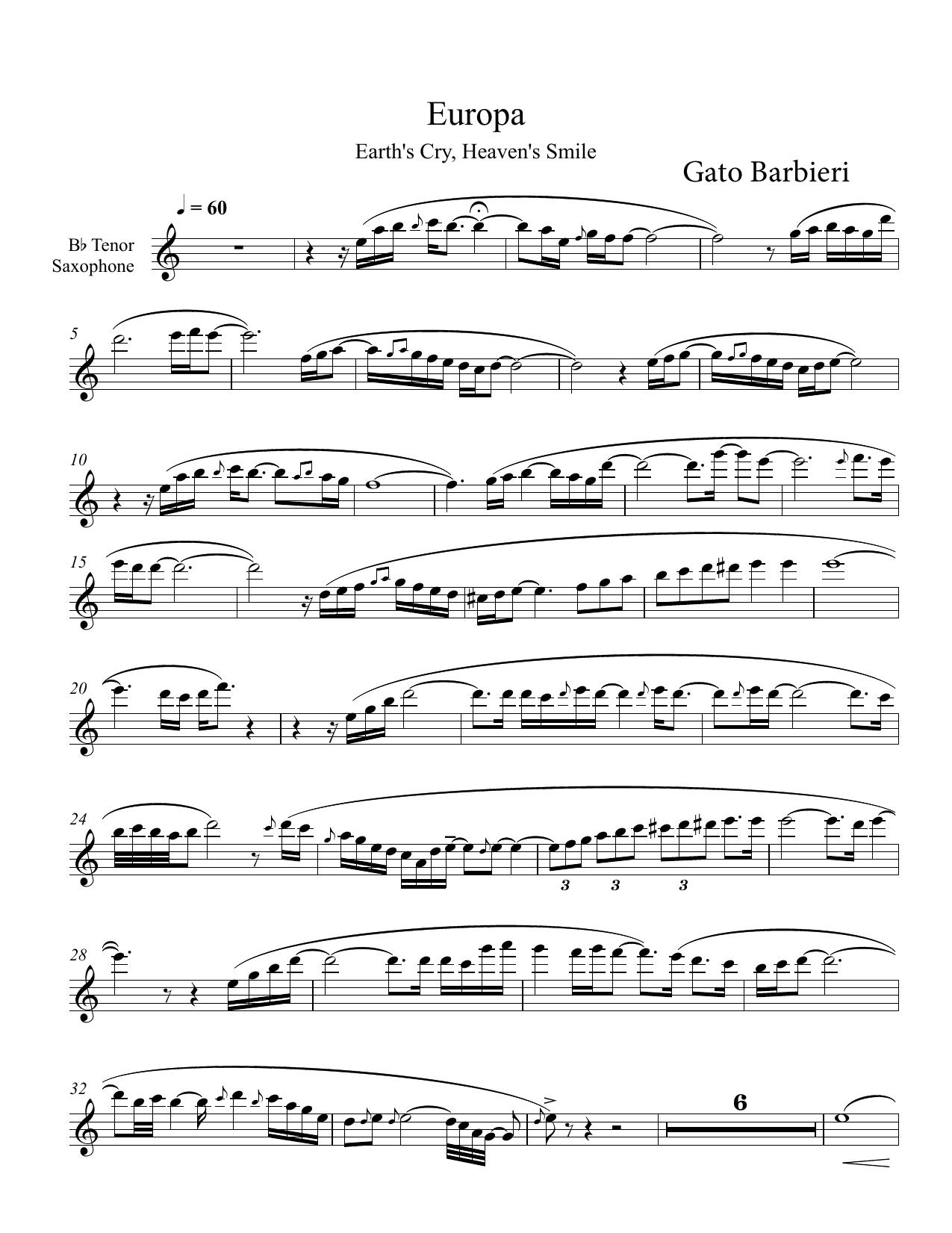
His approach to melody was equally distinctive. He had a gift for taking a simple tune—a tango, a folk song, a pop ballad—and subjecting it to a process of gradual transformation, so that by the end of a performance it had become something entirely his own. This is evident in his versions of “El arriero” by Atahualpa Yupanqui and “El día que me quieras” by Carlos Gardel, both of which he treated with a mixture of reverence and radical reinvention. It is also evident in his biggest commercial hit, his 1976 cover of Carlos Santana’s “Europa (Earth’s Cry, Heaven’s Smile),” where he takes a relatively straightforward instrumental melody and turns it into a vehicle for one of his most passionate and restrained performances.
“Last Tango in Paris” and the Move into Film Music
Barbieri’s international breakthrough came in 1972, when the Italian director Bernardo Bertolucci asked him to compose the score for Last Tango in Paris, the controversial erotic drama starring Marlon Brando and Maria Schneider. Bertolucci wanted music that was neither “too much Hollywood” nor “too much European,” and Barbieri found the median by drawing on the tango—a form he described as “like an opera, but it’s called tango,” filled with tragedy, sensuality, and the memory of Italy in the Argentine soul. The score’s haunting main theme, with its wordless vocal cries and Barbieri’s smoky, aching tenor, became inextricably linked with the film’s atmosphere of doomed eroticism.
The soundtrack won Barbieri the 1973 Grammy Award for Best Instrumental Composition, and it earned two Oscar nominations. It also transformed him from a respected but niche avant-garde musician into an international celebrity, and it opened the door to a second career as a film composer. Over the following years he scored a dozen films in Europe, South America, and the United States, including Firepower (1979) and Strangers Kiss (1983). His film work allowed him to develop a more programmatic and atmospheric side of his writing, and it introduced his sound to audiences who would never have listened to a free jazz record.
Discography
As leader
- In Search of the Mystery (ESP Disk, 1967)
- Obsession (Affinity, 1967, [1978])
- Confluence (Freedom, 1968) with Dollar Brand – also released as Hamba Khale! (1974) and I Grandi del Jazz (1976)
- The Third World (Flying Dutchman, 1969)
- Fenix (Flying Dutchman, 1971)
- El Pampero (Flying Dutchman, 1971)
- Under Fire (Flying Dutchman, 1971 [1973])
- Last Tango in Paris (United Artists, 1972)
- Bolivia (Flying Dutchman, 1973)
- Chapter One: Latin America (Impulse!, 1973)
- Chapter Two: Hasta Siempre (Impulse!, 1973)
- Chapter Three: Viva Emiliano Zapata (Impulse!, 1974)
- Yesterdays (Flying Dutchman, 1974)
- Chapter Four: Alive in New York (Impulse!, 1975)
- El Gato (Flying Dutchman, 1975 compilation) includes 1 previously unreleased track
- Caliente! A&M, 1976)
- I Grandi del Jazz (1976) (Previously released as Confluence and Hamba Khale!)
- Ruby Ruby (A&M, 1977)
- Tropico (A&M, 1978)
- Euphoria (A&M, 1979)
- Bahia (1982)
- Apasionado (1983)
- Para Los Amigos (Doctor Jazz, 1984)
- Passion And Fire (1988)
- The Third World Revisited (1988 compilation)
- Seven Servants (1996)
- Qué Pasa (Columbia, 1997)
- Che Corazón (Columbia, 1999)
- The Shadow of The Cat (2002)
- New York Meeting (2010)
As sideman
With Don Cherry:
- Togetherness (Durium, 1965)
- Complete Communion (Blue Note, 1966)
- Live at Cafe Montmartre 1966 (3 volumes) (ESP-Disk, 1966)
- Symphony for Improvisers (Blue Note, 1966)
With Gary Burton:
- A Genuine Tong Funeral (RCA, 1967)
With the Jazz Composer's Orchestra
With Alan Shorter:
- Orgasm (Verve, 1968)
With Charlie Haden:
- Liberation Music Orchestra (Impulse!, 1969)
With Carla Bley and Paul Haines:
- Escalator Over The Hill (JCOA, 1971)
- Tropic Appetites (Watt, 1974)
With Oliver Nelson:
- Swiss Suite (Flying Dutchman, 1971)
With Antonello Venditti:
- Da Sansiro A Samarcanda (1992)
With Letizia Gambi:
Commercial Peak and Smooth Jazz
The success of Last Tango led Barbieri to sign with A&M Records, the label co-founded by Herb Alpert, and between 1976 and 1979 he released a series of albums that moved decisively toward soul-jazz and jazz-pop. Caliente! (1976) was the first and most successful of these. Produced by Alpert, it featured lush string arrangements, funk-inflected rhythm tracks, and Barbieri’s tenor floating over the top with a new kind of relaxed sensuality. The album included his hit version of “Europa,” which became one of the defining instrumental tracks of the era and cemented his pop-crossover status. The follow-up, Ruby Ruby (1977), continued in a similar vein, with AllMusic describing it as “charming and romantic,” a lush and beautiful record in which Barbieri turns the title track from a haunting ballad into an all-out Latin jam. Tropico (1978) yielded another signature tune, his shimmering version of “Poinciana (Song of the Tree)”.
These records were not universally loved by jazz purists. Some critics felt that the smooth production and pop-oriented material diluted the raw power of Barbieri’s earlier work. But they were hugely successful with the public, and they gave Barbieri a financial and artistic freedom that few jazz musicians of his generation enjoyed. More importantly, they demonstrated that his sound—that hoarse, crying tenor—could work in almost any context, from the most abstract free improvisation to the most accessible ballad.
Collaborations: From Don Cherry to Carlos Santana
Barbieri was a generous and empathetic collaborator, and his career was enriched by partnerships with some of the most important musicians of his time. His early work with Don Cherry, Carla Bley, Charlie Haden, and Abdullah Ibrahim placed him at the heart of the 1960s avant-garde. In the 1970s he collaborated with Carlos Santana, appearing on Santana’s albums and inviting the guitarist to contribute to his own recordings; Santana’s guitar can be heard on Tropico, and the two musicians shared a deep affinity for the fusion of Latin rhythms and rock energy. Herb Alpert produced his most commercially successful albums and played trumpet on several tracks, including on The Shadow of the Cat (2002). Barbieri also worked with Italian composers such as Ennio Morricone, Piero Umiliani, and Luis Bacalov, and with Italian pop stars such as Pino Daniele and Antonello Venditti. In his later years he remained a sought-after guest, contributing his unmistakable sound to projects by a wide range of artists.
Later Years, Awards, and Legacy
The death of his wife Michelle in 1995 after a long battle with cancer sent Barbieri into a period of withdrawal. He stopped recording and touring to care for her, and after her death he underwent triple bypass surgery. But he eventually returned to music, signing with Columbia and releasing Qué Pasa in 1997, a smooth-jazz album that reached No. 2 on Billboard’s contemporary jazz charts. He remarried, to Laura, with whom he had a son, Christian, and he continued to perform regularly, including a long-running monthly residency at the Blue Note jazz club in New York.
His contributions were recognized with a Grammy Award for Last Tango in Paris and a Latin Grammy Lifetime Achievement Award in 2015, whose citation praised his “rebellious but highly accessible musical style, combining contemporary jazz with Latin American genres and incorporating elements of instrumental pop”. He was also nominated for a Latin Grammy for Best Latin Jazz Album for The Shadow of the Cat in 2003.
Barbieri’s legacy is twofold. First, he was one of the first non-American musicians to become a major star in jazz, and he helped to open the music to influences from outside the United States at a time when the jazz canon was still overwhelmingly American. Second, he was a pioneer of the fusion of free jazz and Latin American music, a project that anticipated the work of later musicians such as David Sánchez, Miguel Zenón, and the many artists who now move freely between jazz, folkloric music, and pop. His influence can be heard in the work of saxophonists as diverse as Jan Garbarek, who was influenced by Barbieri’s tone, and the generation of pop-saxophone idols who followed in the wake of “Europa”. He was also the inspiration for the character Zoot in the Muppet band Dr. Teeth and the Electric Mayhem, a testament to his larger-than-life presence in popular culture.
Gato Barbieri once said that music was a mystery to him, and that each time he played was a new experience. That sense of discovery—of a musician forever searching, forever probing, forever trying to unlock the hidden route to harmonic peace—is what makes his best work so enduring. He could scream with his horn, and he could sing with it too, and in the process he created a body of work that is as passionate, as contradictory, and as alive as the continent that inspired it.
Browse in the Sheet Music Library:
Or browse in the categories menus & download the Library Catalog PDF: