
Scores for all instruments: 16,000+ (active and growing), over 236,000 pages.
All genres and levels: Jazz & Blues, Rock & Pop, Classical & Contemporary, Film & Musicals;
books & biographies; methods, études, play-along tracks (MP3) for Jazz & Rock.
Access & benefits: US$15.99 one-time payment, valid for lifetime, full Library access.
Guido d’Arezzo
(b. c. 990, Arezzo? [Italy]—d. 1050, Avellana?)
Guido d’Arezzo was a medieval music theorist whose principles served as a foundation for modern Western musical notation. Educated at the Benedictine abbey at Pomposa, Guido evidently made use of the music treatise of Odo of Saint- Maur-des-Fossés and apparently developed his principles of staff notation there. He left Pomposa in about 1025 because his fellow monks resisted his musical innovations, and he was appointed by Theobald, bishop of Arezzo, as a teacher in the cathedral school and commissioned to write the Micrologus de disciplina artis musicae.
Please, subscribe to our Sheet Music Library. Sheet music should be accessible and affordable for all musicians, from professionals to absolute beginners.
The bishop also arranged for Guido to give (c. 1028) to Pope John XIX an antiphonary he had begun in Pomposa. Guido seems to have gone to the Camaldolese monastery at Avellana in 1029, and his fame developed from there. Many of the 11th-century manuscripts notated in the new manner came from Camaldolese houses. The fundamentals of the new method consisted in the construction by thirds of a system of four lines, or staff, and the use of letters as clefs. The red F-line and the yellow C-line were already in use, but Guido added a black line between the F and the C and another black line above the C.
The best sheet music download from our Library.

The neumes could now be placed on the lines and spaces between and a definite pitch relationship established. No longer was it necessary to learn melodies by rote, and Guido declared that his system reduced the 10 years normally required to become an ecclesiastical singer to a year. Guido was also developing his technique of solmization, described in his Epistola de ignoto cantu .
There is no evidence that the Guidonian hand, a mnemonic device associated with his name and widely used in the Middle Ages, had any connection with Guido d’Arezzo. Guido is also credited with the composition of a hymn to St. John the Baptist, Ut queant laxis, in which the first syllable of each line falls on a different tone of the hexachord (the first six tones of the major scale); these syllables, ut, re, mi, fa, sol, and la, are used in Latin countries as the names of the notes from c to a (ut was eventually replaced by do). His device was of immense practical value in teaching sight-reading of music and in learning melodies.
Search your favorite sheet music in the Sheet Music Library Catalog
Singers associated the syllables with certain intervals; mi to fa, in particular, always represented a half step. Before Guido an alphabetical notation using the letters from a to p was used in France as early as 996. Guido’s system used a series of capital letters, small letters, and double small letters from a to g. Guido’s system also came to be associated with the teaching of the gamut—the whole hexachord range (the range of notes available to the singer). In addition to his innovations Guido also described a variety of organum (adding to a plainchant melody a second voice singing different pitches) that moved largely, but not completely, in parallel fourths. Guido’s work is known through his treatise the Micrologus.

Guido D'Arezzo Music
Legacy
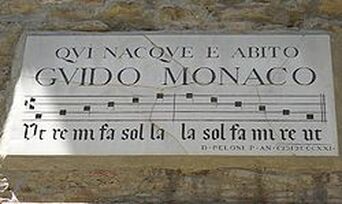
Guido of Arezzo's house with plaque at Via Andrea Cesalpino, 47
A monument to him was erected in his native Arezzo. He is one of the famous Tuscans honored by a statue in the Loggiato of the Uffizi in Florence.
The computer music notation system GUIDO music notation is named after him and his invention.
The "International Guido d'Arezzo Polyphonic Contest" (Concorso Polifónico Guido d'Arezzo) is named after him.
Francisco Valls' controversial Missa Scala Aretina took its name from Guido Aretinus' scale.
Browse in the Sheet Music Library:
Or browse in the categories menus & download the Library Catalog PDF: