Scores for all instruments: 16,000+ (active and growing), over 236,000 pages.
All genres and levels: Jazz & Blues, Rock & Pop, Classical & Contemporary, Film & Musicals;
books & biographies; methods, études, play-along tracks (MP3) for Jazz & Rock.
Access & benefits: US$15.99 one-time payment, valid for lifetime, full Library access.
Table of Contents
Who was Lennie Niehaus (1929-2020)?
The best sheet music download from our Library.


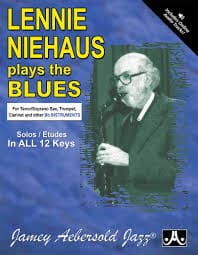


Search your favorite sheet music in the Sheet Music Library Catalog
Lennie Niehaus: The Cool Architect of West Coast Jazz and the Sound of Clint Eastwood
Lennie Niehaus occupies a unique and quietly influential place in American music. He was, at once, a brilliant alto saxophonist who helped define the “Cool School” sound of 1950s West Coast jazz, a gifted and prolific arranger for the Stan Kenton Orchestra, and the composer who gave some of Clint Eastwood’s most iconic films their musical soul. Over a career that spanned nearly sixty years, Niehaus moved seamlessly between the worlds of jazz clubs and Hollywood soundstages, bringing a jazz musician’s sensibility to the craft of film scoring and a classical composer’s discipline to the swing of a big band. He was never a household name in the way of a star soloist or a celebrity director, but his work—melodic, sophisticated, and deeply felt—left an indelible mark on both the jazz tradition and the American cinematic landscape.
Please, subscribe to our Sheet Music Library. Sheet music should be accessible and affordable for all musicians, from professionals to absolute beginners.
Early Life and Musical Foundations
Leonard “Lennie” Niehaus was born on June 1, 1929, in St. Louis, Missouri, into a family steeped in classical music. His father was a violinist who had studied at the Saint Petersburg Conservatory in Russia alongside Jascha Heifetz and who, during the 1920s, played in the orchestras that accompanied silent films in St. Louis theaters. His sister, Agnes, would go on to become a concert pianist. When the advent of talking pictures put an end to the silent-film orchestras, the Niehaus family moved to Los Angeles, where his father found work in a Hollywood studio orchestra.
Young Lennie began his musical training on the violin, taught by his exacting father. But the strict discipline of classical violin study did not hold his interest indefinitely. In grade school, he took up the oboe because the school orchestra needed one, and he quickly became a ferocious practicer. His true passion, however, was ignited not by the concert hall but by the radio. “I liked Harry James,” Niehaus recalled in a 2009 interview, “and when I heard tenor saxophonist Corky Corcoran play ‘The Mole’ in 1942, I wanted to play the tenor saxophone”. His father was horrified. “The saxophone!” Niehaus remembered him saying. “You play either the piano or violin, not the saxophone. You’ll wind up playing in a house of prostitution”. Undeterred, the teenage Niehaus saved money from a restaurant job and went to a music store, only to find that a tenor saxophone cost $125—more than he had. He bought a Martin alto saxophone for $75 instead, and a lifelong relationship with the alto was born.
Niehaus’s jazz education accelerated rapidly. He became consumed by the music, practicing oboe and saxophone all afternoon and evening, and by high school he had also added the bassoon to his arsenal. The pivotal moment came in late 1945, when he saw Charlie Parker perform at Billy Berg’s club in Los Angeles. “The music blew me away,” he said. “I couldn’t play as fast as Bird then, but hearing him didn’t discourage me. I wanted to play like him”. He also discovered the music of Lee Konitz, whose Tristano-school approach to modal improvisation offered a cooler, more cerebral alternative to Parker’s blistering bebop. Niehaus’s own style would become a synthesis of the two: Parker’s harmonic language and rhythmic drive filtered through Konitz’s lyrical restraint.
While still in high school, Niehaus began arranging for Phil Carreón’s big band, a group that at various times featured such future jazz luminaries as Herb Geller, Warne Marsh, Teddy Edwards, and Billy Byers. He graduated high school early, in 1946 at the age of seventeen, and enrolled at Los Angeles City College before transferring to Los Angeles State College (now Cal State L.A.), where he majored in composition and graduated cum laude in 1951. His teachers included Leonard Stein, an authority on Arnold Schoenberg, and the rigorous study of classical counterpoint and twelve-tone technique would later inform some of his most distinctive jazz writing.
The Stan Kenton Years
In early 1952, at the age of twenty-two, Niehaus auditioned for Stan Kenton’s orchestra, which was looking for a replacement for the departing Art Pepper. Kenton called the young saxophonist down to the Florentine Gardens in Los Angeles and put him through his paces. The first tune was Gerry Mulligan’s “Limelight,” and Niehaus sight-read the demanding chart with ease, taking the first solo chorus and impressing Kenton with his sound. He got the job. But his first tenure with Kenton was short-lived: a few months later, he was drafted into the Army during the Korean War.
The Army proved to be an unexpected gift. Stationed at Fort Ord in Northern California, Niehaus auditioned for and joined the base band as an oboe player, a rare commodity that guaranteed him a position. More significantly, it was at Fort Ord that he met a fellow jazz-loving soldier named Clint Eastwood. Eastwood was the swimming instructor; Niehaus played in a quartet that performed at the noncommissioned officers’ club where Eastwood tended bar. A mutual love of jazz sealed a friendship that would, decades later, reshape both of their careers.
After his discharge in 1954, Niehaus rejoined Kenton’s band, stepping into the chair recently vacated by Lee Konitz. He remained with Kenton until 1959, a period during which he became one of the orchestra’s most important creative voices, both as a soloist and as an arranger. His arrangements for Kenton were notable for their harmonic sophistication, their contrapuntal ingenuity, and their sensitivity to the soloist. Gerry Mulligan’s charts had taught him that “when someone’s playing a solo, the background needs to be supportive and engaging, not deafening”. Niehaus took that lesson to heart. His charts for Kenton, such as “Pennies From Heaven,” “Baubles, Bangles and Beads,” and the haunting “End of a Love Affair,” displayed a rare combination of intellectual rigor and emotional warmth. His solo on “End of a Love Affair,” recorded live at the Tropicana, remains a high-water mark of cool jazz ballad playing, opening with just bass and alto before the band swells softly behind him, closing on a dissonant, sighing chord that Niehaus deliberately colored with an atonal feel.
The West Coast Jazz Leader
While still a member of Kenton’s band, Niehaus began recording as a leader for Contemporary Records, the label run by Les Koenig that was documenting the vibrant Los Angeles jazz scene. Encouraged by drummer Shelly Manne, Niehaus was given unusual creative freedom. “Les Koenig… allowed me to record anything I wanted,” he later said. Between 1954 and 1957, he produced a remarkable series of albums—Lennie Niehaus Vol. 1: The Quintets, Vol. 2: Zounds!, Vol. 3: The Octet, Vol. 4: The Quintets and Strings, and Vol. 5: The Sextet—that stand as some of the most elegant and intellectually satisfying small-group jazz of the decade.
These recordings showcased Niehaus’s gifts as both a writer and a player. His writing for four or five horns was a model of economy and wit. As one critic noted, his style was “typical of the time: lightly swinging sound, horns playing clever harmonies, simple thematic material extensively orchestrated, short solos”. He voiced his ensembles to approximate the density of a big band, but he was equally capable of light parodies of chamber music, as on “Three of a Kind,” a three-saxophone fugue, or his witty conversion of “Belle of the Ball” from a waltz into a brisk 4/4. The musicians he assembled for these dates were the cream of the West Coast scene: Bill Perkins, Jimmy Giuffre, Pepper Adams, Stu Williamson, Frank Rosolino, and Shelly Manne, among others.
But it was as a soloist that Niehaus truly stood apart. His alto playing was rooted in Charlie Parker’s bebop vocabulary, but it was distinguished by a lighter, more flowing tone and a rhythmic approach that was relaxed yet subtly adventurous. He had a habit of momentarily playing in a different key to create tension, and his occasional wide intervallic leaps—suddenly jumping from a high note to a low one—had a “subtly unsettling effect” that kept listeners on edge. In 1955, DownBeat magazine named him “New Star on Alto Saxophone,” an honor he shared that year with his friend and frequent collaborator, tenor saxophonist Bill Perkins.
Musical Style and Technique
Lennie Niehaus’s musical personality was defined by a tension between classical discipline and jazz spontaneity. He was a highly trained composer who had studied counterpoint and Schoenbergian twelve-tone technique, yet he was also a working jazz musician who had cut his teeth in big bands and small clubs. This duality shaped everything he wrote and played.
As an improviser, his technique was formidable. He possessed a prodigious command of the alto saxophone, capable of spinning long, flowing lines at fast tempos with apparent ease. One critic described his Parker-based inventions as sounding “deceptively easy,” noting that he delivered “high-quality improvisations” with “great technique”. But unlike Parker, whose playing was often characterized by a raw, anguished intensity, Niehaus’s approach was cooler and more measured. His phrasing was relaxed, often sitting behind the beat in a manner reminiscent of Lee Konitz, and his tone had a woody, centered quality that was perfectly suited to the West Coast aesthetic.
As an ensemble player and section leader, he was equally distinctive. Because he approached contrapuntal jazz from the perspective of an alto saxophonist, his voicings for reed sections showed a particular sensitivity to the higher end of the ensemble, creating a bright, transparent texture that allowed individual lines to remain audible even within a dense harmonic fabric. He was a master of the sax soli, a tightly harmonized passage for the reed section, and his writing in this idiom was both intricate and swinging.
Harmony and Arranging Approach
Niehaus’s harmonic language was sophisticated but never merely academic. He had an ear for rich, close-voiced chords and a gift for creating harmonic motion that felt both surprising and inevitable. In his small-group writing, he often used the four or five horns to approximate a big-band voicing, filling out the middle register while keeping the outer voices active and interesting. His charts were “harmonically daring and spiced with ingenious voicings and rhythmic playfulness,” and he was not afraid to let the rhythm section drop out entirely, leaving the reeds to converse contrapuntally “without a net”.
His work for Stan Kenton revealed a more orchestral side of his harmonic imagination. Kenton favored a band sound with extreme highs and lows—trumpets screaming on top, bass trombone and baritone sax rumbling at the bottom—but Niehaus, following Gerry Mulligan’s example, sought a more balanced and integrated texture. He wrote backgrounds that supported and echoed the soloist rather than overwhelming them, and he used the different sections of the band in dialogue with one another. On The Stage Door Swings (1958), an album of Broadway show tunes, Kenton locked Niehaus in a Chicago hotel room for two and a half weeks and asked him to base each arrangement on a repeating riff. The result was a set of charts that were both structurally ingenious and immensely danceable. His arrangement of “Lullaby of Broadway,” for instance, was built on a modified version of the riff from Kenton’s own “Intermission Riff,” while “Baubles, Bangles and Beads” opened with a line borrowed from Johnny Richards’s arrangement of “I Concentrate on You,” deliberately setting up a moment of recognition, then surprise, and finally delight as the familiar phrase morphed into something entirely new.
Perhaps the most telling example of his harmonic sophistication is the ending he wrote for “End of a Love Affair.” He wanted the chart to close on dissonant notes, creating “a regretful feel, almost a sigh, to play off the song’s title.” While not a strict twelve-tone row, he aimed for an atonal feel, and he added chords that were not in the original tune, both to heighten the emotional ambiguity and to ensure that the alto solo could be faithfully reproduced by another player if he left the band. This was a composer who thought deeply about the relationship between harmony and meaning, even in the context of a dance-band arrangement.
Best Songs and Compositions
Niehaus’s catalog as a composer and arranger is extensive, but several works stand out as particularly representative of his art.
Among his original compositions for small groups, “Elbow Room” is a standout. Recorded on Vol. 5: The Sextet, it is a forty-four-bar AABA construction of blues with a bridge, a piece that is both formally inventive and deeply swinging. “Rush Hour,” “Turn-around,” and “Patterns” are other original tunes that have become favorites among jazz musicians and were later collected in the Jamey Aebersold play-along series, ensuring their continued use as teaching and improvisation vehicles. His writing for the Contemporary albums also produced distinctive arrangements of standards such as “Thou Swell,” “I Wished on the Moon,” and “Knee Deep,” each of which reveals his gift for reimagining familiar material through clever voicings and rhythmic displacement.
For the Stan Kenton Orchestra, Niehaus contributed a number of charts that became staples of the band’s book. His arrangement of “Pennies From Heaven” was the first chart he wrote for Kenton, recorded while he was still in the Army, and it remains a testament to his early mastery of the big-band idiom. “Baubles, Bangles and Beads,” from The Stage Door Swings, is a tour de force of riff-based arranging, while “End of a Love Affair,” from Kenton at the Tropicana, features one of Niehaus’s most celebrated solo performances and a harmonically daring ending that he considered his favorite ballad work with the band.
In the realm of film music, his themes for “Pale Rider,” “The Bridges of Madison County” (particularly the haunting “Doe Eyes” love theme), and “Unforgiven” are among his most enduring contributions. These pieces demonstrate his ability to write melodies of great simplicity and emotional directness—melodies that, in Eastwood’s words, could “keep it simple or make it complicated when it demands it”.
Film Music: The Clint Eastwood Collaboration
The most famous chapter of Niehaus’s career began, improbably, on an Army base in the early 1950s. He and Clint Eastwood had bonded over jazz at Fort Ord, but they lost touch after their service ended. When they reconnected in the 1970s, Niehaus was working as an orchestrator for the composer Jerry Fielding, contributing to scores for films such as The Outlaw Josey Wales (1976) and The Enforcer (1976), both of which starred Eastwood. In 1984, Eastwood asked Niehaus to compose the score for Tightrope, a murder mystery set in New Orleans. Eastwood wanted the music to capture the “cacophony of music” that spilled out of the clubs on Bourbon Street. Niehaus’s solution was ingenious: he recorded eight different tunes in different styles by different musicians and then faded the tracks in and out as Eastwood’s character walked down the street.
That collaboration marked the beginning of one of the most fruitful director-composer partnerships in modern Hollywood. Beginning with Pale Rider in 1985, Niehaus scored fourteen films that Eastwood directed, including Heartbreak Ridge (1986), Bird (1988), White Hunter Black Heart (1990), Unforgiven (1992), A Perfect World (1993), The Bridges of Madison County (1995), Absolute Power (1997), Midnight in the Garden of Good and Evil (1997), True Crime (1999), Space Cowboys (2000), Blood Work (2002), Mystic River (2003), and Million Dollar Baby (2004). He also orchestrated six more Eastwood films after the director began composing his own scores, including Letters From Iwo Jima (2006), Flags of Our Fathers (2006), Changeling (2008), and Gran Torino (2008).
The Niehaus-Eastwood scores are distinguished by their restraint and their deep understanding of the relationship between music and image. Eastwood, a jazz pianist and composer in his own right, had an intuitive sense of what a scene needed, and Niehaus had the technical command and emotional intelligence to deliver it. Pale Rider, a ghostly Western about a mysterious preacher who defends a mining community, features a score of remarkable atmosphere: low, heavy brass, ethereal wordless female choir, and a main theme of ominous grandeur. Unforgiven, a dark meditation on violence and redemption, is scored with a similarly spare and brooding palette, the music never overplaying its hand but always deepening the film’s moral gravity.
The most personal collaboration between the two men was Bird (1988), Eastwood’s biopic of Charlie Parker, the musician who had first inspired Niehaus as a teenager. Niehaus was tasked with the extraordinary technical challenge of isolating Parker’s original saxophone solos from their old mono recordings and re-recording new stereo accompaniments around them. Using the painstaking process of separating Parker’s horn from the original rhythm tracks, Niehaus assembled a group of modern jazz masters—including bassist Ray Brown, trumpeter Jon Faddis, and alto saxophonist Charles McPherson—to create new backings that were faithful to the spirit of the original performances while benefiting from contemporary recording technology. He also taught Forest Whitaker, who played Parker, the rudiments of saxophone playing so that the actor’s on-screen fingering would look convincing. The Bird soundtrack won awards and remains a landmark of jazz film restoration.
Niehaus’s television work was also extensive. He orchestrated the comedy Hogan’s Heroes and composed music for Faerie Tale Theatre and True Colors, and in 1994 he won a Primetime Emmy Award for Outstanding Individual Achievement in Music Composition for his score for the television film Lush Life. He received multiple BMI Film Music Awards for his work on Eastwood’s films.
Other Collaborations
Beyond his work with Kenton and Eastwood, Niehaus was a prolific collaborator across the jazz and entertainment worlds. He arranged music for The King Sisters, Mel Tormé, Dean Martin, and Carol Burnett. He worked extensively as an orchestrator for the composer Jerry Fielding, contributing to scores for films such as Sam Peckinpah’s Straw Dogs (1971), The Mechanic (1972), The Gambler (1974), and The Bad News Bears (1976). His small-group recordings brought him into contact with a who’s who of West Coast jazz, including Shelly Manne, Jimmy Giuffre, Bill Perkins, Hampton Hawes, Mel Lewis, and Red Mitchell. In the mid-1950s, he even deputized for an ailing alto saxophonist in Dizzy Gillespie’s big band for a night, an experience he described as “one of the biggest thrills of my life”.
Influences
Niehaus was candid about his musical influences. His primary models as a saxophonist were Charlie Parker and Lee Konitz, but he also drew inspiration from Benny Carter, Phil Woods, Joe Maini, Cannonball Adderley, and Sonny Criss. As an arranger, he was profoundly shaped by Gerry Mulligan’s charts for the Kenton band, which taught him the importance of supportive, contrapuntal backgrounds and a lighter, more transparent ensemble texture. He also learned from his contemporaries Bill Holman and Shorty Rogers, and from the classical composers he studied in college, particularly Arnold Schoenberg, whose twelve-tone techniques informed some of his most adventurous harmonic experiments. His father, the violinist, gave him a foundation in classical technique and discipline that never left him, even when he was playing in the funkiest jazz clubs.
Legacy
Lennie Niehaus died on May 28, 2020, at his daughter’s home in Redlands, California, at the age of ninety. He was survived by his wife, Patricia, and his daughter, Susan. His passing prompted tributes from across the jazz and film worlds, with obituaries celebrating him as “a giant of the West Coast linear jazz sound” and “one of the most gifted and eloquent alto soloists since Parker”.
His legacy is twofold. In jazz, he is remembered as a key figure in the development of the Cool School, a musician whose small-group recordings for Contemporary remain models of elegant, intelligent, and swinging chamber jazz. His compositions and arrangements continue to be played and studied by jazz musicians, and his pedagogical works—including Jazz Improvisation for Saxophone, Basic Jazz Conception, and Intermediate Jazz Conception—remain widely used in music education, ensuring that his approach to phrasing, articulation, and improvisation is passed on to new generations of players.
In film, he is remembered as the composer who gave Clint Eastwood’s cinema its distinctive musical voice. The themes he wrote for Pale Rider, Unforgiven, The Bridges of Madison County, and Bird are inseparable from the films they accompany, and his sensitive, economical scoring style—always serving the story, never overpowering it—stands as a model of cinematic restraint. Eastwood himself put it best: “Lennie is great because when a movie dictates something simple, he’ll keep it simple or make it complicated when it demands it. He’s so versatile and smart about the relationship of the music to the movie that I’ve used him on almost every project I’ve done”.
Additional Information: Teaching and Method Books
Throughout his career, Niehaus was a dedicated educator. His series of method books, published by Kendor Music and other houses, distilled his decades of experience as a player and arranger into a step-by-step curriculum for jazz improvisation. Jazz Improvisation for Saxophone begins with runs on basic chords and scales and progresses through thirty solos based on well-known standards, twelve jazz etudes, and seven jazz duets, with careful attention to phrasing and articulation throughout. Basic Jazz Conception and Intermediate Jazz Conception offer graded exercises and etudes that are among the most widely used materials in jazz education. Niehaus also contributed to Jamey Aebersold’s play-along series, recording his own compositions and improvisations for students to study and imitate. In a sense, these pedagogical works are as much a part of his legacy as his recordings and film scores: they represent his belief that the techniques of jazz—like the techniques of classical composition—could be taught, analyzed, and passed on, and that the art of improvisation was not a mysterious gift but a craft to be learned and refined.
Lennie Niehaus was, in the end, a musician’s musician. He never sought the spotlight, but his work behind the scenes—in the reed sections of Stan Kenton’s band, in the recording studios of Contemporary Records, and in the scoring stages of Hollywood—shaped the sound of American music in ways that are still being felt today. He brought the cool intelligence of West Coast jazz to the movies, and he brought the emotional power of cinema to the jazz club. His music remains: elegant, swinging, and quietly profound.
Selected discography
- Volume 1: The Quintets (1954, 7" & 10"; 1956, Contemporary 3518)
- Volume 2: The Octet, No. 1 (1954, 7" & 10"), Contemporary); LP reissue on Zounds!
- Volume 3: The Octet, No. 2 (1955, Contemporary 3503)
- Volume 4: The Quintets and Strings (1955, Contemporary 3510)
- Volume 5: The Sextet (1958, Contemporary 3524)
- Zounds! (1958, Contemporary 3540); reissue of The Octet, No. 1 with a further 1956 octet recording
- I Swing for You (1957, EmArcy 36118)
- The Lennie Niehaus Quintet: Live at Capozzoli's (2000, Woofy WPCD96)
With Stan Kenton
- Popular Favorites by Stan Kenton (Capitol, 1953)
- The Kenton Era (Capitol, 1940–54, [1955])
- Contemporary Concepts (Capitol, 1955)
- Kenton in Hi-Fi (Capitol, 1956)
- Kenton with Voices (Capitol, 1957)
- Rendezvous with Kenton (Capitol, 1957)
- Back to Balboa (Capitol, 1958)
- The Ballad Style of Stan Kenton (Capitol, 1958)
- The Stage Door Swings (Capitol, 1958)
- Kenton Live from the Las Vegas Tropicana (Capitol, 1959 [1961])
- Sophisticated Approach (Capitol, 1961) as arranger
- Adventures in Standards (Capitol, 1961) as arranger
- Stan Kenton! Tex Ritter! (Capitol, 1962) with Tex Ritter as arranger and conductor
- Stan Kenton / Jean Turner (Capitol, 1963) with Jean Turner as arranger
- Kenton / Wagner (Capitol, 1964)
Selected television and film scores
- Faerie Tale Theatre (1984)
- Tightrope (1984)
- City Heat (1984)
- Pale Rider (1985)
- Sesame Street Presents: Follow That Bird (1985)
- Never Too Young to Die (1986)
- Ratboy (1986)
- Heartbreak Ridge (1986)
- Emanon (1987)
- Bird (1988)
- White Hunter Black Heart (1990)
- The Rookie (1990)
- Unforgiven (1992)
- Lush Life (TV movie, 1993)
- A Perfect World (1993)
- The Bridges of Madison County (1995)
- Dogwatch (1996)
- Absolute Power (1997)
- Midnight in the Garden of Good and Evil (1997)
- Pocahontas II: Journey to a New World (1998)
- True Crime (1999)
- The Jack Bull (TV, 1999)
- Space Cowboys (2000)
- Blood Work (2002)
- Oprah Winfrey Presents: Mitch Albom's For One More Day (TV, 2007)
The Night We Called It a Day · Lennie Niehaus
Blue Room · Lennie Niehaus
Browse in the Sheet Music Library:
Or browse in the categories menus & download the Library Catalog PDF: