
Scores for all instruments: 16,000+ (active and growing), over 236,000 pages.
All genres and levels: Jazz & Blues, Rock & Pop, Classical & Contemporary, Film & Musicals;
books & biographies; methods, études, play-along tracks (MP3) for Jazz & Rock.
Access & benefits: US$15.99 one-time payment, valid for lifetime, full Library access.
Table of Contents
Miles Davis: the 100 most inspiring musicians of all time
Miles Davis (b. May 26, 1926, Alton, Ill., U.S.—d. Sept. 28, 1991, Santa Monica, Calif.), or Miles Dewey Davis III was an American jazz musician, a great trumpeter who as a bandleader and composer was one of the major influences on the art from the late 1940s.

Davis grew up in East St. Louis, Ill., where his father was a prosperous dental surgeon. He began studying trumpet in his early teens; fortuitously, in light of his later stylistic development, his first teacher advised him to play without vibrato. Davis played with jazz bands in the St. Louis area before moving to New York City in 1944 to study at the Institute of Musical Art (now the Juilliard School)—although he skipped many classes
and instead was schooled through jam sessions with masters such as Dizzy Gillespie and Charlie Parker.
Miles Davis and Parker recorded together often during the years 1945–48. Davis’s early playing was sometimes tentative and not always fully in tune, but his unique, intimate tone and his fertile musical imagination outweighed his technical shortcomings. By the early 1950s, Davis had turned his limitations into considerable assets. Davis explored the trumpet’s middle register, experimenting with harmonies and rhythms and varying the phrasing of his improvisations. With the occasional exception of multinote flurries, his melodic style was direct and unornamented.

Cool Jazz and Modal Jazz
In the summer of 1948, Davis formed a nonet that included the renowned jazz artists Gerry Mulligan, J.J. Johnson, Kenny Clarke, and Lee Konitz, as well as players on French horn and tuba, instruments rarely heard in a jazz context. Mulligan, Gil Evans, and pianist John Lewis did most of the band’s arrangements, which juxtaposed the flexible, improvisatory nature of bebop with a thickly textured orchestral sound. The group was tracks that were originally released as singles (1949–50).
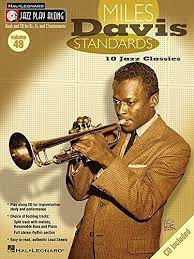
These recordings changed the course of modern jazz and paved the way for the West Coast styles of the 1950s. The tracks were later collected on the album Birth of the Cool (1957).
During the early 1950s, Davis recorded albums that rank among his best. In 1954, having overcome drug addiction, Davis embarked on a two-decade period during which he was considered the most innovative musician in jazz. He formed classic small groups in the 1950s that featured saxophone legends John Coltrane and Cannonball Adderley, pianists Red Garland and Bill Evans, bassist Paul Chambers, and drummers “Philly” Joe Jones and Jimmy Cobb. Davis’s albums recorded during this era, including ’Round About Midnight (1956), Steamin’ (1956), and Milestones (1958), among others, affected the work of numerous other artists.
He capped this period of his career with Kind of Blue (1959), perhaps the most celebrated album in the history of jazz. A mellow, relaxed collection, the album includes the finest recorded examples of modal jazz, a style in which improvisations are based upon sparse chords and nonstandard scales rather than on complex, frequently changing chords.
Released concurrently with the small-group recordings, Davis’s albums with pieces arranged and conducted by Gil Evans—Miles Ahead (1957), Porgy and Bess (1958), and Sketches of Spain (1960)—were also monuments of the genre. The Davis-Evans collaborations were marked by complex arrangements, a near-equal emphasis on orchestra and soloist, and some of Davis’s most soulful and emotionally powerful playing. Davis and Evans occasionally collaborated in later years, but never again so memorably as on these three masterful albums.

Free Jazz and Fusion
The early 1960s were transitional, less-innovative years for Davis. He began forming another soon-to-be-classic small group in late 1962 with bassist Ron Carter, pianist Herbie Hancock, and teenage drummer Tony Williams; tenor saxophonist Wayne Shorter joined the lineup in 1964.
Davis’s new quintet was characterized by a light, free sound and a repertoire that extended from the blues to avant-garde and free jazz. Compared with the innovations of other modern jazz groups of the 1960s, the Davis quintet’s experimentation in polyrhythm and poly tonality were more subtle but equally daring. Live at the Plugged Nickel (1965), E.S.P. (1965), Miles Smiles (1966), and Nefertiti (1967) were among the quintet’s timeless, influential recordings.
About the time of Miles in the Sky and Filles de Kilimanjaro (both 1968), Davis began experimenting with electronic instruments. With other musicians, including keyboardists Chick Corea and Joe Zawinul and guitarist John McLaughlin, Davis cut In a Silent Way (1969), regarded as the seminal album of the jazz fusion movement. It was considered by purists to be Davis’s last true jazz album.
Davis won new fans and alienated old ones with the release of Bitches Brew (1969), an album on which he fully embraced the rhythms, electronic instrumentation, and studio effects of rock music. A cacophonous kaleidoscope of layered sounds, rhythms, and textures, the album’s influence was heard in such 1970s fusion groups as Weather Report and Chick Corea’s Return to Forever. Davis continued in this style for a few years, with the album Live-Evil (1970) and the film soundtrack A Tribute to Jack Johnson (1970) being particular highlights.

Legacy
Davis was injured in an auto accident in 1972, curtailing his activities, then retired from 1975 through 1980. He returned to public notice with The Man with the Horn (1981) and subsequently dabbled in a variety of musical styles, concentrating mostly on jazz-rock dance music, but there were also notable experiments in other styles. Davis won several Grammy Awards during this period for such albums as We Want Miles (1982), Tutu (1986), and Aura (1989).
One of the most-memorable events of Davis’s later years occurred at the Montreux Jazz Festival in 1991, when he joined with an orchestra conducted by Quincy Jones to perform some classic Gil Evans arrangements of the late 1950s. Davis died less than three months later. His final album, Doo-Bop (1992), was released posthumously.
Jazz sheet music and transcriptions download here.
Search your favorite sheet music in the Sheet Music Library Catalog
Miles Davis Quintet, Teatro dell'Arte, Milan, Italy, October 11th, 1964 (Colorized)
Track list:
Autumn Leaves 00:00 My Funny Valentine 15:07 All Blues 26:33 All of You 40:13 Joshua 50:47
Personnel:
Miles Davis (trumpet), Wayne Shorter (sax), Herbie Hancock (piano), Ron Carter (bass), Tony Williams (drums)
Browse in the Sheet Music Library:
Or browse in the categories menus & download the Library Catalog PDF:
Miles Davis Kind Of Blue Full Album 1959
Kind of Blue is a studio album by American jazz musician Miles Davis, released on August 17, 1959, by Columbia Records. For this album, Davis led a sextet featuring saxophonists John Coltrane and Julian "Cannonball" Adderley, pianist Bill Evans, bassist Paul Chambers, and drummer Jimmy Cobb, with new band pianist Wynton Kelly replacing Evans on "Freddie Freeloader". The album was recorded at Columbia's 30th Street Studio in New York City in two sessions on March 2 and April 22, 1959.
Influenced in part by Bill Evans, who had been a member of the ensemble in 1958 and was called back for this album, Miles Davis departed further from his early hard bop style in favor of greater experimentation with musical modes, as on the title track of his previous album, Milestones (1958).
Basing Kind of Blue entirely on modality, Miles Davis gave each performer a set of scales that encompassed the parameters of their improvisation and style and consequently more creative freedom with melodies; Coltrane later expanded on this modal approach in his own solo career.
Kind of Blue is regarded by many critics as Davis's masterpiece, the greatest jazz album ever recorded, and one of the greatest albums of all time. Its impact on music, including jazz, rock, and classical music, has led writers to also deem it one of the most influential albums ever made. The album was one of fifty recordings chosen in 2002 by the Library of Congress for the inaugural year of the National Recording Registry, being deemed "culturally, historically, or aesthetically significant". In 2003, it was ranked number 12 on Rolling Stone magazine's list of the "500 Greatest Albums of All Time", repositioned to number 31 in the 2020 revision. In 2019, Kind of Blue was certified 5× Platinum by the Recording Industry Association of America (RIAA) for shipments of at least five million copies in the United States.