
Scores for all instruments: 16,000+ (active and growing), over 236,000 pages.
All genres and levels: Jazz & Blues, Rock & Pop, Classical & Contemporary, Film & Musicals;
books & biographies; methods, études, play-along tracks (MP3) for Jazz & Rock.
Access & benefits: US$15.99 one-time payment, valid for lifetime, full Library access.
How to Execute Mordents, Trills, and Appoggiaturas
Search your favorite sheet music in the Sheet Music Library Catalog
The real sign for the inverted mordent  pralltrifler or schneller, as it is sometimes called in German, seems to be going out of use, though it is still quite frequent in Chopin’s works. In former times, the inverted mordent was played with repeated alternations of the principal note and its upper auxiliary note, and was therefore really a trill. But at the present time, it calls for only a single alternation, even when it appears as an embellishment of a note of longer value. As the inverted mordent requires very rapid execution, it absorbs only an inconsiderable amount of time from the beginning of the ornamented note, as may be seen from the following illustrations:

Two small notes written in a corresponding position would be executed in the same manner.
The tendency to play an inverted mordent so that the third note is the strongest must be condemned absolutely and without qualifications. The effect would be as though two small notes were played in advance. It would be better to play all the notes with equal force and with the strength that would be naturally given if the note were unornamented, but even stronger rather than weaker.
Please, subscribe to our Sheet Music Library. Sheet music should be accessible and affordable for all musicians, from professionals to absolute beginners.
The very common and pernicious practice of playing these small notes as though they were unimportant, and therefore to be played in the incorrect way we have indicated, is largely due to this manner of notation. Accidentals are used in connection with the inverted mordent and modify the upper auxiliary note:

It is quite immaterial whether the accidental is written above, below, or next to the inverted mordent sign, as in all cases the upper auxiliary note is the only one affected. The less advanced player would do well in performing the inverted mordent to confine himself to a moderately strong tone production, intentionally playing the first note with somewhat more emphasis than the others. Never before, but always directly on the beat.
The sign of the mordent is becoming obsolete even more rapidly than the sign of the inverted mordent. It is distinguished from, the inverted mordent by the cross-stroke through the sign. The mordent calls for a single quick alternation between a principal note and its under auxiliary note. This auxiliary note must always be a semitone below the principal note, that is to say, the in interval of a minor second. Accidentals must be written if a different tone is desired, namely:

In playing the mordent, the accent is placed on the first of the three notes. Often instead of the sign being written, the mordent is expressed by small notes after the following manner:
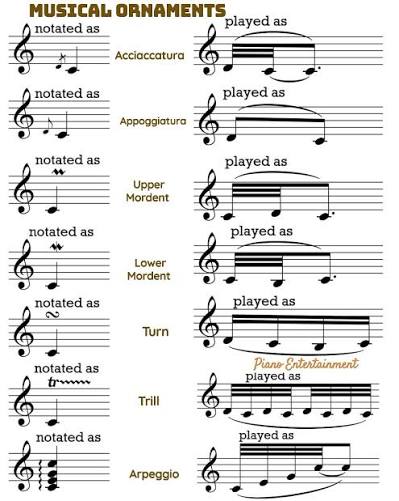
The inverted mordent and mordent belong to the so-called appoggiaturas, a category to which belong other embellishments that, having no distinctive signs of abbreviation, are written in small notes. But for all appoggiaturas, whether consisting of one or several notes, there is but one rule, namely: that they must be played directly upon the beat of the principal note. It is an error, which is very common, to suppose that appoggiaturas are to be played before the beat and with a weaker degree of force; this fault must be deprecated because it destroys the diamond-like brilliancy peculiar to this class of embellishment.
The best sheet music download from our Library.
The long appoggiatura is very nearly obsolete. It appears in notation as a dissonant note preceding a principal note, the note of suspension or anticipation being written as a small note and prefixed to the principal note. The object of this ornament is to make clearer the harmonic progression, for example:

Modern editions usually discard this manner of writing. The long appoggiaturas in their original mode of notation are still common not only in Bach but also even in Mozart. It is impossible in a few words to do justice to this embellishment.
The prefixed half note, or quarter note, is a note of suspension and invariably must be played on the beat rhythmically. Furthermore, the long appoggiatura must receive the full written value of the prefixed small note, and the following note receives what is left. The small notes affect only the one voice.
That such error in executing the long appoggiatura as indicated above is wide-spread is due largely to the unusual manner of writing, and to the fact that it is one to which the ordinary student is unaccustomed.
The short appoggiatura (also called the acciaccatura) is very easily recognized by the cross-stroke through the hook of an eighth note, a manner of notation that has been general since about the year 1800. The older manner of writing the same with a sixteenth note, or a thirty-second note, is readily understood is and does not cause the rhythmical confusion that is attached to the long appoggiatura. It will never be mistaken for the latter form of appoggiatura. There will still remain the error of playing the short appoggiatura before instead of upon the beat of the principal note. Also, it must not be played too light, nor too weak.
In order to understand the intention of the composer, three things respecting the short appoggiaturas must be kept in mind, namely:
- That a short appoggiatura has but the briefest time value.
- That it must be played directly at the beginning of the beat of the principal note, and
- That it must, be played with a force equal to that of the principal note.
The following combination of short appoggiatura (acciaccatura), trill and turn is found in Beethoven’s C major Sonata, Op. 2, III:
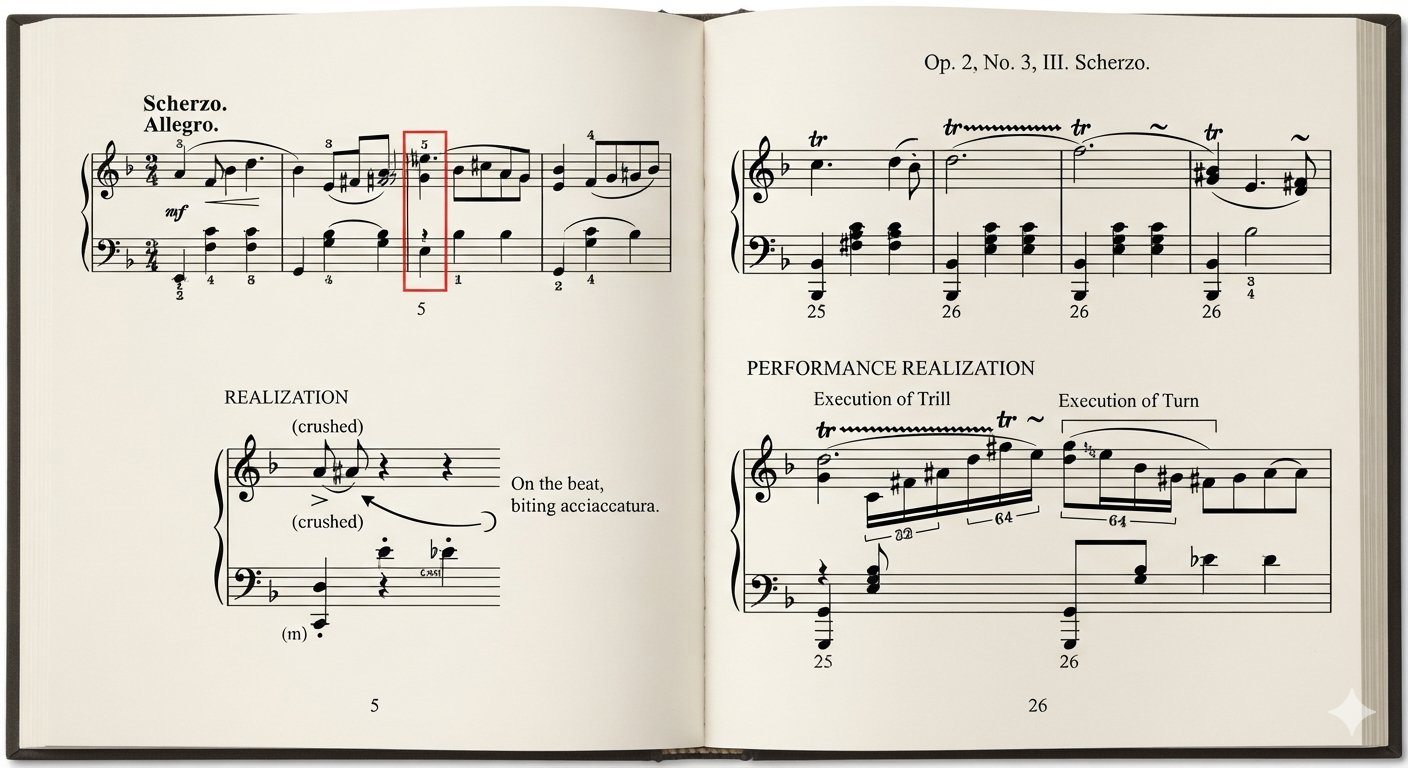
On account of the brisk tempo of the composition, it is wholly sufficient to play the trill as a simple mordent. Therefore, as a single alternation of C and its upper auxiliary D. And then upon the beat of the eighth note written large (C), there comes the added force of the short appoggiatura D, which receives the accent. The turn should be played in the time value of the written notes. The following is the recommended manner of execution:

Some further examples of simple short appoggiaturas are found in the slow movement of Beethoven’s Sonata, Op. 31, I:

In all five cases false methods of execution are very prevalent, much of the rhythmic value is lost; the only correct manner is that in accord with the explanation we have just given:

Browse in the Sheet Music Library:
Or browse in the categories menus & download the Library Catalog PDF:
Bach - Prelude and Fugue No. 15 in G Major, BWV 884 from WTC book II
Bach - Prelude and Fugue No. 15 in G Major, BWV 884 from WTC book II Well tempered Clavier Vol. 2 Gabriele Tomasello, piano recorded in Catania, February 2nd 2015.