Table of Contents
Scores for all instruments: 16,000+ (active and growing), over 236,000 pages.
All genres and levels: Jazz & Blues, Rock & Pop, Classical & Contemporary, Film & Musicals;
books & biographies; methods, études, play-along tracks (MP3) for Jazz & Rock.
Access & benefits: US$15.99 one-time payment, valid for lifetime, full Library access.
Happy birthday, Ron Carter, born on this day in 1937.
Ron Carter "New Foursight Quartet" - Live in Poland (2021)
Ron Carter: The Architect of the Low End – A Comprehensive Biography
Ronald Levin Carter, born on May 4, 1937, in Ferndale, Michigan, is a towering figure whose name has become synonymous with the jazz double bass. His career, spanning over six decades, is a masterclass in musical elegance, harmonic sophistication, and rhythmic innovation. As the most-recorded jazz bassist in history, with his bow tie and stately presence, Carter has been the anchor for over 2,200 recording sessions, fundamentally shaping the sound of modern jazz. From his foundational work in Miles Davis’s legendary Second Great Quintet to his prolific solo catalog and thousands of sideman appearances, Ron Carter’s legacy is not just in the notes he played, but in the profound musical conversations he made possible.
Early Life and Education: A Classical Foundation
The best sheet music download from our Library.
Carter’s musical journey began not with the bass, but with the cello, which he started playing at the age of ten. His early education was steeped in the Western classical tradition, a background that would deeply inform his later revolutionary approach to jazz. He attended the historic Cass Technical High School in Detroit, where he made the pivotal switch to the double bass.
This classical foundation was solidified through rigorous higher education. Carter earned a Bachelor of Arts in music from the prestigious Eastman School of Music in 1959, where he played in the school's Philharmonic Orchestra. He continued his studies in New York City, a move that would prove fateful, earning a master’s degree in double bass performance from the Manhattan School of Music in 1961. This deep academic grounding set him apart from many of his peers, imbuing him with a profound understanding of counterpoint, voice leading, and orchestral texture that he would later translate into the jazz idiom.

Please, subscribe to our Sheet Music Library.
Career Breakthroughs: From the Chitlin' Circuit to the Second Great Quintet
While still a student at Eastman, Carter’s world expanded. He and friends, including saxophonist Pee Wee Ellis, formed a house band for the Pythodd Room, a club in Rochester’s Black community. There, he encountered legendary musicians on the Chitlin' Circuit, who encouraged him to test his skills in New York. Upon arrival, he quickly immersed himself in the city's vibrant progressive jazz scene. His first professional jazz gig was with Chico Hamilton in 1959, followed by crucial freelance work with avant-garde luminaries like Eric Dolphy, Jaki Byard, Randy Weston, and Thelonious Monk.
A key moment came on August 15, 1960, when he recorded on Eric Dolphy’s seminal album Out There, playing cello alongside bassist George Duvivier. The album's advanced harmonies and "third stream" concepts signaled Carter’s arrival as a forward-thinking force.
The opportunity that would cement his place in history arrived in 1963. Miles Davis, in the process of revolutionizing his sound once again, asked the young bassist to join his group. Carter became the anchor of the legendary "Second Great Quintet," a lineup often revered as one of the greatest small ensembles in jazz history, featuring Wayne Shorter on saxophone, Herbie Hancock on piano, and a teenage Tony Williams on drums.
Within this ensemble of equals, Carter’s role was elevated from mere timekeeper to a central protagonist. The group's collective improvisational ethos demanded a bassist who was not just a harmonic and rhythmic pillar but a melodic and interactive force. Carter was the perfect fit. His tenure with Davis, lasting until 1968, produced a string of groundbreaking albums, including E.S.P., Miles Smiles, Sorcerer, and Nefertiti, which redefined the possibilities of acoustic jazz. On E.S.P., he became the only member besides Davis to contribute original compositions to the group’s book, penning three tunes, including the waltz "Mood".
A Prolific Sound: The CTI Years and Beyond
After leaving Davis’s group in 1968, Carter entered the most prolific phase of his career as a leader and a sideman. He became a cornerstone of Creed Taylor’s CTI Records, a label that defined the sound of jazz in the 1970s with its lush, funky, and impeccably produced aesthetic. Carter’s deep, warm, and singing tone became one of the label’s signature sounds, anchoring classic albums not only under his own name but also for a staggering array of artists.
His own leader discography from this period is a testament to his broad vision. Albums like Blues Farm (1973) and All Blues (1973) are landmark recordings that showcase his soulful compositions and his pioneering use of the piccolo bass—a smaller, higher-tuned instrument he co-developed, which allowed him to solo with the melodic agility of a horn. Other seminal CTI-era albums include Spanish Blue (1974) and Yellow & Green (1976).
Simultaneously, he was the in-demand bassist for hundreds of sessions, contributing iconic lines to recordings that spanned the entire musical spectrum. His resumé includes playing on soul-pop star Roberta Flack’s First Take, providing the unforgettable bass line on Gil Scott-Heron's revolutionary poem "The Revolution Will Not Be Televised," and laying down the groove on Billy Joel’s "Big Man on Mulberry Street". He also formed deep musical partnerships with Joe Henderson, Houston Person, Hank Jones, and Cedar Walton, among countless others.
Musical Style, Technique, and the Poetics of Harmony
To understand Ron Carter’s genius is to appreciate his redefinition of the bassist’s role. He rejected the idea that his primary function was to simply mark the root of a chord on the first beat of a bar. In a famous lecture at Berklee College of Music, he declared, "I don’t play root [notes] anymore… The last root I played was…1978. It was the right one, too.”
Carter’s approach is built on creating a continuous, improvised counter-melody. His legendary walking bass lines are not merely connecting chords; they are intricate, flowing statements of harmonic and melodic intent. He often delays or omits the tonic, choosing instead to begin a phrase with a more colorful chord tone—like a third, fifth, or seventh—that creates tension, drama, and a profound sense of forward motion. This ability to play what might initially seem like a "wrong" note, and then weave a line that retroactively contextualizes it into perfect logic, is a hallmark of his mastery.
His sound is equally distinctive. Carter possesses a massive, rich, and woody tone that is instantly recognizable. He is a master of articulation, from the deep, resonant pluck of his pizzicato to expressive glissandos (slides) and his signature use of "gonglike tones" on the lower strings. This combination of a huge sound with fleet, horn-like agility allows him to solo with a rare authority. His classical training is ever-present in his sophisticated use of bowed passages (arco) and his cello recordings, which add chamber music textures to his jazz work.
The pivotal technical innovation that facilitates his solo voice is the piccolo bass. In the early 1970s, Carter began exploring a smaller-bodied upright bass, tuned a fourth higher (A-D-G-C), which positions its pitch range closer to a cello. This higher tuning allows him to play in a more lyrical, melodic register while retaining the deep, woody timbre of an upright bass, fundamentally changing the perception of the instrument's role in a band.
Film and Television: A Visual and Compositional Presence
Carter’s elegance and charisma have also made him a sought-after presence on screen. His filmography is a chronicle of a musician deeply woven into the cultural fabric of his time.
His most prominent acting role came in Robert Altman’s 1996 film Kansas City, a period drama set in a 1930s jazz club. Carter appears as a bassist in the film’s "Hey-Hey Club," where the music is central to the narrative. He and fellow bassist Christian McBride are featured in the end credits, duetting on Duke Ellington’s "Solitude". A year earlier, he appeared as himself in the documentary One Night with Blue Note (1985).
Perhaps his most significant film contribution is to Bertrand Tavernier’s 1986 masterpiece, ’Round Midnight. The film, a poignant fictionalization of the lives of expatriate jazz musicians in Paris starring Dexter Gordon, features Carter not only performing on screen as part of an all-star ensemble but also as a composer. His instrumental composition "Call Sheet Blues," written for the film, earned him his first Grammy Award in 1988 for Best Instrumental Composition. He also composed for Tavernier's subsequent film, The Passion of Beatrice (1987).
His screen credits extend to include appearances in the 2008 comedy What Happens in Vegas and as himself in numerous music documentaries, including Miles Davis’s Birth of the Cool (2022) and the 2021 film Walking the Changes, reflecting his lifelong dedication to the music. In 2022, the PBS documentary Ron Carter: Finding the Right Notes offered an intimate portrait of his life, practice, and relentless quest for musical perfection.
A Constellation of Collaborations
A thorough list of Ron Carter’s collaborators would be akin to an encyclopedia of modern music. His career is defined by the monumental breadth of artists who sought his foundational support. The following is but a cross-section of his legendary partnerships:
- The Miles Davis Circle: Beyond the Second Great Quintet, his work with Davis’s alumni is extensive. He was the bassist of choice for Herbie Hancock's groundbreaking early solo work, Wayne Shorter’s visionary Blue Note albums, and the earth-shattering debut of drummer Tony Williams’s group, Lifetime. He later reunited with Hancock, Shorter, and Williams, with Freddie Hubbard on trumpet, as the quintet V.S.O.P., a direct homage to their 1960s acoustic legacy.
- Piano Masters: Carter’s empathetic and propulsive support has been the foundation for a who's who of jazz pianists, including Herbie Hancock, McCoy Tyner, Horace Silver, Duke Pearson, Andrew Hill, Cedar Walton, Tommy Flanagan, Hank Jones, and later, Gonzalo Rubalcaba.
- Guitar Virtuosos: His duo and quartet collaborations with guitarist Jim Hall are among the most lauded in jazz, producing sublime albums like Alone Together (1972). He also worked extensively with Wes Montgomery, Gabor Szabo, George Benson, and across genres with Bill Frisell.
- The Avant-Garde and the Mainstream: His sessionography bridges every style. He contributed to the "third stream" experiments of Eric Dolphy, the spiritual jazz of Alice Coltrane, and the classic hard-bop of Lee Morgan, Freddie Hubbard, and Cannonball Adderley.
- Beyond the Jazz Spectrum: Carter’s universal appeal found him recording with vocalists from Roberta Flack and Aretha Franklin to Bette Midler and Billy Joel, and crossing into hip-hop with his iconic appearance on A Tribe Called Quest’s foundational album The Low End Theory, on the track "Verses from the Abstract".
- A Modern Touch: In a testament to his timeless relevance, in April 2022, at the age of 84, he sat in with Grateful Dead founding member Bob Weir at Radio City Music Hall, demonstrating his seamless adaptability across generations and genres.
Search your favorite sheet music in the Sheet Music Library Catalog
Legacy, Awards, and Enduring Influence
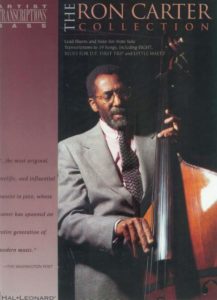
Ron Carter’s influence on the double bass is so profound that it’s nearly impossible for a contemporary jazz bassist to exist outside his shadow. He fundamentally elevated the instrument from a background role to a leading, interactive force. His book, Building Jazz Bass Lines, is a standard pedagogical text studied by generations of players seeking to understand his harmonic concepts and walking bass construction.
His technical innovations, particularly the piccolo bass, have expanded the instrument’s sonic and expressive range. His approach to phrase-building, where the bass line functions as an independent contrapuntal melody, has become deeply embedded in the DNA of post-1960s jazz.
Beyond performance, Carter is a dedicated educator. He was a distinguished professor at the City College of New York for two decades and has been a faculty member at the Juilliard School’s Jazz Studies program since 2008, shaping the sensibilities of the next generation of rhythm section players.
His accolades are a testament to a life of supreme accomplishment:
- Three Grammy Awards: For Best Instrumental Composition ("Call Sheet Blues," 1988), and twice for Best Jazz Instrumental Performance, Individual or Group (for a Miles Davis tribute, 1994).
- Guinness World Record: Officially certified as the most-recorded jazz bassist in history, a staggering testament to his skill and demand.
- International Honors: He was awarded the title of Commander of the Ordre des Arts et des Lettres by the French government in 2010, and The Order of the Rising Sun, Gold Rays with Rosette by the Japanese government in 2021 for fostering cultural exchange through jazz.
- Hall of Fame Inductions: He was elected to the DownBeat Jazz Hall of Fame in 2012 and was inducted into the Alabama Jazz Hall of Fame in 2024.
The image of Ron Carter—impeccably dressed, standing stoically with his bass, projecting an aura of calm, assertive charisma—is iconic. But his true legacy lives in the music. It is in the sound of a perfectly chosen note that defies expectation yet feels inevitable; in the deep, swinging groove that makes a band float; and in the thousands of recordings where his intelligence and soul provide the invisible architecture for genius. He didn’t just play the bass; he redefined its voice, and in doing so, he became one of jazz’s most essential and enduring figures.
Search your favorite sheet music in the category of Jazz, Blues, Soul, & Gospel.

Ron Carter - Telepathy (full album) by Ron Carter and Jim Hall
Ron Carter - Ron Carter Meets Bach Full Album
Composer - JS Bach Arragner, Bass - Ron Carter
1 Air 3:03 2 Christ Lag In Todesbanden (Chorale) 1:34 3 Wachet Auf, Ruft Uns Die Stimme (Chorale-Prelude) 4 Arioso 3:45 5 Jesu, Joy Of Man's Desiring 2:53 6 Es Woll Uns Gott Genadig Sein (Chorale) 1:29 7 Gavotte En Rondeau 3:31 8 Prelude, Interlude And Fugue In C Major 8:25 9 Siciliano 2:14 10 Praeludium In C Major, Interlude, Praeludium In C Minor 8:16 11 Komm Susser Tod, Komm Sel'ge Ruh' 1:40