
Scores for all instruments: 16,000+ (active and growing), over 236,000 pages.
All genres and levels: Jazz & Blues, Rock & Pop, Classical & Contemporary, Film & Musicals;
books & biographies; methods, études, play-along tracks (MP3) for Jazz & Rock.
Access & benefits: US$15.99 one-time payment, valid for lifetime, full Library access.
Table of Contents
Erik Satie
Please, subscribe to our Sheet Music Library. Sheet music should be accessible and affordable for all musicians, from professionals to absolute beginners.
The best sheet music download from our Library.
For the price of a single songbook, get a full Sheet Music Library!
Erik Satie: The Precursor of Modernism
Erik Satie (born Éric Alfred Leslie Satie, 17 May 1866 – 1 July 1925) occupies a singular position in music history: an iconoclast, a humorist, a mystic, and a prophet of twentieth-century modernism. Debussy famously christened him “the precursor” for his early harmonic innovations, yet Satie’s influence extends far beyond that single epithet. He anticipated organized total chromaticism, minimalism, ambient music, and even the conceptual art of John Cage. His painstaking quest for perfection in simplicity, coupled with an ironic wit and a shrewd awareness of contemporary developments in the other arts, made him the personification of the esprit nouveau in wartime France.
Search your favorite sheet music in the Sheet Music Library Catalog

Early Life and Education
Satie was born in Honfleur, Normandy, the eldest son of Alfred Satie, a ship-broker, and Jane Leslie Anton, whose mother was Scottish. After the Franco-Prussian War, the family moved to Paris, but in 1872 Jane Satie died, and Éric and his brother Conrad were sent back to Honfleur to be raised by their paternal grandparents as Catholics. There, in 1874, Satie began music lessons with a local organist named Vinot, who stimulated his lifelong love of Gregorian chant. A second tragedy struck in 1878 when his grandmother drowned mysteriously, and Satie returned to Paris to be informally educated by his father.
In January 1879, Alfred Satie married Eugénie Barnetche, a piano teacher and mediocre salon composer, who resolved to mold the young Éric in her own image. That November, she enrolled him in the preparatory piano class of Émile Descombes at the Paris Conservatoire. Satie loathed his seven years at what he later called “a sort of local penitentiary”. Descombes described him in 1881 as the “laziest student in the Conservatoire,” and although reports suggest he was a gifted pianist, he was utterly lacking in motivation and poor at sight-reading. By 1885 he had reached the intermediate class of Georges Mathias, who likewise thought him “worthless”. His closest friend at the time, the Spanish-born poet Contamine de Latour, maintained that Satie only persisted with his studies to secure a reduced term of military service; in the end, he deliberately contracted bronchitis to be invalided out of the army in April 1887.
During his convalescence, Satie discovered the works of Flaubert and Joséphin Péladan. His father, who had established a music publishing business in 1883, brought out five songs Satie had written with Latour. Despite these attempts to conform to bourgeois musical expectations, family relations became increasingly strained, and in late 1887 Satie left home to begin an independent career in Montmartre.
The Montmartre Years and the Rose+Croix
Satie’s first room, at 50 rue Condorcet, was close to the famous Chat Noir cabaret, where he quickly became a habitué. Free from his restrictive upbringing, he embraced the bohemian lifestyle, creating a persona as a long-haired man-about-town in frock coat and top hat. By 1890 he was conductor of the orchestra for Henri Rivière’s shadow-theatre spectacles at the Chat Noir, and he fell under the influence of the humorist Alphonse Allais, whose whimsical buffoonery shaped Satie’s own early journalism. In 1891 he left the Chat Noir for the Auberge du Clou, where his friendship with Claude Debussy deepened. Debussy was the only one to recognise the serious intent behind Uspud, Satie’s outrageous “Christian ballet” designed to scandalise the musical establishment. Debussy’s perceptive description of Satie as “a gentle medieval musician lost in this century” dates from 1892, and their intimate, if complicated, friendship would last twenty-five years.
His association with the flamboyant Joséphin Péladan during 1891–2 proved decisive. As the official composer for Péladan’s Ordre de la Rose-Croix Catholique du Temple et du Graal, Satie was allowed free rein to experiment, and Péladan’s Rosicrucian Salons gained him his first public hearings. In this period he developed his interests in mystical religion and Gothic art, and in Le fils des étoiles he invented “static sound décor”: incidental music that pursued a self-sufficient course oblivious to its theatrical surroundings. He broke with Péladan in August 1892 and between 1893 and 1895 founded his own Église Métropolitaine d’Art de Jésus Conducteur, of which he was the only member. He also made three attempts to gain election to the Académie des Beaux-Arts, all unsuccessful, and underwent his only known love affair, with the painter Suzanne Valadon, in 1893.
The Arcueil Years and the Schola Cantorum
In 1895 Satie adopted his famous “Velvet Gentleman” persona, buying seven identical dun-coloured suits. At the end of 1898 he moved to the southern suburb of Arcueil, where he would live for the rest of his life. There he closed his door to the world, adopting in 1905 the appearance of a respectable bourgeois functionary—bowler hat, wing collar, and umbrella. He walked the ten kilometres into Paris every day, stopping at cafés to drink and compose, and returned in the small hours. To earn a living he worked as a café-concert accompanist, notably for Vincent Hyspa, and found greater commercial success with songs for Paulette Darty, the “Queen of the Slow Waltz”.
In October 1905, in a determined attempt to improve his technique, Satie enrolled as a mature student at the Schola Cantorum. He gained a diploma in counterpoint under Albert Roussel in 1908 and took various parts of Vincent d’Indy’s composition course, including fugue and orchestration, between 1905 and 1912. His progress was impressive, though not exceptional, and his main aim seems to have been to develop a modern form of fugue using short-winded, elliptical subjects.
Rise to Fame and the Ballets Russes
The turning point came in January 1911, when Maurice Ravel performed some of Satie’s earliest pieces at a concert of the Société Musicale Indépendante. Satie was suddenly seen as a harmonic forerunner of Impressionism and became a focus for young composers. Debussy conducted his orchestrations of the Gymnopédies two months later, though Satie was upset by his friend’s jealousy of their success. The publisher Demets agreed to publish his recent Véritables préludes flasques in 1912, enabling Satie to give up his “degrading” cabaret work and stimulating a productive period that culminated in the Sports et divertissements of 1914.
A second lucky break came when Jean Cocteau heard Viñes and Satie perform the Trois morceaux en forme de poire in 1916. With his energy and high-society contacts, Cocteau opened doors for Satie, leading to the Diaghilev–Massine–Picasso ballet Parade in 1917. After this succès de scandale, Satie’s career revolved around the theatre, and he found himself writing mostly to commission. In October 1916 he received a commission from the Princesse de Polignac that resulted in his masterpiece, Socrate, completed two years later. Satie set extracts from Plato’s Dialogues as a “symphonic drama” without “the least idea of conflict,” calling it “a return to classical simplicity with a modern sensibility”. The work greatly impressed Stravinsky when he heard it in 1919.
The composition of Socrate was interrupted in 1917 by a libel case brought against Satie by the critic Jean Poueigh, following the scandal of Parade; Satie narrowly escaped a prison sentence. After 1920 his journalistic output increased, and there were two festivals of his music. That year also saw the first performance, with Milhaud, of Musique d’ameublement (“furniture music”)—music designed to be, like furniture, part of the background. In 1921 Satie joined the Communist Party and became increasingly involved with the Dada movement. In 1923 a group of young composers—Cliquet-Pleyel, Désormière, Jacob, and Sauguet—adopted him as their mascot, and he promoted the “École d’Arcueil”.
Final Years and Death
The year 1924 proved eventful with the ballets Mercure (Picasso–Massine) and Relâche (Picabia–Borlin), both of which provoked first-night scandals. Relâche’s most significant component was René Clair’s surrealist film Entr’acte, for which Satie composed the first synchronised film score by an avant-garde composer. After Relâche, Satie’s years of heavy drinking caught up with him, and he was hospitalised in February 1925 with cirrhosis of the liver and pleurisy. He died on 1 July 1925, at the age of 59. When his friends finally entered his squalid room in Arcueil, they had to evict two cartloads of accumulated rubbish before they could sort out his papers and manuscripts.
Musical Style and Aesthetic
Satie’s career is best viewed as a single span whose unconventional direction was determined by a continual rethinking of the aims and aesthetics of music in reaction to nineteenth-century practice and excesses. Dance, theatre, and cabaret music run as continuous threads through his output, as do the cardinal French virtues of simplicity, brevity, and precision. Just as there is no motivic development in his oeuvre and no sense of harmonic direction toward a climax, his style as a whole does not develop in any conventional sense. In many ways the 1887 Sarabandes are more sophisticated harmonically than his final ballet Relâche; his genius lay rather in a capacity for constant renewal and experimentation within a limited textural range.
His harmonic ear was his greatest gift, though his work gained greater strength through the sparser, more contrapuntal approach he adopted after his years at the Schola Cantorum. Satie formulated his compositional aesthetic retrospectively in 1917: “Do not forget that the melody is the Idea, the outline; as much as it is the form and the subject matter of a work. The harmony is an illumination, an exhibition of the object, its reflection … Great Masters are brilliant through their ideas, their craft is a simple means to an end, nothing more. It is their ideas which endure”. This principle can already be seen in the four barless Ogives of 1886, where a single melodic line is given two contrasting harmonisations, the form being A–A1–A2–A1. Through repetition Satie makes a lot out of a little, and the concept is timeless and spatial, as if the same sculpture were being viewed from different angles.
Harmony and Technique
Satie’s harmonic language was quietly revolutionary. In the three Sarabandes of 1887 he made his first experiment in juxtaposing musical cells within the binary form of a Baroque dance movement; the uncompromising harmonic vocabulary—chains of unresolved sevenths and ninths—undoubtedly influenced Debussy’s 1894 Sarabande. His use of parallel harmony, or harmonic planing, became a signature: in Le Fils des étoiles (1892) he employed series of quartal chords in parallel motion, a technique that reduces or negates the effect of functional harmonic progression. He was one of the first composers to break with the rules of traditional harmony by experimenting with extended chords, unresolved dominants, and structures that privileged atmosphere over tonal function.
Satie’s modal writing was equally distinctive. The Gymnopédies are lilting, modal, and never quite predictable, while the Gnossiennes acquire an oriental feeling through their modal use of the raised fourth degree, melodic decorations, and more static basslines. In the Rose+Croix pieces of 1891–5 he moved beyond the Ogives, endlessly experimenting in search of a perfect compositional system; golden-section proportioning is frequent, and Vexations (1893) is both the first organised piece of total chromaticism on a hexachordal basis and the first minimalist piece, with a period of silent meditation before the 840 repetitions of a short, self-repeating chordal chain.
Repetition and juxtaposition are the cornerstones of his technique. He assembled pieces like jigsaw puzzles from short motifs, emphasising abrupt contrast rather than developmental logic. Many of his works are barless, freeing the music from regular metre; he also removed time signatures and key signatures in works such as the Gnossiennes, and he was among the first to add strange, whimsical performance instructions to challenge performers’ preconceptions. His cabaret years left a permanent mark: he transferred the parodic techniques and musical idioms of cabaret entertainment to works for the concert hall, infusing his compositions with popular idioms and adopting aesthetic principles of parody, diversity, nostalgia, and repetition from the Parisian cabaret, café-concert, circus, and music hall.
Key Compositions
See also: List of compositions by Erik Satie
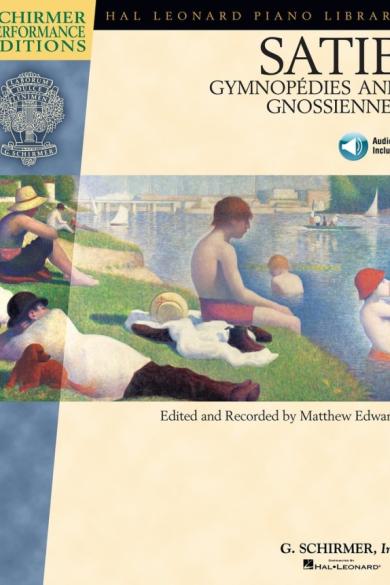
Trois Gymnopédies (1888) are Satie’s best-known works: dreamy, anti-virtuosic piano pieces with winding quarter-note melodies and slowly waltzing left-hand accompaniments. Their title translates as “Three Nude Dances,” after an ancient Greek festival where young men danced naked or unarmed. Debussy orchestrated the first and third in 1897.
Six Gnossiennes (1890–97) are dreamlike piano miniatures written mostly in free time, with free-flowing rhythm and form; the etymology suggests an introspection on how one expresses oneself musically and personally.
Je te veux (1903) is a charming cabaret-style waltz with lyrics by Henry Pacory, written for the singer Paulette Darty; it has been recorded by artists from Yvonne George to Jessye Norman.
Trois morceaux en forme de poire (1903) for piano four hands is a mixture of pieces written in 1890–91 with arrangements of more recent cabaret songs.
Parade (1917), a ballet choreographed by Léonide Massine for Diaghilev’s Ballets Russes, with sets and costumes by Picasso, was Satie’s first ballet score and a succès de scandale. It includes a “Ragtime du paquebot” and shows Satie incorporating music-hall and jazz idioms.
Socrate (1918) , a “symphonic drama” setting Plato’s dialogues, is regarded by Orledge as Satie’s masterpiece. Stravinsky admired it, and it exemplifies Satie’s “return to classical simplicity with a modern sensibility”.
Vexations (1893) consists of a short chordal chain to be repeated 840 times; complete performances can last between 14 and 28 hours, and it is considered both a precursor of total chromaticism and the first minimalist piece.
Sports et divertissements (1914) is a miniature Gesamtkunstwerk combining exquisitely calligraphed texts, music, and drawings by Charles Martin.
Embryons desséchés (1913) parodies Rossini, Chopin, and Beethoven, and rethinks the implications of sonata form.
Le Piccadilly (1904) is one of the earliest French experiments in ragtime.
Relâche (1924) and its companion film Entr’acte represent Satie’s late Dadaist phase; Entr’acte is the first synchronised film score by an avant-garde composer.
Music in Film and Theatre
Satie’s music has had a rich and varied afterlife in film. His original score for René Clair’s Entr’acte (1924) was written for the Ballets Suédois production Relâche and is widely praised as a model of film music; it has been described as “the first original film score of consequence by an avant-garde composer”. The film features cameo appearances by Satie and Man Ray, and Satie carefully pegged the music to each filmic sequence. Later composers and performers have re-scored Entr’acte, including The Cinematic Orchestra.
Beyond Entr’acte, Satie’s Gymnopédies and Gnossiennes have been used in countless films, television programmes, and advertisements. His repetitive, atmospheric piano pieces are particularly suited to soundtracks: they have appeared in films such as Miss Mary (1986), Iron Jawed Angels (2004), and Julie & Julia (2009). The BBC has noted that Satie’s music is “so often seen as a precursor to ambient music, minimalism, film and advert music, conceptual art, and surrealism”.
In the theatre, Satie wrote several stage works. Geneviève de Brabant (c. 1900) was premiered as an “opera for marionettes” at the Théâtre des Champs-Élysées in 1926. Le piège de Méduse is a play with music, and Le médecin malgré lui (1924) was a setting of spoken dialogue from Gounod’s opera for Diaghilev’s Monte Carlo season. His ballets—Parade, Mercure, and Relâche—were collaborative theatrical events that blurred the boundaries between music, dance, visual art, and film. While Satie did not write a traditional Broadway-style musical, his stage works and their collaborative, multi-media nature anticipate later developments in music theatre.
Collaborations
Satie was a compulsive collaborator, and his partnerships with leading avant-garde figures defined much of his career. His friendship with Claude Debussy was the most intimate and complicated: Debussy championed Satie’s early work, orchestrated the Gymnopédies, and called him “a gentle medieval musician lost in this century,” though their relationship was not without jealousy and rivalry. Maurice Ravel was instrumental in Satie’s 1911 “discovery,” performing his early pieces at the Société Musicale Indépendante.
Satie’s collaboration with Jean Cocteau opened the doors to the Ballets Russes and to Parade; Cocteau championed him in Le coq et l’arlequin and as godfather to Les Six. With Sergei Diaghilev, Léonide Massine, and Pablo Picasso, Satie created Parade (1917) and later Mercure (1924). He worked with Francis Picabia and René Clair on Relâche and Entr’acte (1924). He was admired by Igor Stravinsky, who was impressed by Socrate. Satie also collaborated with Darius Milhaud on the first performance of Musique d’ameublement and with members of Les Six, including Poulenc and Auric, who saw themselves as reacting against Debussy’s aesthetic. His later protégés, the École d’Arcueil (Cliquet-Pleyel, Désormière, Jacob, and Sauguet), adopted him as their mascot.
Awards and Recognition
Satie’s career was notably devoid of conventional honours. He made three unsuccessful attempts to gain election to the Académie des Beaux-Arts. He did not win the Prix de Rome or any other major institutional award during his lifetime. Recognition came instead through the advocacy of younger musicians: Ravel’s 1911 performance, Debussy’s orchestrations, Cocteau’s championship, and the admiration of Stravinsky and Les Six. In 1920 there was a festival of his music at the Salle Erard in Paris. His posthumous reputation, however, has far outstripped any official honour: he is now widely regarded as a foundational figure of modernism, and his influence is considered a form of recognition far more significant than any prize.
Influences and Legacy
Satie’s influence on twentieth-century music is immense. During his lifetime he guided a new generation of French composers away from Wagner-influenced Impressionism toward a leaner, more epigrammatic style. Among those influenced by him were Debussy, Ravel, and Francis Poulenc, and he is seen as an influence on later composers such as John Cage and John Adams. Cage famously said of Satie: “In Satie it is not a question of relevance. He is indispensable”.
Satie’s technique foreshadowed most of the “advances” of twentieth-century music, from serialism to minimalism, and even muzak. He has been called the first minimalist and the first ambient musician; Brian Eno is among those who have acknowledged his importance. His musique d’ameublement anticipated environmental music and background music by decades. His repetitive structures and juxtapositional methods prefigured the work of minimalist composers, and his barless, metre-free pieces liberated composition from regular rhythmic constraints. His influence extends beyond the concert hall into prog rock, synth-pop, film music, advertising, conceptual art, and surrealism; the BBC has documented his impact on musicians such as Gary Numan, John Foxx, and Steve Hackett.
Eccentricities and Additional Information
Satie was famously eccentric. He ate only white foods, kept a strict daily timetable (rising at 7:18, inspired from 10:23 to 11:47, lunching at 12:11), and carried a hammer in his coat to repel potential assailants. He bought seven identical dun-coloured velvet suits in 1895, earning the nickname “The Velvet Gentleman”. He was the founder and only member of his own church, the Église Métropolitaine d’Art de Jésus Conducteur. Although he was a musical iconoclast, he was uninterested in—even antipathetic to—technological innovations such as the telephone, the gramophone, and the radio; he made no recordings and is known to have made only one telephone call. He was incompetent with money, spending or giving away his income as soon as he received it. He contributed to numerous publications under his own name and pseudonyms, and his habit of embellishing scores with written remarks became so established that he had to insist they not be read aloud during performances.
Browse in the Sheet Music Library:
Or browse in the categories menus & download the Library Catalog PDF:
Satie
Erik Satie was not a conventional composer, and he did not lead a conventional life. He rejected the excesses of Romanticism, turned his back on the prizes and institutions of the musical establishment, and pursued a singular vision of music as idea, as illumination, and as an object of quiet subversion. His Gymnopédies and Gnossiennes may be ubiquitous, but they are only the most accessible surface of a body of work that anticipated minimalism, ambient music, total chromaticism, conceptual art, and the multimedia collaborations of the later twentieth century. His collaborators ranged from Debussy and Ravel to Picasso, Cocteau, and Stravinsky; his admirers include John Cage and Brian Eno; his music continues to haunt film, television, and the popular imagination. A century after his death, Satie remains what Debussy called him: the precursor—a composer who looked constantly toward the future, and whose radical simplicity has proved more enduring than the grand gestures of his age.
Erik Satie: Gymnopédies & Gnossiennes (Full Album)
Tracklist: 00:00:00 3 Sarabandes (1887): No. 1 00:05:33 3 Sarabandes (1887): No. 2 00:10:33 3 Sarabandes (1887): No. 3 00:14:47 3 Gymnopédies (1889): No. 1: Lent et douloureux 00:18:27 3 Gymnopédies (1889): No. 2: Lent et triste 00:21:45 3 Gymnopédies (1889): No. 3: Lent et grave
00:24:38 Gnossiennes 1-3 (1890): No. 1 00:28:45 Gnossiennes 1-3 (1890): No. 2 00:30:45 Gnossiennes 1-3 (1890): No. 3 00:34:11 Gnossiennes 4-6 (1889-1897): No. 4 00:37:02 Gnossiennes 4-6 (1889-1897): No. 5 00:39:53 Gnossiennes 4-6 (1889-1897): No. 6
00:41:27 2 Préludes du nazaréen (1892): No. 1, assez lent 00:46:09 2 Préludes du nazaréen (1892): No. 2, assez lent 00:49:15 2 Prélude de la porte Héroique du ciel (1894) 00:53:00 2 Pièces froides (1897), No. 1: Airs a faire fuir: D’une manière très particulaire 00:55:59 2 Pièces froides (1897), No. 1: Airs a faire fuir: Modestemente 00:57:42 2 Pièces froides (1897), No. 1: Airs a faire fuir: S’inviter 01:00:45 No 2: Danses de travers: En y regardent à deux fois 01:01:39 No 2: Danses de travers: Passer 01:02:25 No 2: Danses de travers: Encore 01:03:47 Petite ouverture à danser (1900)