Scores for all instruments: 16,000+ (active and growing), over 236,000 pages.
All genres and levels: Jazz & Blues, Rock & Pop, Classical & Contemporary, Film & Musicals;
books & biographies; methods, études, play-along tracks (MP3) for Jazz & Rock.
Access & benefits: US$15.99 one-time payment, valid for lifetime, full Library access.
Table of Contents
Richard Wagner: The Revolutionary Who Reshaped Music, Drama, and the Modern Imagination
Few figures in the history of Western art provoke as much awe, debate, and outright controversy as Wilhelm Richard Wagner. Born in Leipzig in 1813 and dying in Venice in 1883, Wagner was not merely a composer; he was a self-styled revolutionary who sought to dissolve the boundaries between music, poetry, drama, and staging into a single, overwhelming aesthetic experience. His concept of the Gesamtkunstwerk—the “total work of art”—and his development of the leitmotif would fundamentally alter the course of opera, and his harmonic innovations in Tristan und Isolde are widely regarded as the birth pangs of musical modernism.
Yet Wagner’s legacy is inseparable from the darker currents of his thought: his virulent antisemitism and the subsequent appropriation of his music by the Nazi regime have ensured that his work remains a site of moral and aesthetic contestation. This article explores the full scope of Wagner’s life, his musical language, his greatest works, his presence in film and popular culture, his collaborations, and the immense, contradictory legacy he left behind.
The best sheet music download from our Library.
For the price of a single songbook, get a full Sheet Music Library!
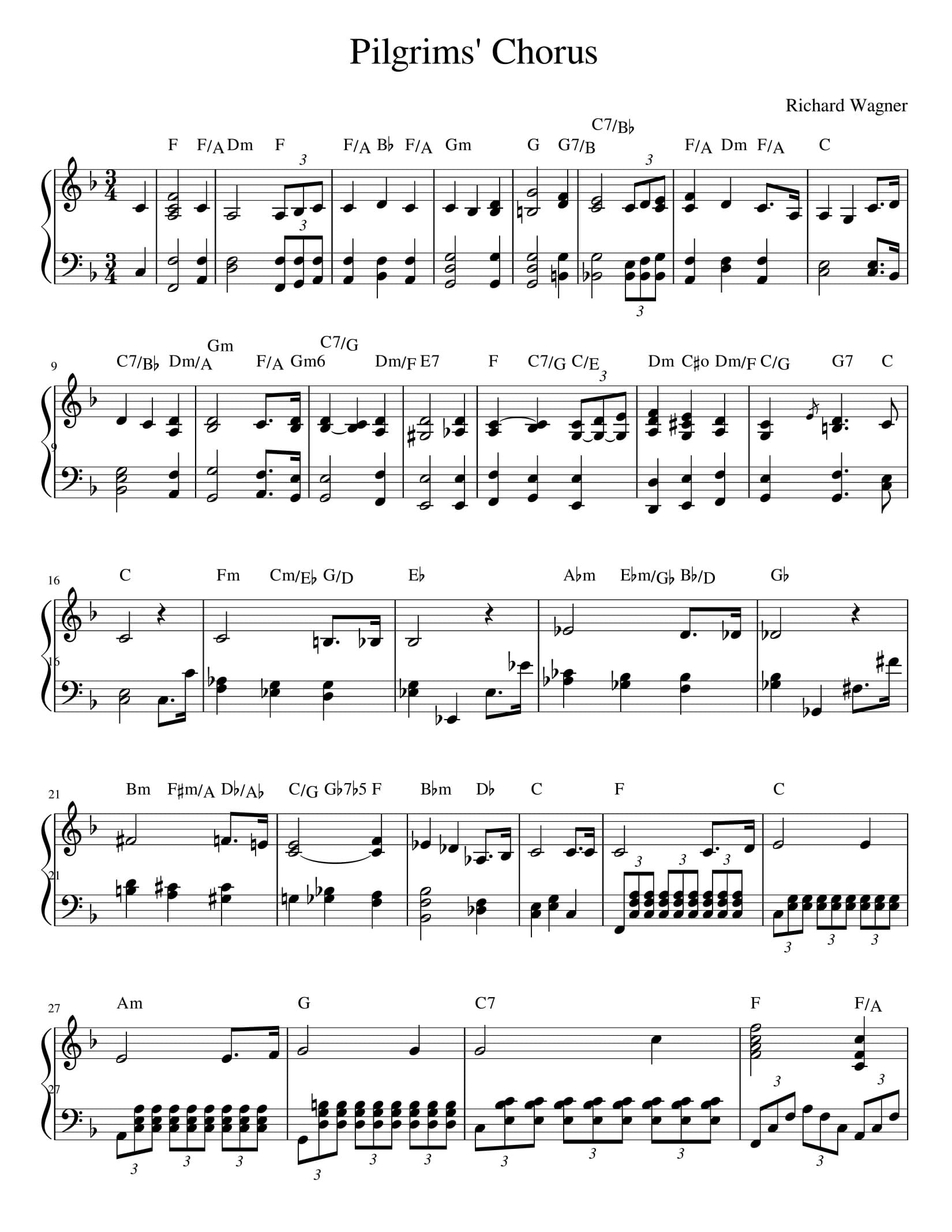
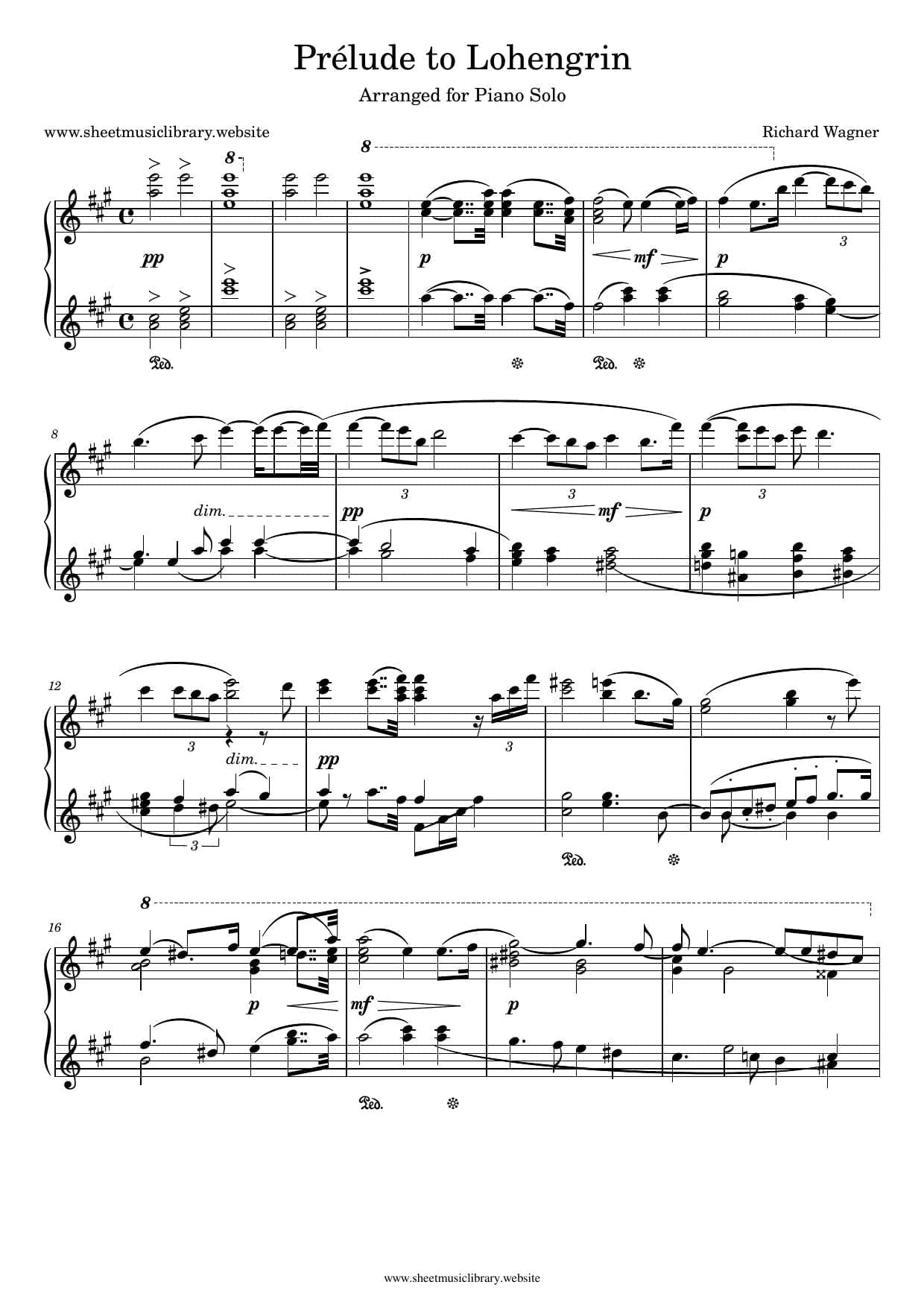
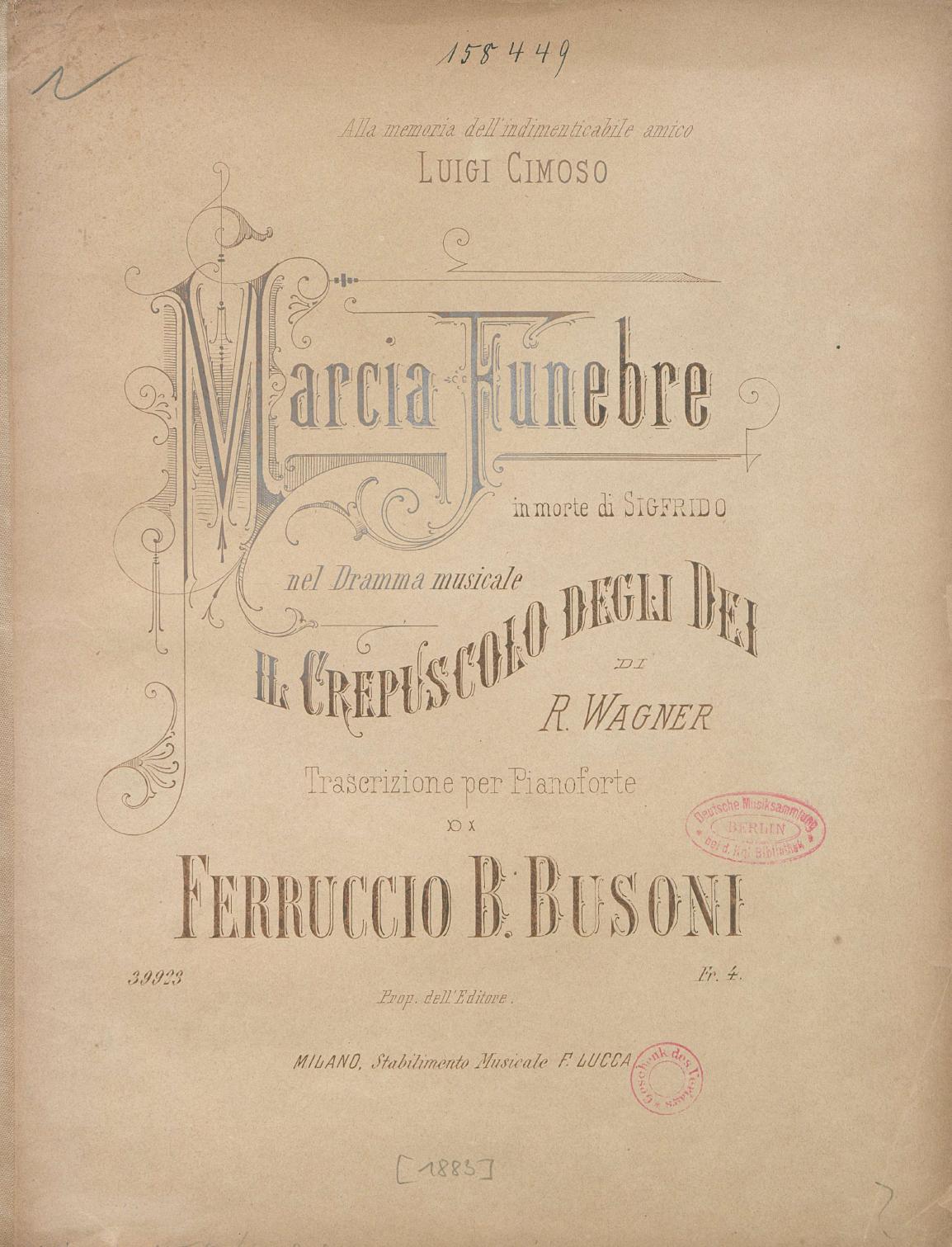
Search your favorite sheet music in the Sheet Music Library Catalog
Biography: From a Turbulent Youth to the Heights of Bayreuth
Richard Wagner was born on 22 May 1813 in Leipzig, the ninth child of Carl Friedrich Wagner, a police clerk, and Johanna Rosine Wagner. His father died of typhoid fever just six months after Richard’s birth, and his mother subsequently lived with the actor and playwright Ludwig Geyer, whom she likely married in 1814. The young Wagner, known until age fourteen as Wilhelm Richard Geyer, grew up in an artistic household; Geyer’s love of the theatre left an indelible mark on the boy, who would later recall performing as an angel in one of his stepfather’s productions.
After Geyer’s death in 1821, Wagner was sent to the Kreuzschule in Dresden, where his fascination with the Gothic and the theatrical began to take root. He showed little interest in academic study, preferring poetry and music, and began taking harmony lessons around the age of fifteen before enrolling at Leipzig University in 1831.
Please, subscribe to our Sheet Music Library. Sheet music should be accessible and affordable for all musicians, from professionals to absolute beginners.
Wagner’s early professional career was marked by restlessness, debt, and a tempestuous love life. In 1833 he became chorusmaster at the Würzburg Theater, and in 1834 he fell in love with the actress Minna Planer, whom he married in 1836. The couple’s early years together were dogged by financial hardship; Wagner held posts as Kapellmeister in Magdeburg, Königsberg, and Riga, but debts repeatedly forced him to flee creditors. In 1839, the Wagners escaped Riga and eventually settled in Paris, where Wagner spent two miserable years failing to secure performances of his music while working as an arranger for a publishing house. It was during this period, however, that he completed Rienzi and Der fliegende Holländer (The Flying Dutchman), the latter inspired by the stormy sea passage from Riga to London.
Success finally arrived in 1842 with the Dresden premiere of Rienzi, thanks in part to the support of Giacomo Meyerbeer, followed soon after by Der fliegende Holländer and Tannhäuser. Wagner was appointed Royal Saxon Court Conductor in Dresden, but his involvement in the failed 1848–49 revolution forced him to flee Germany; he missed the 1850 premiere of Lohengrin while living in exile in Switzerland. During his Zurich years, Wagner wrote the theoretical essays that would define his aesthetic—The Artwork of the Future (1849), Opera and Drama (1851), and the notorious Judaism in Music (1850)—and completed the libretti for the entire Ring cycle.
The turning point in Wagner’s fortunes came with the patronage of King Ludwig II of Bavaria, who settled the composer’s debts and financed productions of Tristan und Isolde (1865), Die Meistersinger von Nürnberg (1868), Das Rheingold (1869), and Die Walküre (1870) in Munich. Wagner’s personal life also stabilised: in 1870 he married Cosima von Bülow, the daughter of Franz Liszt and the former wife of conductor Hans von Bülow. His grandest ambition, however, was the construction of a festival theatre dedicated exclusively to his own works.
The inaugural Bayreuth Festival was held in 1876, opening with the first complete performance of Der Ring des Nibelungen in an opera house built to Wagner’s specifications. His final music drama, Parsifal, premiered at Bayreuth in 1882, just months before his death in Venice on 13 February 1883.
Musical Style, Harmony, and Technique
Wagner’s mature style represents one of the most radical departures in the history of Western music. At its core lies the principle of the leitmotif—a recurring musical phrase associated with a particular character, object, emotion, or idea. Unlike the simple “reminder motifs” of earlier composers, Wagner’s leitmotifs were endlessly transformed, developed, and combined throughout a work, functioning as a symphonic commentary on the drama. In Der Ring des Nibelungen, the sheer density of leitmotivic interplay is staggering; scholars still debate the exact number of distinct motifs, but their deployment creates a web of meaning that operates simultaneously on psychological, narrative, and symbolic levels.
Harmonically, Wagner pushed the tonal system to its breaking point. The opening of Tristan und Isolde—the famous “Tristan chord” (F–B–D♯–G♯)—contains not one but two dissonances that resist straightforward resolution, creating a sense of agonising, unfulfilled desire that mirrors the opera’s tragic narrative. Theorists from Ernst Kurth onward have identified this chord as the catalyst for a “crisis” in Romantic harmony; its extreme chromaticism and delayed resolutions paved the way for the atonality of the twentieth century. Wagner’s use of harmonic suspension—prolonging dissonance and delaying cadential resolution—created a feeling of “unending melody” (unendliche Melodie) that dissolved the traditional boundaries between arias, recitatives, and ensembles.
Wagner’s orchestration was equally revolutionary. He dramatically expanded the size and scope of the orchestra, particularly the brass section. In the Ring, he called for an orchestra of up to 127 players, including Wagner tubas (a new instrument family combining elements of the horn and tuba), a bass trumpet, and a contrabass trombone. He divided the orchestra into distinct choirs—strings, woodwinds, and brasses—and used them with a painterly sensitivity to colour and dramatic effect. His innovations in the use of the valve horn and his practice of placing the orchestra in a sunken pit at Bayreuth (the “mystic gulf”) were designed to blend the sound into a unified, immersive wash that subordinated individual virtuosity to the overarching drama.
Underpinning all of this was Wagner’s theory of the Gesamtkunstwerk, or “total work of art.” In essays such as The Artwork of the Future and Opera and Drama, Wagner argued that contemporary opera had become a shallow entertainment in which music, drama, and spectacle were artificially separated. His solution was a new form of music drama in which the text, music, staging, and even the architecture of the theatre would be unified under the primacy of the drama. In this conception, the music does not merely accompany the action; it is the action, unfolding as a continuous, through-composed narrative in which every element serves the dramatic whole.
Major Works and Compositions
See also: List of works for the stage by Richard Wagner and List of compositions by Richard Wagner
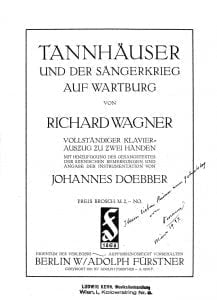
Wagner’s artistic output is dominated by his ten mature music dramas, but his oeuvre also includes orchestral works and choral pieces of considerable significance. His early operas—Die Feen (1833), Das Liebesverbot (1836), and Rienzi (1840)—show the influence of Weber and Meyerbeer, but it was with Der fliegende Holländer (1843) that his distinctive voice began to emerge. Tannhäuser (1845) and Lohengrin (1850) continued his exploration of Germanic myth and medieval romance, with Lohengrin containing some of his most beloved music, including the “Bridal Chorus” (better known as “Here Comes the Bride”).
The monumental Der Ring des Nibelungen (1848–1874) is unquestionably Wagner’s magnum opus. This four-opera cycle—Das Rheingold, Die Walküre, Siegfried, and Götterdämmerung—takes over a quarter of a century to complete and totals roughly fifteen to sixteen hours of music. Based on Norse mythology and the medieval Nibelungenlied, the Ring traces the theft of a cursed ring of power, the downfall of the gods, and the redemption of the world through love. Die Walküre contains the justly famous “Ride of the Valkyries,” a piece whose thrilling energy has made it one of Wagner’s most recognisable creations, even for listeners who have never set foot in an opera house.
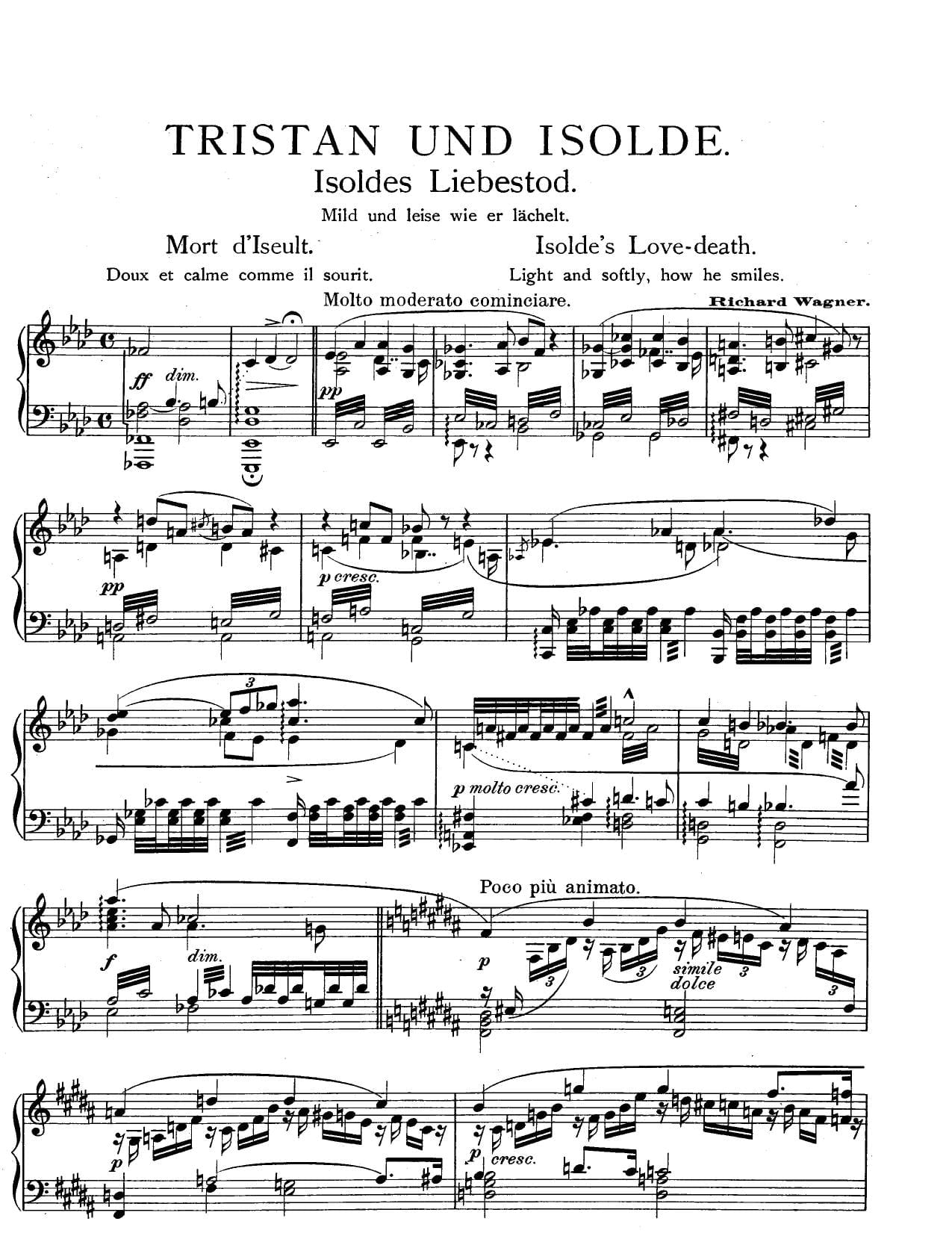
Tristan und Isolde (1865) is the work that most decisively altered the course of music history. Based on the Celtic legend of the doomed lovers, it is a drama of unrelieved chromatic longing in which the external action is almost static and the true drama unfolds in the characters’ inner psychological states. The Prelude and Liebestod (Love-Death) are among the most intensely expressive passages in the entire repertoire, and the opera’s harmonic language is widely regarded as the point of departure for modern music. Die Meistersinger von Nürnberg (1868), by contrast, is Wagner’s only mature comedy. A warm, humane work celebrating the art of song and the German burgher tradition, it contains the radiant “Prize Song” and the profound “Wahn” monologue, and it remains one of the longest operas in the standard repertoire.
Wagner’s final work, Parsifal (1882), is a “festival drama” of quasi-religious intensity. Drawing on the Arthurian legend of the Holy Grail, it explores themes of redemption, compassion, and spiritual purification. Its slow, ritualistic pacing and luminous orchestration make it a unique and transcendent listening experience, and it was intended to be performed only at Bayreuth. Among his non-operatic works, the Siegfried Idyll (1870)—a tender chamber piece written as a birthday gift for Cosima—stands out as one of his most intimate and purely beautiful creations.
Wagner in Film and Modern Media
Wagner never wrote for the cinema, but his music and his aesthetic have shaped film more profoundly than those of any other composer. The connection began in the silent era. D. W. Griffith’s The Birth of a Nation (1915)—a film whose racism is inseparable from its technical innovation—used passages from Rienzi and a modified version of the “Ride of the Valkyries” to accompany the climactic ride of the Ku Klux Klan. This set a precedent: Wagner’s music became the default soundtrack for cinematic spectacle, whether heroic or monstrous. The “Ride” has since accompanied helicopter attacks in Francis Ford Coppola’s Apocalypse Now (1979), buffoonish neo-Nazis in The Blues Brothers (1980), and Elmer Fudd in the classic Looney Tunes short What’s Opera, Doc?.
More important than the direct use of his compositions is Wagner’s influence on the language of film scoring itself. The concept of the leitmotif—a musical theme that represents a character, place, or idea—became a defining trait of Hollywood scores from the 1930s onward. Max Steiner’s score for King Kong (1933), Erich Wolfgang Korngold’s swashbuckling masterpieces, John Williams’s music for Star Wars, and Howard Shore’s scores for The Lord of the Rings all owe a profound debt to Wagner’s practice. Williams, in particular, has acknowledged Wagner as a primary model for his system of character-specific themes, and Shore’s Ring-like tapestry of motifs for Middle-earth is a direct cinematic analogue of Wagner’s operatic technique. As film scholar David Kram has observed, “the idea of the extension of harmony, the large orchestras and what we call romanticism came to Hollywood via Wagner’s influence”. Wagner’s conception of the Gesamtkunstwerk—the integration of image, word, and music into a single immersive experience—also anticipates the totalising ambitions of cinema itself.
Collaborations and Relationships
Wagner was a notoriously difficult collaborator, but his career was shaped by a series of intense, often fraught relationships with patrons, conductors, writers, and fellow composers. His most important early champion was Giacomo Meyerbeer, the French grand-opera composer, who used his influence to secure the Dresden production of Rienzi—a debt Wagner later repaid with the vicious antisemitic attacks in Judaism in Music. Franz Liszt was both a musical ally and, eventually, a family connection. Liszt conducted the premiere of Lohengrin in Weimar in 1850 and was one of the most tireless advocates of Wagner’s music; Wagner married Liszt’s daughter Cosima in 1870. The conductor Hans von Bülow, Cosima’s first husband, was also a devoted interpreter of Wagner’s works, even after Wagner and Cosima began their affair.
King Ludwig II of Bavaria was the indispensable patron of Wagner’s later years, rescuing him from financial ruin and enabling the premieres of Tristan, Meistersinger, Rheingold, and Walküre. The philosopher Friedrich Nietzsche was initially a passionate admirer and friend, but he later broke with Wagner, accusing him of decadence and of betraying the Dionysian spirit of tragedy; Nietzsche’s critique in The Case of Wagner remains one of the most penetrating analyses of the composer’s aesthetic. Wagner’s circle also included the conductor Hermann Levi, who premiered Parsifal despite Wagner’s antisemitism, and the young Richard Strauss, who was deeply influenced by Wagner’s orchestral and harmonic innovations.
Awards and Honors
Wagner’s lifetime was marked less by formal awards than by the gradual realisation of his artistic ambitions. He received no major state honours comparable to those bestowed on some of his contemporaries, and his relationship with the German establishment was always adversarial. His true “award” was the creation of the Bayreuth Festival itself, a permanent institution dedicated to his works that has operated, with interruptions, since 1876. In the twentieth and twenty-first centuries, his operas have received countless Grammy Awards for best opera recording, and the Bayreuth Festival remains one of the most prestigious cultural events in Europe. The Richard Wagner Medal is awarded by the city of Bayreuth to individuals who have made outstanding contributions to the festival.
Influences
Wagner’s musical influences were eclectic. He revered Beethoven, particularly the Ninth Symphony and the late string quartets, and he saw himself as completing Beethoven’s project of unifying music and drama. Carl Maria von Weber provided a model for German Romantic opera, and Meyerbeer showed him the possibilities of grand spectacle. Bach and Mozart were constants in his musical imagination, and he deeply absorbed the counterpoint and harmonic language of the classical tradition. From the literary side, the German Romantics—Novalis, E. T. A. Hoffmann, and the Schlegel brothers—shaped his conception of art as a quasi-religious vocation, while his reading of Schopenhauer gave philosophical weight to his later works, especially Tristan and Parsifal.
Legacy: Influence on Classical Music, Rock, Jazz, and Film
Wagner’s influence on classical music is incalculable. His harmonic innovations in Tristan directly enabled the breakdown of tonality, and composers as diverse as Richard Strauss, Gustav Mahler, Arnold Schoenberg, Alban Berg, Claude Debussy (who both admired and resisted him), and Benjamin Britten grappled with his legacy. The Second Viennese School took his chromaticism to its logical conclusion, while the French Impressionists reacted against his Teutonic weight. In the twentieth century, the Bayreuth Festival became a pilgrimage site for Wagnerians, and the “New Bayreuth” productions of his grandsons Wieland and Wolfgang Wagner revolutionised operatic staging.
In the realm of popular music, Wagner’s influence has been more diffuse but no less real. The rock composer Jim Steinman explicitly coined the term “Wagnerian rock” to describe his work with Meat Loaf, particularly the Bat Out of Hell albums, which fuse the bombast of 1950s rock and roll with the operatic scale and emotional intensity of Wagner. Steinman was described in his obituaries as “the Wagner of rock,” and his use of massive orchestrations, choral backing, and overwrought melodrama is directly descended from Wagner’s aesthetic.
Phil Spector’s “Wall of Sound”—the dense, reverb-drenched production style he applied to girl groups and later to the Beatles—has likewise been described as Wagnerian in scope. Progressive rock bands such as Yes, Emerson, Lake & Palmer, and the Moody Blues embraced the large-scale conceptual ambition and symphonic textures that Wagner pioneered. In heavy metal, Manowar and Rammstein have cited Wagner as an inspiration, and the Slovenian avant-garde group Laibach created a sonic suite called VolksWagner using material from Tannhäuser, Siegfried Idyll, and the Ride.
Wagner’s relationship with jazz is more ambivalent. As critic Richard S. Ginell has noted, Wagner’s music is “so tied into a specific Romantic sound world that most jazz—with its emphasis on lean textures and improvisatory freedom set to a steady pulse—would seem to be in revolt against it”. Nevertheless, there have been notable intersections. Stan Kenton, the iconoclastic big-band leader, recorded an album called Kenton/Wagner in 1964, applying his massive, brassy ensemble style to eight Wagner excerpts. More recently, jazz musicians such as Branford Marsalis have engaged with Wagnerian motifs—Marsalis discovered that a tune on his album Braggtown inadvertently paraphrased the “fate” leitmotif from Götterdämmerung. Hip-hop artists and experimental ensembles have also filtered Wagner through contemporary idioms, though these encounters remain marginal compared to his impact on classical and film music.
The Controversial Legacy: Antisemitism and Appropriation
No discussion of Wagner’s legacy can ignore the darkest dimension of his thought. Wagner was a virulent antisemite, and his essay Judaism in Music (1850) is a toxic document that attacks Jews as incapable of producing genuine art and accuses composers such as Meyerbeer of commercialising music for financial gain. Wagner’s antisemitism was not merely a private prejudice; it was embedded in his theoretical writings and, some scholars argue, in the characterisation of figures such as Alberich and Mime in the Ring. After his death, his widow Cosima and the Bayreuth circle actively cultivated his cult, and the Nazi regime elevated Wagner to the status of a national icon, exploiting his music for propaganda and associating it indelibly with Hitler’s aesthetic ambitions.
This appropriation has ensured that Wagner remains a profoundly divisive figure. Performances of his music in Israel remain taboo for many, and every revival of his operas provokes renewed debate about whether the art can be separated from the artist’s politics. The scholarly consensus is not monolithic: some argue that the music dramas contain a utopian, redemptive impulse that transcends Wagner’s personal bigotry, while others insist that the antisemitism is structural and cannot be excised.
Wagner
Richard Wagner was a colossus who strode across the nineteenth century, remaking opera, harmony, and the very concept of artistic synthesis. He was a genius of the first order, a visionary who imagined a theatre in which music, poetry, and spectacle would fuse into a single overwhelming experience, and he possessed the ruthless determination to bring that vision into being against overwhelming odds. His leitmotif technique became the lingua franca of film scoring, his harmonic language opened the door to modernism, and his conception of the Gesamtkunstwerk continues to shape how we think about immersive art in the age of cinema and beyond.
Yet he was also a man of poisonous prejudices, and his posthumous canonisation by the Nazi regime has left a stain that no amount of aesthetic admiration can fully erase. To engage with Wagner is to confront the inseparable entanglement of sublime art and human cruelty. His music remains, in the words of one critic, an “irresistible force”—and the questions it raises about beauty, power, and complicity are as urgent today as they were in the nineteenth century.
Browse in the Sheet Music Library:
Or browse in the categories menus & download the Library Catalog PDF:
Best of Richard Wagner - Classical Music Gems
00:00:00 Lohengrin, WWV 75, Act I Part: Prelude (1) 00:07:59 Tannhäuser, WWV 70 Part: Overture (1) 00:22:47 Tristan und Isolde, WWV 90, Act I Part: Prelude (excerpt) (3) 00:25:52 Tristan und Isolde, WWV 90 Part: Prelude and "Love Death" (1) 00:44:28 Die Walküre, WWV 86B, Act III, Scene 1 Part: "Ride of the Valkyries" (4) 00:49:59 Lohengrin, WWV 75, Act III Part: Introduction (1) 00:52:59 Die Meistersinger von Nürnberg, WWV 96 Part: Overtüre (3) 01:03:18 Die Meistersinger von Nürnberg, WWV 96, Act I Part: Prelude (2) 01:11:49 Parsifal, WWV 111 Part: Overture (5) 01:26:18 Der fliegende Holländer, WWV 63 Part: Overture (5) 01:36:44 Das Liebesverbot, WWV 38 Part: Overture (5)