Scores for all instruments: 16,000+ (active and growing), over 236,000 pages.
All genres and levels: Jazz & Blues, Rock & Pop, Classical & Contemporary, Film & Musicals;
books & biographies; methods, études, play-along tracks (MP3) for Jazz & Rock.
Access & benefits: US$15.99 one-time payment, valid for lifetime, full Library access.
Table of Contents
Who is Joep Beving (b. 1976)?
Joep Beving: The Gentle Giant of Piano Poetry
In an era dominated by fleeting digital distractions and algorithmic playlists, Joep Beving has emerged as an unlikely phenomenon. A nearly seven-foot-tall Dutch pianist who composes what he describes as "simple music for complex emotions," Beving has quietly become one of the most streamed living pianists in the world, amassing over one billion streams across his catalogue. His music, which he prefers to call "piano poetry" rather than classical or neoclassical, occupies a unique space between contemplation and accessibility, silence and sound, vulnerability and strength.
The best sheet music download from our Library.
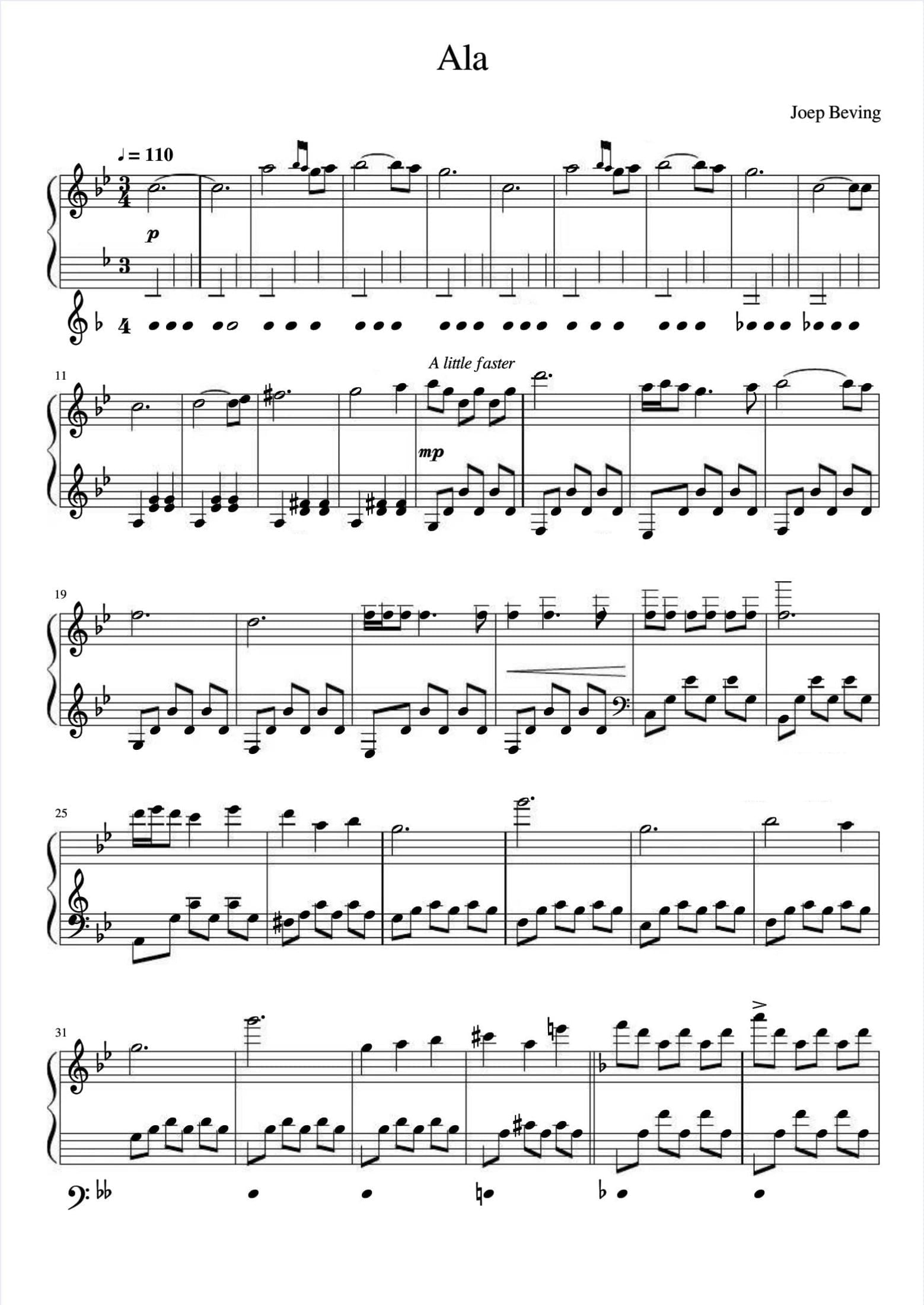

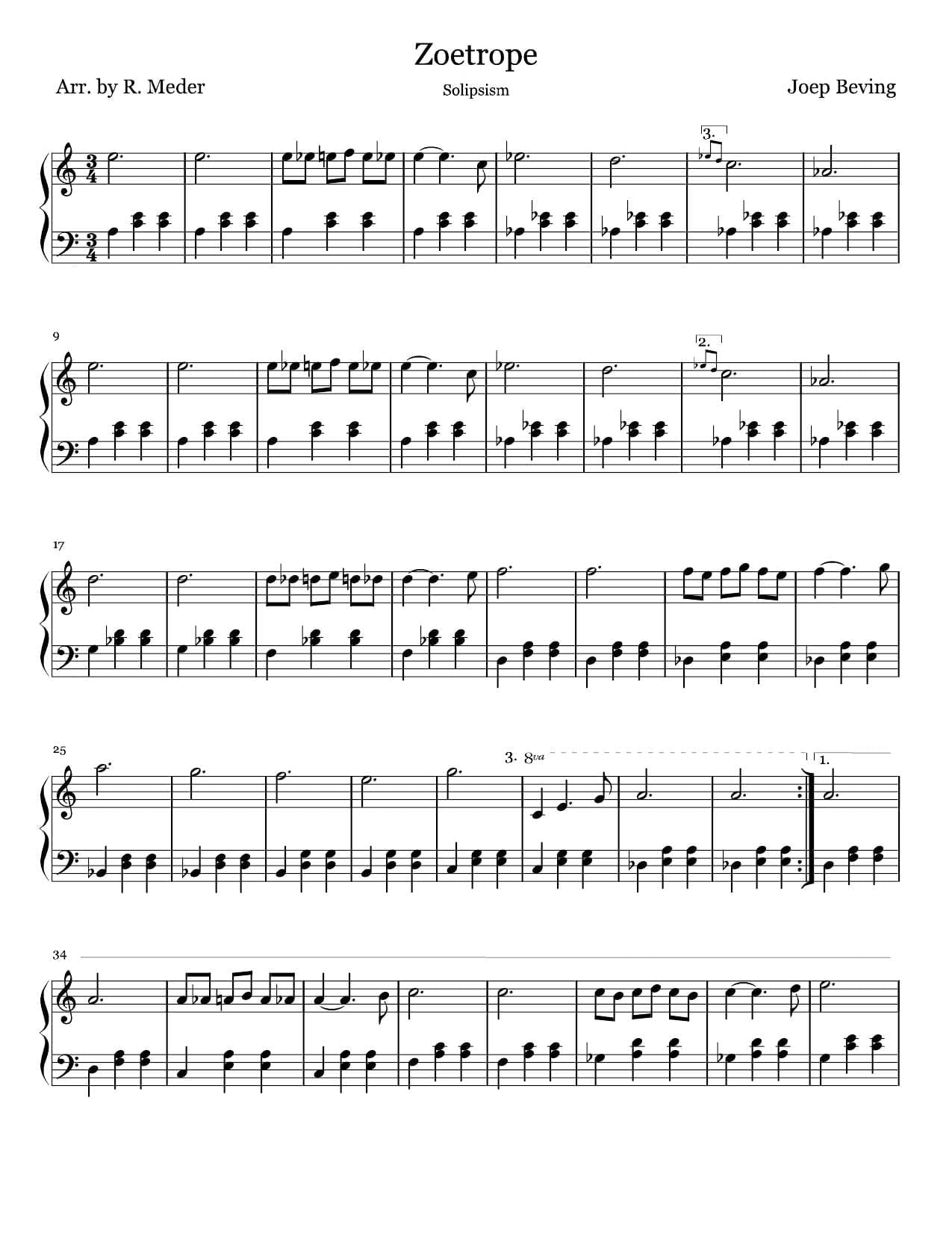
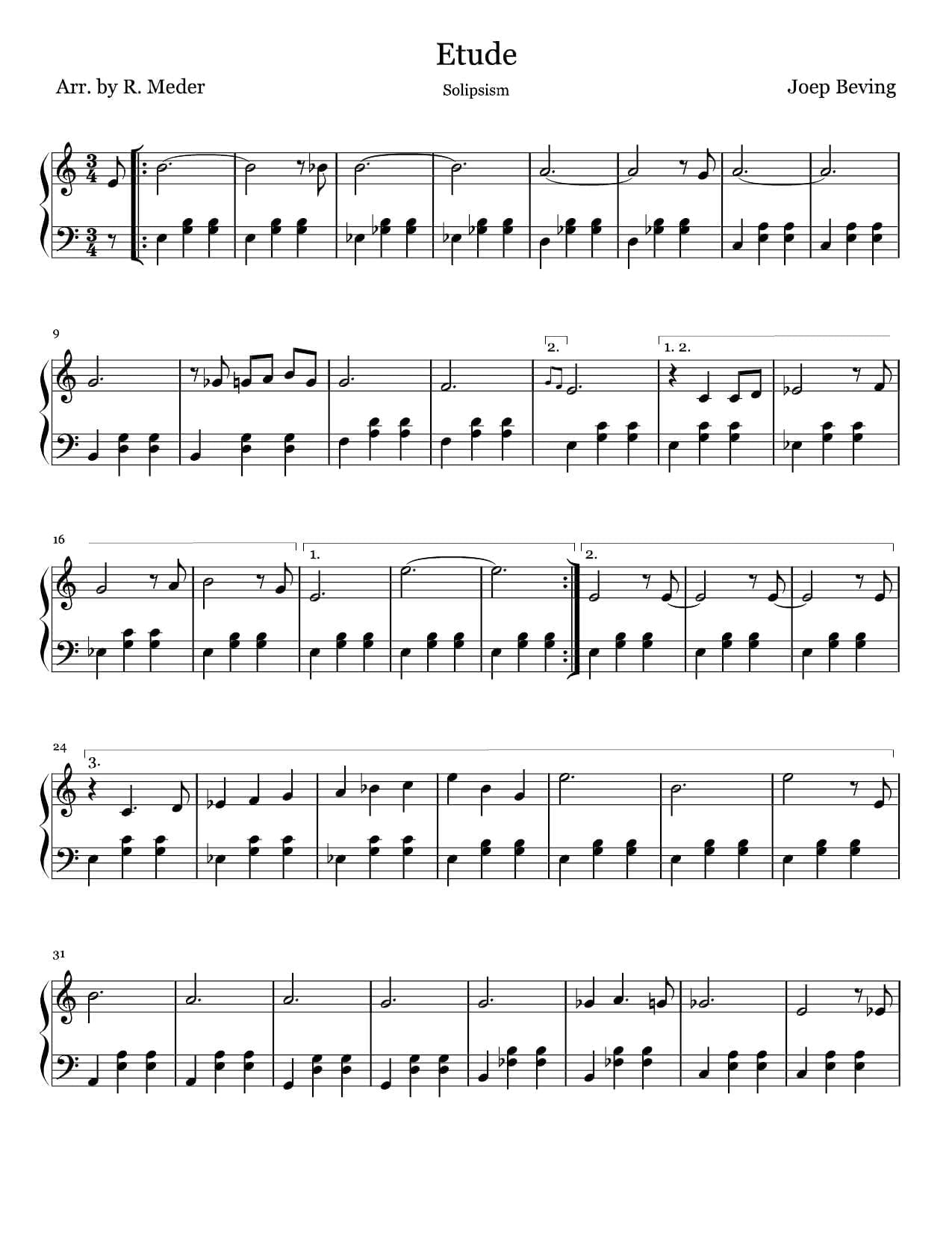
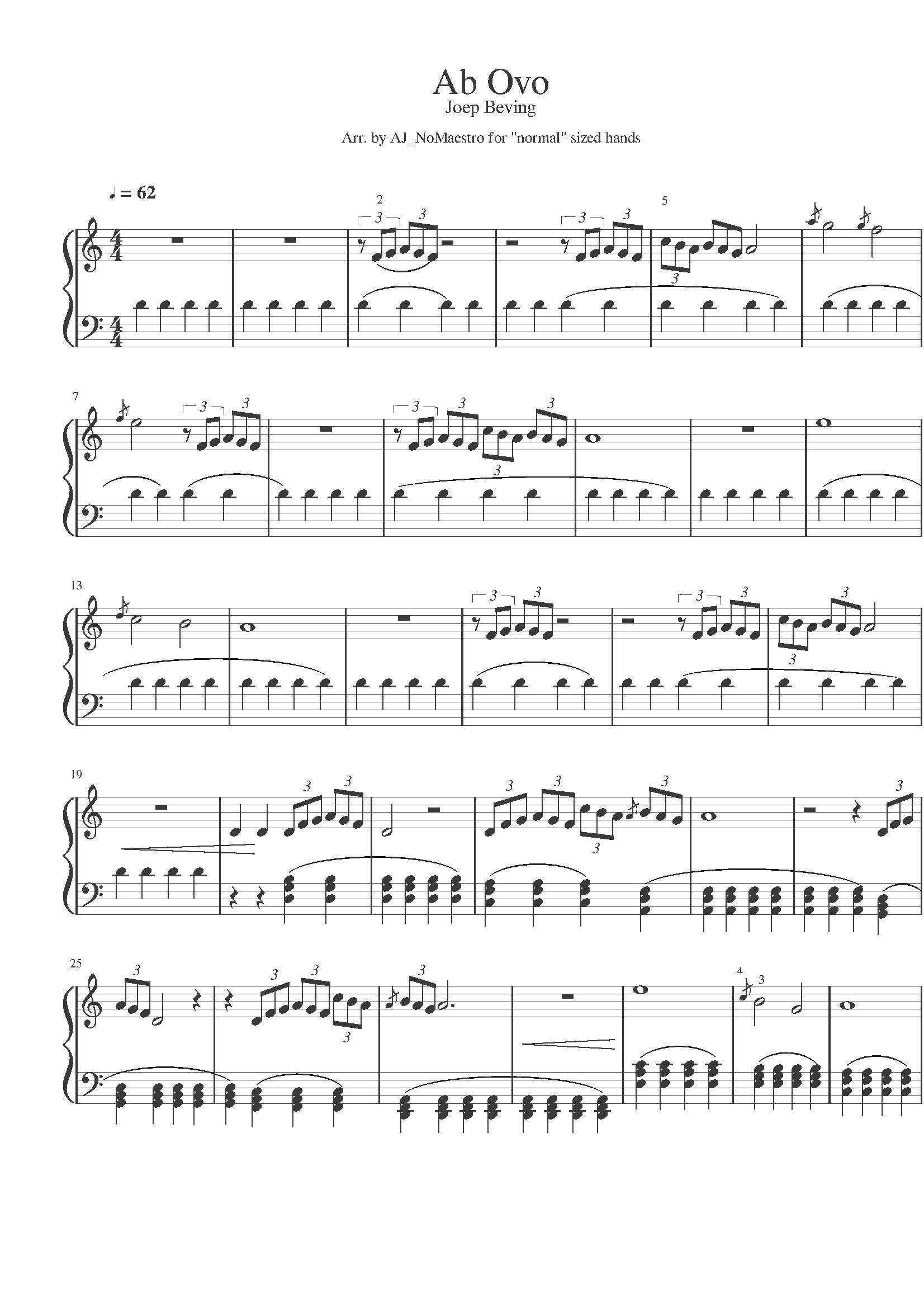
Beving's journey to prominence is as unconventional as his music. He did not follow the traditional path of conservatory training and competition victories. Instead, he spent years in the commercial world of advertising before a period of work-related stress led him back to the piano in 2014. What began as private improvisation—a form of therapy—evolved into a self-released album that unexpectedly went viral, launching a career that has since seen him perform at the Sydney Opera House, collaborate with orchestras, and sign with the legendary Deutsche Grammophon label.
Please, subscribe to our Sheet Music Library. Sheet music should be accessible and affordable for all musicians, from professionals to absolute beginners.
This article explores the full breadth of Joep Beving's artistry: his remarkable biography, his distinctive musical style and technique, his harmonic language, his most significant compositions, his work in film music, his collaborations with other musicians, his influences and legacy, and the philosophical underpinnings that give his music its profound emotional resonance.
Search your favorite sheet music in the Sheet Music Library Catalog
Biography: From Advertising Executive to Accidental Virtuoso
Early Life and Musical Beginnings
Joep Beving was born on January 9, 1976, in the small Dutch city of Doetinchem, in the eastern Netherlands. Music was a passion from childhood. The son of a schoolteacher, he began making music at an early age and formed his first band at fourteen. His talent was evident enough that he won a place at a conservatoire, embarking on what seemed like a conventional path toward a career as a concert pianist.
However, fate intervened. After just one year of study, Beving developed a repetitive strain injury to his wrist that forced him to abandon his piano studies. It was a devastating blow for a young musician, but it would ultimately lead him down a path that shaped his unique artistic identity. Rather than pursuing music formally, Beving enrolled in a program of public policy and administration, subsequently entering the advertising industry. In this commercial world, he found a way to remain connected to music: he became responsible for the music in numerous commercials, composing soundtracks for short films including Hortum (2010) and Het cadeau (2015).
The Burnout and the Breakthrough
For years, Beving navigated the high-pressure world of advertising, but the pace and demands of the industry eventually took their toll. In 2014, suffering from work-related stress, he turned back to the piano as a means of coping. What emerged was not the virtuosic classical repertoire he had once studied, but something far more personal: simple, contemplative pieces that he describes as "simple music for complex emotions".
These improvisations, recorded privately in his apartment, became the foundation of his debut album, Solipsism. Initially self-released in 2015 for distribution among family and friends, the album escaped its creator's immediate orbit when he posted it on an online music service. The response was extraordinary. Within a year, Solipsism had been streamed 85 million times, turning Beving into what Deutsche Grammophon describes as "a true phenomenon of the classical piano world".
The Deutsche Grammophon Years
Beving's viral success eventually reached the ears of Christian Badzura, Vice President of A&R New Repertoire at Deutsche Grammophon. In a twist of fate, Badzura happened to hear Solipsism playing in his favourite Berlin bar, where a rare vinyl pressing had found a home. He traced the pianist to Amsterdam and signed him. The relationship was formalised with the release of Beving's DG debut album, Prehension, in April 2017, followed by the Yellow Label reissue of Solipsism five months later.
Prehension (2017) continued in the vein of its predecessor, offering more of Beving's intimate, contemplative piano pieces. The album included "Hanging D," a track that Beving has identified as a personal milestone—a fast, loud piece that provides a dramatic contrast to his generally quiet repertoire and gives him the opportunity to be "truly relaxed during the other pieces" in live performance.
The Trilogy: Solipsism, Prehension, and Henosis
Beving's first three albums form a loose trilogy exploring themes of reality, connection, and the nature of existence. Conatus (2018) served as an interlude of sorts, containing reworks of tracks from both Solipsism and Prehension by artists Beving admires, including Eefje de Visser, Andrea Belfi, Thomas Bloch, Tom Trago, and Cello Octet Amsterdam.
Henosis (2019) completed the trilogy and represented a significant expansion of Beving's sonic palette. Released in April 2019 and honoured with an Edison Award seven months later, the album found Beving's piano complemented by a diverse range of other instruments and players. The album's title—Henosis is a Greek word meaning "oneness" or "union"—reflects its composer's feeling for "the interdependence of all living beings and the seemingly infinite 'oneness' that connects everything within the universe".
Hermetism, Post, and Beyond
Beving's subsequent projects continued to explore philosophical and spiritual themes. Hermetism (April 2022) was inspired by ancient philosophical beliefs in the laws that govern the orderly operation of the universe, drawing on Hermeticism, a spiritual philosophy stemming from ancient writings attributed to the legendary Greek author Hermes Trismegistus. At its core are seven universal laws of nature, passed down through the centuries and later compiled in The Kybalion.
In April 2023, Beving released Post, an EP that marked another departure. Described as a "new work for strings, piano, percussion, ney flute and Bulgarian women's folk choir," Post explores themes of alienation and reconciliation, fragmentation and healing, depression and recovery. Its music directly inspired and became the soundtrack to an eponymous short film by writer-director Hugo Keijzer.
In 2025, to mark the tenth anniversary of Solipsism, Beving returned to the studio to re-record its tracks. The resulting Solipsism Redux, released on August 22, 2025, retains the essentially minimalistic style and contemplative nature of the original while adding further layers to the music's emotional depth. The most recent album, Liminal (2026), was inspired by Guillaume Logé's book Wild Renaissance and serves as an invitation "to relinquish the human illusion of control and to view oneself once more as a humble co-creator in harmony with nature".
Musical Style and Technique: The Art of Piano Poetry
"Piano Poetry" and the Rejection of Labels
Joep Beving resists easy categorisation. While Wikipedia and many critics label his music as "modern classical" or "neoclassical," Beving himself rejects these terms. "I'm more of an ambient musician, and I use pop techniques to construct songs," he has said. He prefers to describe his work as "piano-driven, contemplative piano music, 'piano poetry,' or simply ambient music".
This resistance to labels reflects the genuinely hybrid nature of his music. His compositions are shorn of excess, tracing simple, affecting melodies with the concision of pop music, yet his touch borrows heavily from classical tradition, and the atmosphere of his resonant lines draws inspiration from ambient sound. Critics have compared his style to that of Ólafur Arnalds, Hania Rani, Max Richter, and Nils Frahm, placing him within a broader movement of post-classical composers who straddle the space between pop, electronic, and art music.
The Prepared Piano and the Schimmel Upright
One of the most distinctive aspects of Beving's sound is his use of prepared piano techniques. Despite his nearly seven-foot stature—a fact frequently mentioned in profiles, perhaps because it contrasts so strikingly with the delicacy of his music—Beving favours a Schimmel upright piano inherited from his grandmother over a grand piano. To achieve his signature timbre, he places felt behind the hammers to soften the tone, creating a warm, muted sound that is immediately recognisable.
This choice of instrument is not merely practical but deeply personal. The Schimmel upright, with its familial history, connects Beving to his past and to the domestic intimacy that characterises his music. The felt modification transforms the piano's percussive nature, making it sing rather than strike, breathe rather than attack.
Minimalism and Repetition
Beving's music is marked by slow, kaleidoscopic patterns and intimate, meditative melodies. His essentially minimalist style, often tinged with heartfelt romantic expression, has remained central to everything he has composed since Solipsism. His compositions typically unfold gradually, with simple melodic figures repeated and subtly varied, creating a hypnotic, trance-like quality.
The slower tempos of his work, particularly evident in Solipsism Redux, retain this essentially minimalistic style while adding further layers to the music's contemplative nature. Beving has spoken of allowing his compositions to "grow" organically rather than rigidly constructing them, exploring what he calls "musical grey areas".
The Dance Between Sound and Silence
A crucial element of Beving's artistry is his relationship with silence. As the title of one interview suggests, his music is a "dance between sound and silence". He has described his relationship with the piano as "almost like a Zen practice, where the instrument helps to translate all the complexity of the outside world into notes, tension, sound, and silence". This interplay is "highly meditative" and has brought him "a great deal of inner peace".
In live performance, Beving has learned to embrace slowness and silence. In the beginning, he was nervous and wanted to finish pieces quickly so as not to bore the audience, but he had to learn to embrace the exact opposite. This willingness to let silence speak is one of the qualities that distinguishes his performances and recordings, creating a sense of spaciousness that invites the listener into a contemplative state.
Therapeutic and Meditative Dimensions
Beving has spoken openly about the therapeutic dimension of his music. "In a way, it acts as a medicine—deeply therapeutic—and sometimes, it can even be a portal," he has said. This therapeutic quality was present from the very beginning, when he turned to the piano to cope with work-related stress in 2014. His music emerged not from a desire to impress or innovate, but from a need to process and express complex emotions.
This authenticity resonates with listeners. In an age of anxiety and distraction, Beving's music offers a space for reflection and stillness. It has been described as "a quiet rebellion against the madness" of contemporary life.
Harmony: Simplicity and Emotional Depth
The Harmonic Language of "Simple Music for Complex Emotions"
Beving's harmonic language is deceptively simple. He works primarily with diatonic and modal harmonies, eschewing the complex chromaticism of jazz or late Romantic classical music. His chord progressions are often straightforward, built on common triads and seventh chords that would be familiar to any student of popular music.
Yet within this simplicity lies remarkable emotional depth. Beving's genius lies in his ability to find the precise harmonic colour that matches the emotional content of each piece. A single suspended chord, held for an extended period, can convey longing or uncertainty. A subtle shift from major to relative minor can transform the entire emotional landscape of a composition.
Modal Explorations
Much of Beving's music is modal rather than strictly tonal in the traditional sense. He frequently employs the Aeolian (natural minor), Dorian, and Mixolydian modes, creating atmospheres that are neither fully resolved nor entirely unsettled. This modal ambiguity contributes to the dreamlike, contemplative quality of his work.
In Hermetism, Beving drew explicitly on the seven universal laws of Hermetic philosophy, and this conceptual framework is reflected in the harmonic structure of the album. Each piece explores different modal centres and harmonic relationships, creating a sense of systematic exploration within an emotionally expressive context.
The Influence of Jazz Harmony
While Beving's music is not jazz, his harmonic vocabulary shows the influence of jazz pianists, particularly Bill Evans, whom he cites as a major influence. Evans's use of extended chords, inner voice movement, and modal exploration can be heard in Beving's more harmonically adventurous moments. The warmth and richness of Evans's chord voicings find a distant echo in Beving's piano textures, albeit filtered through a minimalist aesthetic.
Harmony as Emotional Architecture
For Beving, harmony is not merely a technical concern but the architecture of emotion. "My ultimate goal is to create some harmony between people," he has said, "but from having made my previous albums, I am realistic about that endeavour too". This dual meaning of harmony—both musical and human—reflects his holistic approach to composition. Composing becomes "a way of tuning in, of finding harmony between human will and the broader forces of life".
Best Songs and Compositions
"Sleeping Lotus"
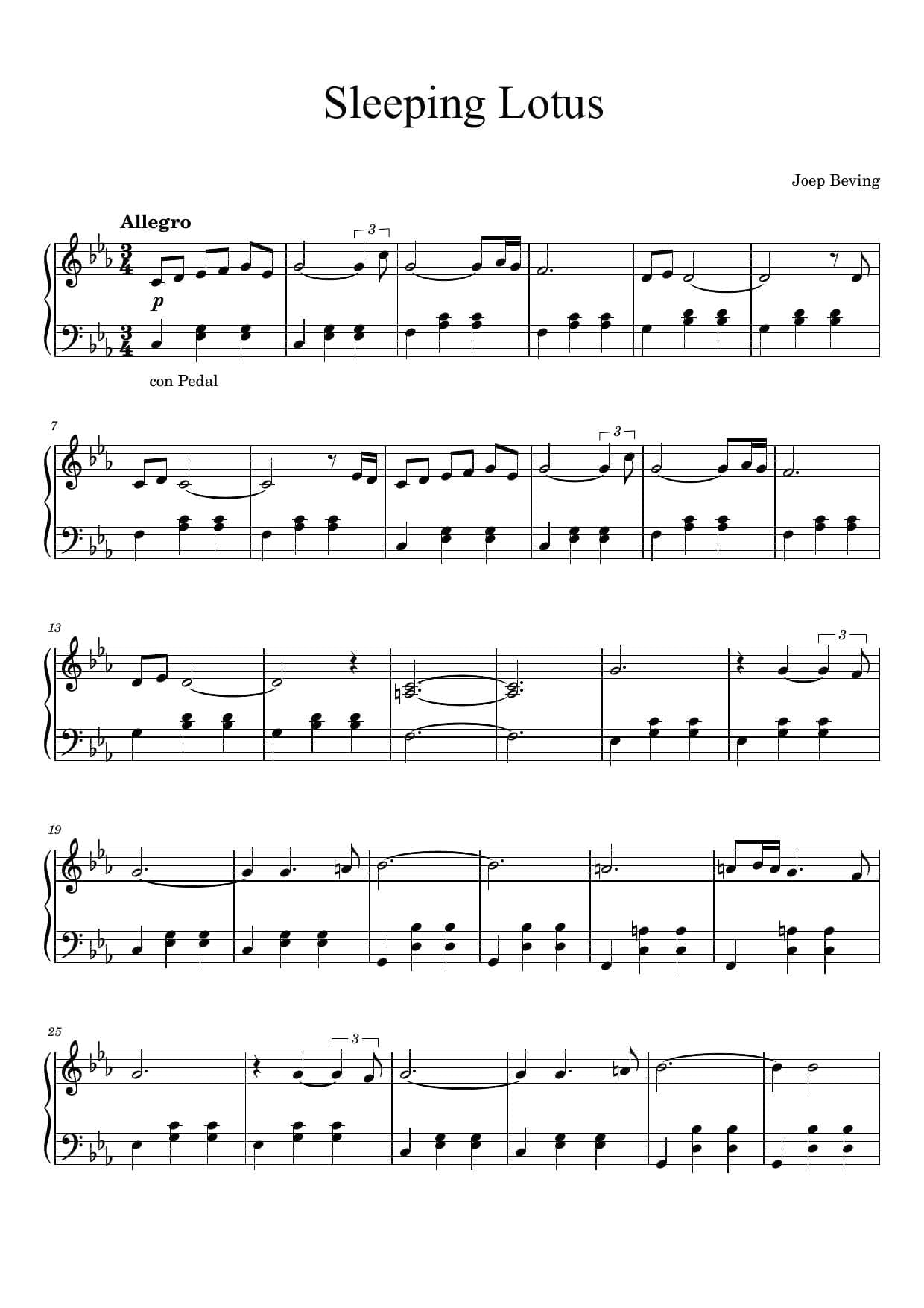
Perhaps Beving's most famous composition, "Sleeping Lotus" from Solipsism, has drawn over 75 million plays on Spotify alone. The piece exemplifies Beving's aesthetic: a simple, repeating melodic figure over a gentle harmonic foundation, gradually unfolding over several minutes. Its title suggests both serenity and potential, and the music captures this duality—a stillness that is not empty but full of latent energy.
"Hanging D"
From Prehension, "Hanging D" represents a different side of Beving's artistry. It is fast and loud, providing a dramatic contrast to his generally quiet repertoire. The piece's title refers to the note D, which hangs suspended in the harmonic texture, creating tension and resolution in equal measure. Beving has described it as a highlight of his live performances, allowing him to release energy that builds during the quieter pieces.
"Ab Ovo"
"Ab Ovo," whose title is Latin for "from the egg" or "from the beginning," is one of Beving's most beloved compositions. It appears on Solipsism and has become a staple of his live performances. The piece begins with a simple, almost childlike melody that gradually accumulates harmonic depth and emotional weight, embodying the idea of development from a simple origin.
"Ala"
From Henosis, "Ala" showcases Beving's ability to integrate subtle electronic textures with his piano writing. The piece features prepared piano sounds and ambient textures that expand his sonic palette while maintaining the intimacy that characterises his work.
"Unus Mundus"
Another highlight from Henosis, "Unus Mundus" (Latin for "one world") reflects the album's theme of interconnectedness. The piece builds gradually from a simple piano figure, adding layers of sound and complexity that suggest the unfolding of a unified reality.
"Aika"
Written for the Japanese film The Promised Land (楽園, Rakuen), "Aika" is one of Beving's most emotionally direct compositions. The piece is named after a character in the film, a young girl whose disappearance sets the plot in motion. The music captures both the innocence of childhood and the tragedy that befalls the character, demonstrating Beving's ability to write music that serves narrative while standing alone as a concert piece.
"Post"
The title track from the Post EP represents Beving's most ambitious work to date, featuring strings, percussion, ney flute, and Bulgarian women's folk choir. The piece explores themes of alienation and reconciliation, and its scope demonstrates Beving's ability to work beyond the confines of solo piano.
"Antoinette"
Composed for the Dutch film Mon père est un avion (Mijn vader is een vliegtuig, 2021), "Antoinette" is a poignant piano piece that captures the film's themes of memory, loss, and familial connection. Its melody is among Beving's most memorable, and it has become a favourite among his listeners.
"Solitude"
From Henosis, "Solitude" is a meditation on isolation and introspection. The piece's sparse texture and slow harmonic rhythm create a sense of vast, empty space, inviting the listener into a state of contemplation.
Film Music and Soundtracks
The Promised Land (楽園, 2019)
Joep Beving's most significant contribution to film music came with the Japanese film The Promised Land (楽園, Rakuen), directed by Takahisa Zeze. The film, based on a novel by Shuichi Yoshida, is a dark psychological drama about two disappearances that occur twelve years apart in a small Japanese town. The director carefully selected existing songs from Beving's albums and asked him to write a title track for the film.
The resulting soundtrack album, released by Deutsche Grammophon in October 2019, contains ten tracks, including the newly composed "Aika" (愛華), named after a character in the film. The soundtrack demonstrates how well Beving's music lends itself to cinematic narrative. His ability to convey complex emotions through simple means—a single melodic line, a repeated chord progression—makes his compositions ideal for film, where music must support and enhance visual storytelling without overwhelming it.
The soundtrack was released internationally, and "Aika" was also issued as a digital single. The film's Japanese release in October 2019 brought Beving's music to a new audience in Japan, where his contemplative aesthetic resonated strongly with audiences.
Mon père est un avion (2021)
In 2021, Beving contributed the track "Antoinette" to the Dutch film Mon père est un avion (Mijn vader is een vliegtuig), directed by Antoinette Beumer. The film, whose English title is My Father Is an Airplane, is a drama about family, memory, and the stories we tell about those we love. "Antoinette" captures the film's emotional core, its title referencing both the director and a character in the narrative.
Post (2023)
The Post EP was directly inspired by and became the soundtrack to a short film by writer-director Hugo Keijzer. The film explores themes of alienation and reconciliation, depression and recovery, mirroring the emotional journey of Beving's music. The collaboration between Beving and Keijzer demonstrates the synesthetic relationship between his music and visual storytelling—his compositions seem to invite cinematic interpretation.
Early Film Work
Before his career as a recording artist, Beving composed soundtracks for the short films Hortum (2010) and Het cadeau (2015) while working in advertising. This early experience in composing for visual media gave him a practical understanding of how music functions in narrative contexts, skills that would later serve him well in his film soundtrack work.
Collaborations: The Art of Musical Dialogue
Maarten Vos
Beving's most significant ongoing collaboration is with Berlin-based producer and cellist Maarten Vos. Their partnership began after the two musicians shared a bill in Amsterdam in 2018, and Vos contributed to Henosis (2019), Beving's third album. This collaboration deepened over time, culminating in their first full collaborative album, Vision of Contentment, released in July 2024 via Nils Frahm's LEITER label.
Vision of Contentment contains eight new compositions that blend Beving's piano with Vos's cello and synths. The album was mixed by Nils Frahm at Berlin's famed Funkhaus complex, adding another layer of creative collaboration. The collaboration between Beving and Vos represents a meeting of kindred spirits: both are interested in the intersection of classical tradition and contemporary electronic production, and both share a commitment to emotional directness over technical display.
The Edinburgh International Festival described their collaboration as "an enchanting fusion of classical artistry and avant-garde experimentation," with Beving's "emotive piano work that melds minimalist and modern influences" joining forces with Vos's "electronic innovation". Their work together has been characterised as "a search for 'harmony and understanding' that also involves 'a big fuck you to fascists and fear'"—a statement that reveals the political and ethical dimensions of their artistic partnership.
Nils Frahm
Nils Frahm, the German pianist, composer, and producer, has been a significant figure in Beving's career. Frahm's LEITER label released Vision of Contentment, and Frahm himself mixed the album at his Berlin studio. Frahm is often mentioned alongside Beving as a fellow traveller in the post-classical/neoclassical movement, and their mutual respect reflects a shared aesthetic sensibility.
Residentie Orkest
In 2024, Beving embarked on his first collaboration with a full orchestra, joining forces with the Residentie Orkest The Hague. The collaboration, which continued into 2025, involved orchestral adaptations of Beving's work, including a complete orchestral performance of his debut album Solipsism. Beving described the experience as exploring new musical territory, and the collaboration brought his intimate compositions into a new sonic dimension.
The orchestral collaboration was particularly meaningful for Beving because the COVID-19 pandemic had prevented him from experiencing Henosis in live performance with the full instrumentation he had envisioned. "Corona has nipped the live experience of my album Henosis in the bud," he said, and the orchestral collaboration offered a way to realise his musical visions in a new context.
Grace Davidson and the Sonderling Quartet
For The London Session EP (August 2020), Beving collaborated with soprano Grace Davidson and the Sonderling Quartet on a vocal version of "An Amalgamation Waltz 1839" from Prehension. This collaboration demonstrated Beving's willingness to reimagine his own work in new contexts, adding the human voice to his predominantly instrumental palette.
Echo Collective
Beving has also performed with the Echo Collective, an ensemble known for its work in contemporary classical and ambient music. Their collaboration has brought Beving's music into new chamber music contexts, further expanding the sonic possibilities of his compositions.
Influences and Legacy
Musical Influences
Beving's musical influences are eclectic and revealing. He cites Bill Evans, Keith Jarrett, Philip Glass, and Arvo Pärt as key inspirations. The presence of Evans and Jarrett, both jazz pianists of extraordinary sensitivity and harmonic sophistication, suggests the depth of Beving's understanding of the piano tradition. Glass and Pärt, meanwhile, represent the minimalist and spiritual dimensions of contemporary classical music that have shaped his aesthetic.
Beving also cites inspirations ranging from Chopin, Satie, and Mahler to Radiohead. This seemingly disparate list reflects the breadth of his musical curiosity. Chopin and Satie represent the intimate, miniature piano tradition; Mahler the orchestral and emotional grandeur; Radiohead the alternative rock sensibility that infuses his approach to melody and texture.
Beyond music, Beving is deeply influenced by ancient philosophy and Eastern spirituality. His album Hermetism was directly inspired by Hermetic philosophy, and he has described his music as a "quiet rebellion against the madness" of contemporary life.
Legacy and Impact
Joep Beving's legacy is still being written, but several aspects of his impact are already clear. First, he has demonstrated that contemplative, instrumental piano music can achieve massive popular success in the streaming era without compromising its artistic integrity. His one billion streams are not the result of algorithmic manipulation or commercial compromise but of genuine emotional connection with listeners around the world.
Second, Beving has helped to redefine what "classical" music can mean in the twenty-first century. By rejecting the label while embracing the piano tradition, he has created a space for music that is neither purely classical nor purely popular, neither rigidly composed nor freely improvised. His work has opened doors for other artists who similarly resist easy categorisation.
Third, Beving has shown that vulnerability and introspection can be strengths in a cultural landscape often dominated by noise and aggression. His music offers a counter-narrative to the frantic pace of contemporary life, inviting listeners to slow down, to breathe, to listen.
Fourth, Beving has demonstrated the potential of the piano as a vehicle for emotional expression in an era when the instrument might seem to belong to a bygone age. His use of prepared piano techniques, his embrace of electronic textures, and his willingness to collaborate across genres have kept the piano relevant and vital for new generations of listeners.
Critical Reception
Critical reception of Beving's work has been largely positive, though some classical purists have questioned whether his music belongs in the classical tradition. The Dutch broadcaster VRT has called him "the poster boy of neoclassical music", while others have described his music as "trance-like," "hypnotic," and "deeply therapeutic." The Brisbane Times noted in a review of a 2017 Melbourne performance that "it's not often an upright piano makes it to the big time, sitting centre-stage"—a recognition of how Beving's choice of instrument challenges conventional expectations.
His music has been particularly well-received in the streaming world, where his tracks regularly appear on playlists for studying, relaxing, and sleeping. Yet this accessibility does not diminish the artistic seriousness of his work. As one critic observed, his music is "more than comforting sonic wallpaper for hipsters".
Additional Information and Interesting Facts
The Gentle Giant
Beving's physical stature—nearly seven feet tall—is frequently mentioned in profiles, and it creates an amusing contrast with the delicacy of his music. The Japanese release of The Promised Land soundtrack describes him as a "gentle giant" (優しき巨人), and this image captures something essential about his persona: a man of imposing physical presence who creates music of extraordinary tenderness.
The Grandmother's Piano
The Schimmel upright piano that Beving favours was inherited from his grandmother. This familial connection adds a layer of personal history to his music, linking his artistic practice to his family heritage. The fact that he continues to use this instrument, rather than a modern concert grand, speaks to his commitment to intimacy and authenticity over conventional prestige.
The Accidental Career
Beving's career began almost by accident. He did not set out to become a recording artist; he made Solipsism for himself and his friends. Its viral success was entirely unexpected. This accidental quality permeates his work, which retains an air of private reflection even when performed in the world's great concert halls.
The Philosophical Dimension
Beving's music is inseparable from his philosophical interests. Solipsism takes its title from the philosophical idea that only the individual's mind exists because nothing outside of it can be known with certainty. Henosis explores the concept of mystical union. Hermetism engages with ancient spiritual laws. Liminal considers the threshold between nature, technology, and human creativity. Each album is not merely a collection of pieces but a coherent exploration of philosophical themes.
Streaming Success
Beving's streaming numbers are remarkable for an instrumental artist working in a niche genre. Solipsism alone was streamed 85 million times within a year of its release, and Sleeping Lotus has drawn over 75 million plays on Spotify alone. His total catalogue has surpassed one billion streams, placing him among the most-listened-to pianists in the world. This success has made him a case study in how streaming can democratise access to non-commercial music.
Live Performance Philosophy
Beving approaches live performance with a philosophy of presence and patience. He has learned to embrace silence and slowness, to trust the audience's attention, and to create an atmosphere of shared contemplation. His concerts are not virtuosic displays but communal experiences of stillness and reflection. He has performed at major festivals including Lowlands in the Netherlands and the Walden Festival in Brussels, as well as in prestigious venues like the Sydney Opera House and the Rudolfinum in Prague.
The Redux Project
The Solipsism Redux project, released in 2025 to mark the tenth anniversary of the original album, represents a unique approach to revisiting one's own work. Rather than simply reissuing the original recordings, Beving went back into the studio to re-record the tracks with the benefit of a decade of experience. The resulting versions are slower, more contemplative, and more refined, demonstrating how artistic interpretation evolves over time.
Joep Beving's music is an anomaly in the contemporary cultural landscape. It is quiet in a noisy world, contemplative in a distracted age, and emotionally vulnerable in a culture that often prizes irony and detachment. Yet its success—measured not only in streams and sales but in the genuine connection it has forged with listeners around the world—suggests that these qualities are not weaknesses but strengths.
Beving's journey from advertising executive to accidental piano phenomenon is a testament to the power of authenticity. He did not set out to become famous; he set out to process his own emotions through music. That the world responded so powerfully to this private act of expression is a reminder that genuine art, however personal, can speak to universal human experiences.
His musical style, rooted in minimalism yet open to the full emotional range of the piano tradition, offers a new model for what classical music can be in the twenty-first century. His collaborations with Maarten Vos, Nils Frahm, and the Residentie Orkest demonstrate his willingness to grow and evolve, to allow his music to be transformed by interaction with other artists.
As Beving continues to explore new territories—Liminal (2026) engages with questions of nature, technology, and human creativity—his legacy as one of the most important and influential pianists of his generation seems assured. He has shown that a single instrument, played with honesty and openness, can speak volumes in an age of noise. In the words he uses to describe his own work, he creates "accessible music for complex emotions," and in doing so, he has touched something deep and universal in the human experience.
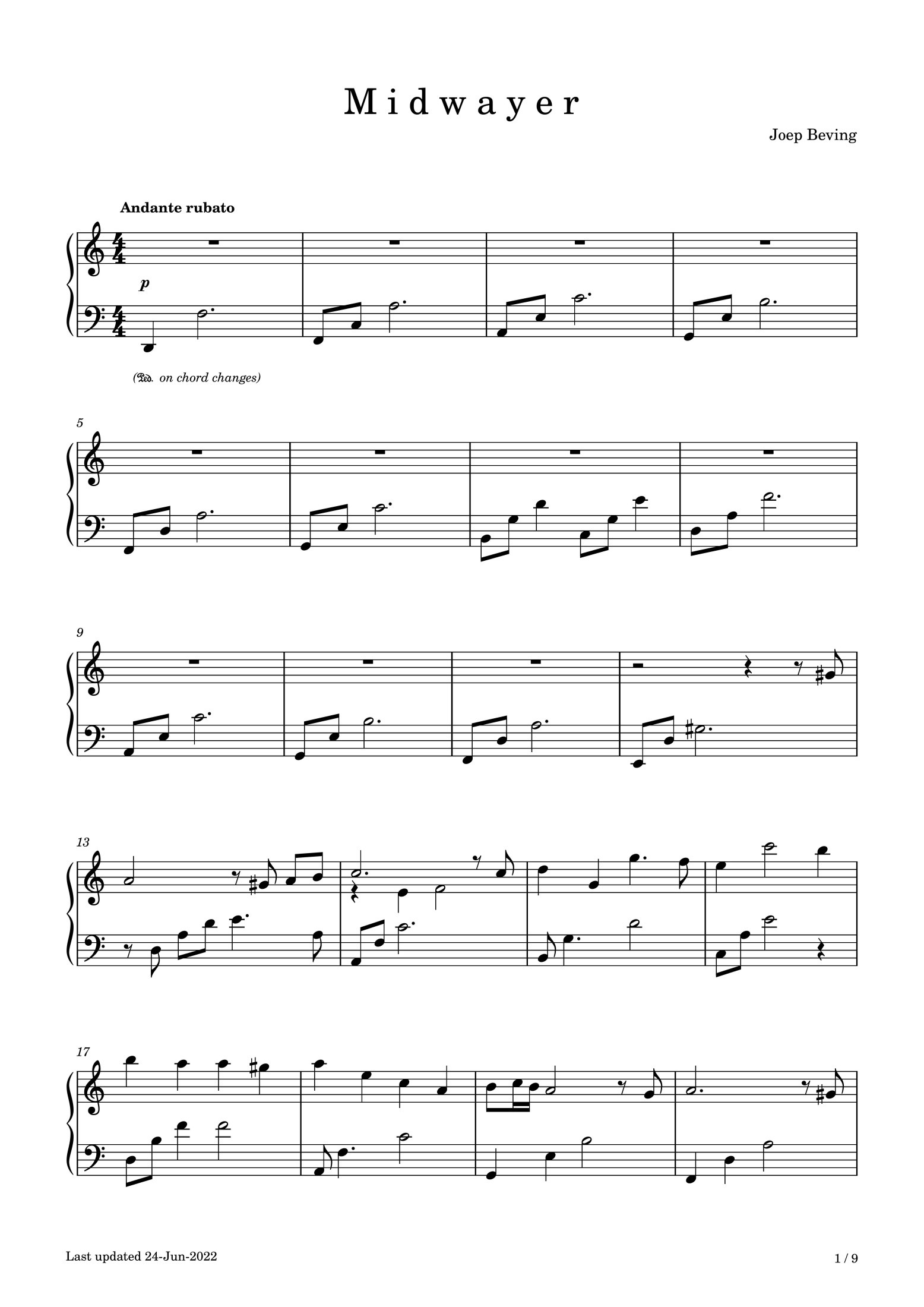
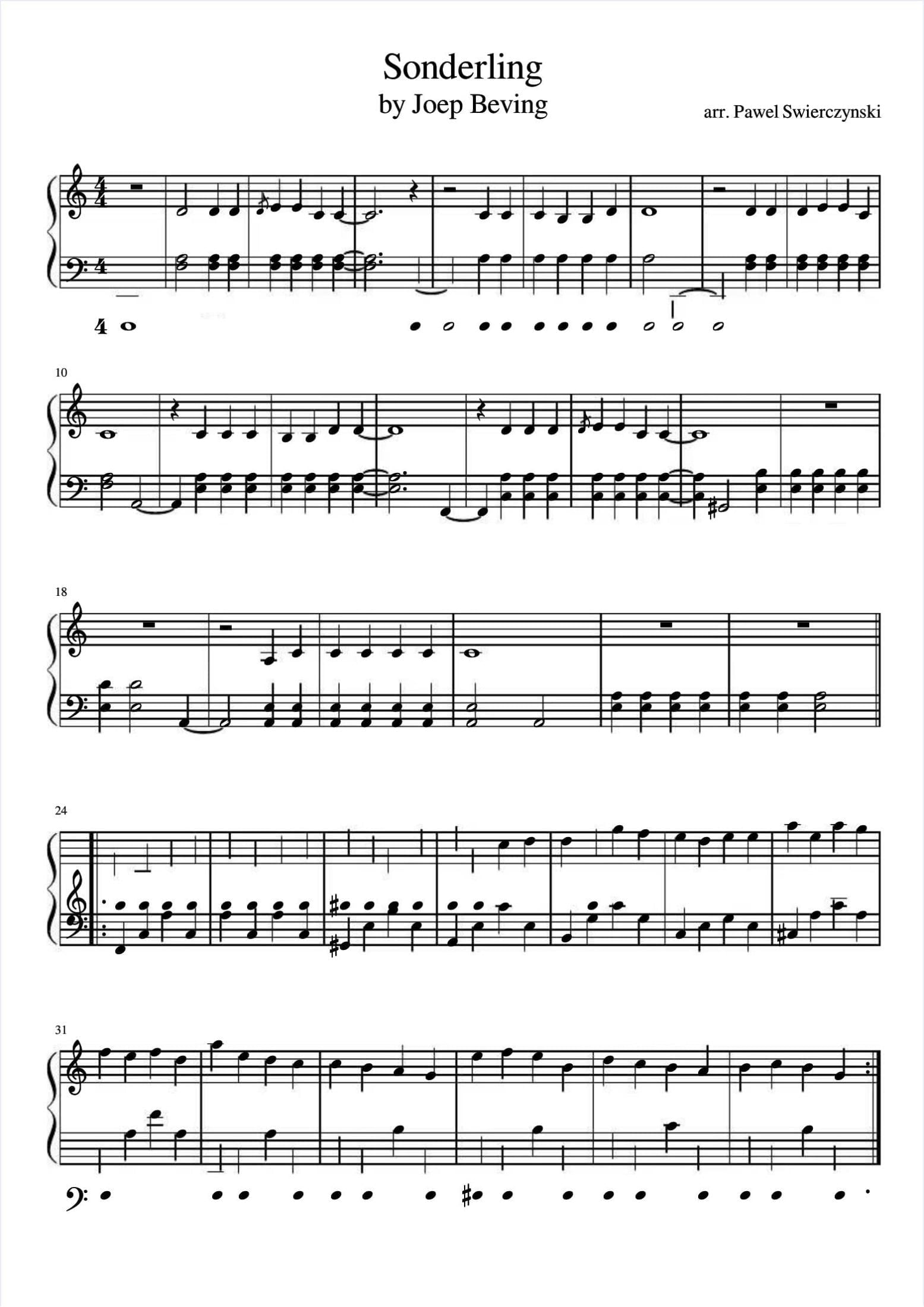
Joep Beving Sleeping Lotus Solipsism Piano Solo sheet music, Noten, partitura, spartiti, 楽譜, 乐谱
Discography
- Solipsism (2015)
- Prehension (2017)
- Conatus (2018)
- Henosis (2019)
- Trilogy (2021)
- Hermetism (2022)
- vision of contentment (2024)
- Liminal (2026)
List of released singles:
- For Mark (2022)
- Nocturnal (2022)
- Sinfonia (After Bach, BVW 248) (2021)
- Antoinette (From "Mijn vader is een vliegtuig") (2021)
- Sinfonia (2021)
- Ala (2019)
- Venus (2019)
- Unus Mundus (2019)
- Into the dark blue (2019)
- Prelude(2018)
- Hanging D (2018)
- Sonderling (2017)
- Ab Ovo (2017)
Musical style and influences
Joep Beving cites his musical influences as Bill Evans, Keith Jarrett, Philip Glass, Arvo Pärt, Chopin, Satie, Radiohead and Mahler. His favourite classical composers are Scriabin, Prokofiev (especially his 3rd Piano Concerto), Mahler, Brahms, Arvo Pärt, Peteris Vasks and Tigran Hamasyan.
Beving says his writing is free of rules. His music often follows a pop structure (AABA) but also takes inspiration from ambient, electronic and minimal classical music.
Browse in the Sheet Music Library:
Or browse in the categories menus & download the Library Catalog PDF: