
Scores for all instruments: 16,000+ (active and growing), over 236,000 pages.
All genres and levels: Jazz & Blues, Rock & Pop, Classical & Contemporary, Film & Musicals;
books & biographies; methods, études, play-along tracks (MP3) for Jazz & Rock.
Access & benefits: US$15.99 one-time payment, valid for lifetime, full Library access.
Table of Contents
The best sheet music download from our Library.
Please, subscribe to our Sheet Music Library. Sheet music should be accessible and affordable for all musicians, from professionals to absolute beginners.
Dmitri Shostakovich: The Voice of a Century Under Siege
Few composers in the history of Western music have lived a life as inextricably bound to the political cataclysms of their time as Dmitri Dmitrievich Shostakovich. Born in the twilight of the Russian Empire and dying in the stagnant dusk of the Soviet Union, Shostakovich created a vast and profoundly moving body of work that served simultaneously as a mirror to his era and as a deeply personal diary of artistic survival. His fifteen symphonies and fifteen string quartets stand as twin peaks of twentieth-century music, offering a window into the soul of a man forced to navigate the treacherous waters of Stalinist oppression, the horrors of war, and the moral compromises of existence under a totalitarian regime. More than any other composer, Shostakovich captured the agonies and struggles of Soviet citizens' daily lives, creating music of extraordinary power, expressiveness, and ambiguity that continues to fascinate and unsettle listeners to this day.
Search your favorite sheet music in the Sheet Music Library Catalog
Biography: From Privilege to Peril
Dmitri Shostakovich was born on September 25, 1906, in St. Petersburg, Russia, into a family that, while not aristocratic, occupied a comfortable position in pre-Revolutionary society. His father, Dmitriy Boleslavovich Shostakovich, was a chemical engineer who had attended St. Petersburg University, while his mother, Sofiya Vasilievna Kokoulina, had studied at the conservatory and was a gifted pianist. It was from his mother that the young Dmitri received his first piano lessons at the age of eight, and his prodigious talent quickly became apparent. The family was deeply musical, and Shostakovich's early exposure to the piano and to the great works of the classical repertoire laid the foundation for his future career.
Shostakovich's childhood unfolded against the backdrop of the Russian Revolution. He attended a private school from 1915 to 1919, where his classmates were the children of society's elite, and it was during this period that he first saw an opera—an experience that inspired him to devote himself seriously to music. By 1917, at the age of eleven, he was already composing short piano pieces, though most of these early efforts were unfortunately destroyed. The privations of the post-Revolutionary "War-Communism" era severely impacted the family's fortunes, and Shostakovich's mentor appealed to the authorities for ration cards and funds to support the young prodigy. During this difficult period, he developed tuberculosis of the lymph glands and was sent to a sanatorium in Gaspra, Crimea, where he recovered and developed a lifelong love of travel.
In 1919, at the age of thirteen, Shostakovich entered the Petrograd Conservatory, where he studied piano and composition. His teachers included Maximilian Steinberg, the son-in-law of Nikolai Rimsky-Korsakov, under whom he studied orchestration, harmony, form, and composition. His student years were marked by exceptional achievement; he graduated in 1925 with his First Symphony, Op. 10, which he had begun composing while still a teenager. The premiere of the First Symphony on May 12, 1926, was a major success, and it quickly became the first Soviet composition to enter the general musical repertory in the West. Aged only nineteen, Shostakovich was suddenly world-famous.
The years that followed saw Shostakovich emerge as a leading figure in Soviet musical modernism. He produced three ballets and two masterly operas: The Nose, Op. 15 (1928), and Lady Macbeth of the Mtsensk District, Op. 29 (1932). The latter, in particular, seemed to promise a brilliant career as an opera composer. However, in 1936, Stalin himself attended a performance of Lady Macbeth, and shortly afterward, the composer was publicly vilified in Pravda—most likely on the dictator's orders—as an "enemy of the people". The article denounced his music as "formalism," a term that would become a deadly weapon against countless Soviet artists. This event, which came to be known as the "Lady Macbeth affair," marked a turning point in Shostakovich's life. Faced with the machinery of destruction, he outwardly presented himself as repentant, consigning his experimental Fourth Symphony to the drawer and offering what appeared to be a more conformist work in the Fifth Symphony.
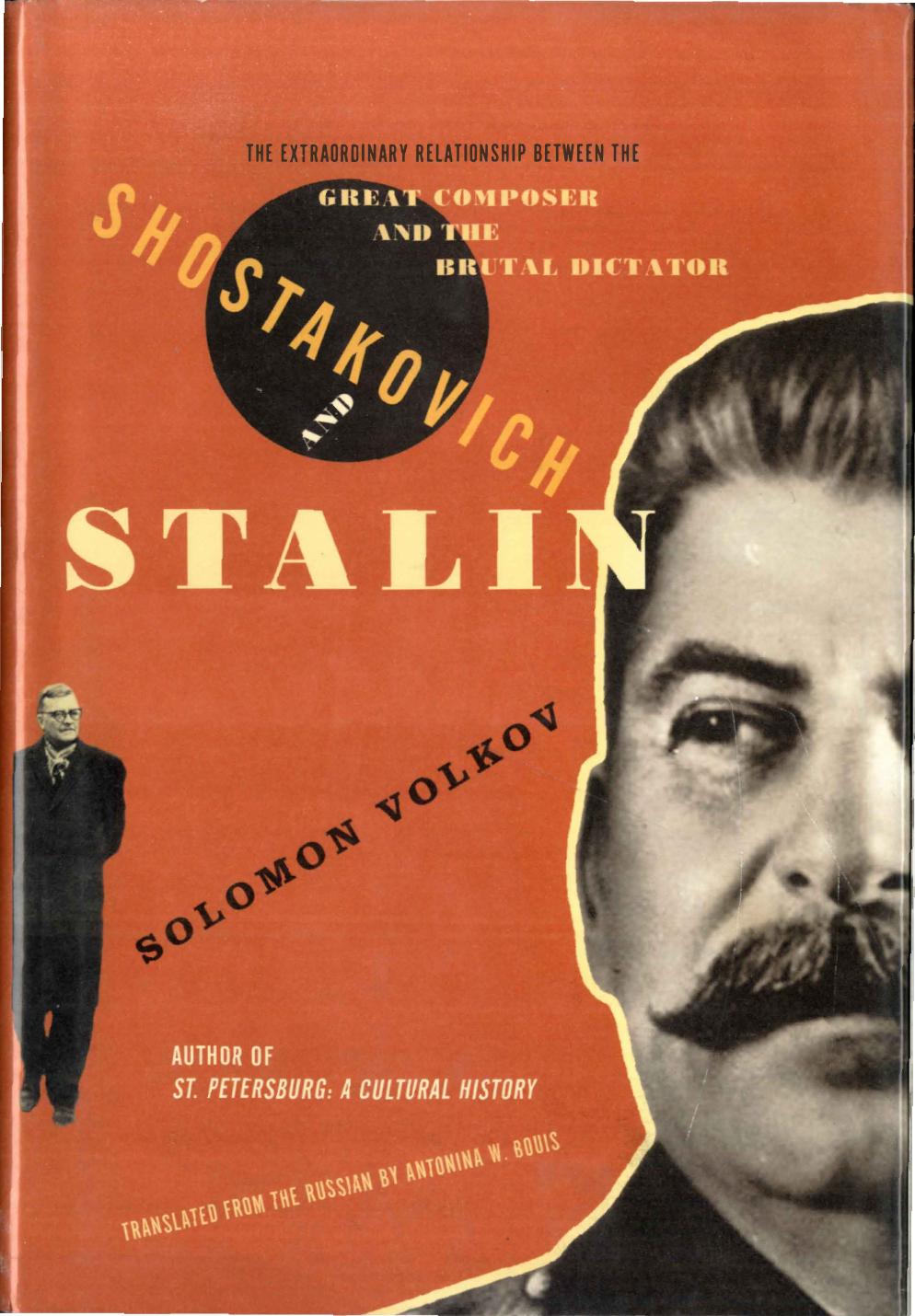

The war years brought both renewed danger and unprecedented recognition. The Seventh Symphony, Op. 60, written during the Siege of Leningrad in 1941, became a symbol of the wartime struggle throughout the Allied world. Yet in 1948, Shostakovich was again violently criticized and humiliated at the Soviet Composers' Congress. His works were banned, and he was politically and artistically isolated. In 1960, having withstood the attacks of 1936 and 1948, he gave in to pressure and joined the Communist Party—a capitulation that caused him profound personal misery and offended many of his friends and colleagues.
During this period of intense pressure, Shostakovich wrote, in just three days, his String Quartet No. 8, Op. 110, which he called "an obituary for myself". His final years were marked by unremitting ill-health, and he spent long periods in hospitals and sanatoria. The music of his final period—including his last two symphonies, his late quartets, and his Viola Sonata, Op. 147—is spare, dark, and reflective of deep anguish. He died in Moscow on August 9, 1975, having composed to the very end. Throughout his life, the official pressure he endured was evidenced by the fact that he destroyed almost all the letters he received, never kept a diary, and guarded his conversations with friends and family.
Musical Style and Technique: The Language of Ambiguity
Shostakovich's musical language is one of the most distinctive and immediately recognizable in the twentieth century. It is characterized by sharp contrasts, elements of the grotesque, and ambivalent tonality, drawing on a remarkably free and mobile yet steadfastly tonal idiom. At the heart of his style lies a fundamentally energetic type of pitch organization, a motive and mobile force that drives his music forward. Unlike many of his contemporaries who embraced full-blown serialism, Shostakovich remained rooted in tonality, but he expanded its possibilities in ways that were entirely his own.
His approach to form was generally conservative, often adhering to classical models. He typically wrote in four movements, with an allegro in sonata form, a slow second movement, a scherzo, and a brilliant finale. However, within these traditional frameworks, he played constantly with durational symmetry and asymmetry, balance and imbalance, stability and instability, creating a music of extraordinary dramatic tension. This tension between traditional form and disruptive content is one of the defining features of his style.
Shostakovich also cultivated his own form of "linearism," looking both directly to Paul Hindemith and to Hindemith's preferred source, Johann Sebastian Bach. The influence of neoclassicism manifested itself in his quotations of idioms from the baroque and Viennese classical periods, as well as in his use of pre-classical polyphonic forms such as the fugue and passacaglia. Yet he absorbed these influences into a personal language that was unmistakably his own. There are also characteristic devices that recur throughout his work, such as the glissando and the "wrong-note" waltz, which he used to create moments of grotesque irony.
Starting in the late 1960s, Shostakovich began using twelve-tone rows in many of his most significant compositions. His aggregate melodies often convey distinct zones of chromatic activity, diatonic activity, or a mixture of both, demonstrating a sophisticated engagement with serial techniques that remained integrated within his essentially tonal language.
Harmony: The Architecture of Dissonance
Shostakovich's harmonic language is perhaps the most idiosyncratic aspect of his style. Analysts have long noted that the most crucial lacuna in Western understanding of his music concerns his harmonic and tonal language. His harmony is characterized by what some scholars have called "non-integrative" harmony, meaning that it is largely based on idiomatic melodic progressions and harmonic turns that resist easy categorization.
One of the most distinctive features of his harmonic vocabulary is his use of symmetrical chromatic space. He creates passages that evoke the disruptive, nihilistic influence of dark powers through rootless diminished-seventh chords and linear segments, in which the four tritones interlock to create the eight-note octatonic scale. This use of octatonicism, along with other symmetrical divisions of the octave, gives his music a sense of instability and menace that is particularly effective in his darker works.
Shostakovich's aversion to tonicization is another important feature of his compositional language. He maintains harmonic function but alters its effect through mixture and voice leading, often avoiding the clear establishment of a tonal center. His harmonic progressions often proceed by maximally smooth cycles, in which he skips steps in the system of triadic relationships, using minor triads in ways that create a sense of continuous motion without clear resolution. This harmonic restlessness is one of the primary sources of the tension that pervades so much of his music.
The composer's harmonic language also draws on Russian Orthodox chant and the modal inflections of Mussorgsky, particularly in the works written after 1936. The Mussorgsky-like music written by Shostakovich in this period, with its austere diatonic palette, often sounds very similar to the original tunes of the Old Believers, a sect that Shostakovich learned much about through Mussorgsky's example. This engagement with archaic Russian musical traditions gave his music a deep sense of historical rootedness even as it grappled with the most contemporary of horrors.
Best Songs and Compositions: The Twin Cycles
Among Shostakovich's vast output, two cycles stand supreme: the fifteen symphonies and the fifteen string quartets. Together, these thirty works constitute one of the most significant bodies of music produced in the twentieth century, offering a comprehensive survey of the composer's artistic evolution and his responses to the tumultuous events of his life.
Of the symphonies, the Fifth, Op. 47 (1937), the Eighth, Op. 65 (1943), and the Tenth, Op. 93 (1953), have entered the standard repertoire everywhere. The Fifth Symphony is perhaps the most famous of all. Composed in 1937, at the height of Stalin's Purges, it is far more than a superb work of dramatic instrumental music—it is a subtle response to a time when artistic freedom could be life-threatening. The symphony follows the principle "Per aspera ad astra" (through hardship to the stars), symbolized in the tonal trajectory from D minor to D major. The first movement begins with several abruptly broken-off leaps of a sixth, a powerful gesture without goal or counterpart. The restrained, pallid main theme and an energetic secondary theme are led, in free variations, through an intense interplay of menace and paralysis. The second movement is a grotesque, dark ländler dance shaped by coarse rhythms, while the third movement is a broadly expansive Largo of delicate, fragile mourning. The finale is an aggressive march that drives the music onward, yet in the midst of the storm, moments of reflection and doubt intrude. The world premiere in November 1937 was a triumph, and the press hailed the work as a "creative response by a Soviet artist to justified criticism"—an interpretation that Shostakovich, at least publicly, never contradicted.
The Seventh Symphony, Op. 60 (1941), written during the Siege of Leningrad, became a symbol of the wartime struggle throughout the Allied world. The Eighth Symphony, Op. 65 (1943), is a vast, dark, and deeply pessimistic work that many consider to be one of his greatest achievements. The Tenth Symphony, Op. 93 (1953), composed in the months following Stalin's death, is one of Shostakovich's most personal works, its self-expression rivalling the string quartets into which he channeled most of his inner conflicts. The modernist Fourth Symphony, Op. 43 (1936), long suppressed by the Soviet authorities, is now recognized as a masterpiece. The Thirteenth Symphony, Op. 113 (1962), for bass, chorus, and orchestra, is a campaigning work from the period of Khrushchev's Thaw, setting poems by Yevtushenko condemning anti-Semitism and injustice. The Fourteenth Symphony, Op. 135 (1969), and the Fifteenth Symphony, Op. 141 (1971), reveal a composer in his final period, writing music that is spare, dark, and profoundly reflective.
Among the string quartets, the Eighth Quartet in C minor, Op. 110 (1960), is by far the most famous. It was written in just three days while Shostakovich was in Dresden, surrounded by the devastation of a city still ravaged by the war. The quartet is built almost entirely on the DSCH motif—a musical cryptogram derived from the composer's own name, in which the letters D, E-flat, C, and B correspond to the German notation D, Es, C, H. The composer inserts a selection of self-quotations from earlier compositions at significant points along the score, creating a deeply autobiographical work that has been called "an obituary for myself". The quartet is in five movements played without pause, beginning with a fugal lament on the DSCH motif and culminating in a devastating conclusion. Its popularity far exceeds any of the other quartets, and it has become one of the most performed works in the entire chamber music repertoire.
Other notable works include the Piano Trio No. 2 in E minor, Op. 67 (1944), a deeply moving work written in memory of a close friend, and the Violin Concerto No. 1 in A minor, Op. 77 (1947-48), one of the great violin concertos of the twentieth century. The Cello Concerto No. 1 in E-flat major, Op. 107 (1959), written for Mstislav Rostropovich, is a brilliant and sardonic work that has become a staple of the cello repertoire. The opera Lady Macbeth of the Mtsensk District, despite the controversy it provoked, remains one of the most powerful operas of the twentieth century, a work of savage satire and profound emotional depth.
Music in Films: The Cinematic Collaborator
Shostakovich's engagement with cinema was lifelong and deeply significant. He was involved with Soviet film music from the beginning, first as a silent film pianist, then scoring New Babylon in 1929, a film about the Paris Commune. Over the course of his career, he wrote almost forty film scores, making him one of the most prolific composers for cinema in the Soviet Union.
His most important cinematic collaboration was with the director Grigori Kozintsev. Together, they worked on numerous films, including Hamlet (1964) and King Lear (1970), both of which feature scores of remarkable depth and dramatic power. Shostakovich's score for Hamlet is particularly notable for its dark, brooding atmosphere, capturing the psychological complexity of Shakespeare's tragedy. The Gadfly suite, drawn from his score for the 1955 film, has become a popular concert work, particularly the "Romance" movement, which showcases the composer's lyrical gift at its most accessible.
Another significant collaboration was with the director Leo Arnshtam, with whom Shostakovich worked on three women's war films: Podrugi (1935-36, Girlfriends), Zoya (1944), and Sof'ya Perovskaya (1967-68). Beginning with Podrugi, the director and composer sought to construct Soviet femininity in response to current cultural politics, providing cinematic examples of the New Soviet Woman within the emerging revolutionary war film genre. The scores to these films buttress the construction of the Soviet woman using musical cues that simultaneously narrate war and femininity, from military brass topoi and nationalist borrowings to original underscoring.
Shostakovich also collaborated with Mikhail Tsekhanovsky, one of the initiators of Russian animated film, on several cartoons and musical film-fairytales aimed primarily at children—the only director with whom he worked in these genres. His score for Five Days – Five Nights (1960), written while he was in Dresden, was composed during the same period as his String Quartet No. 8 and shares its dark, introspective character.
The composer's film music often served as a laboratory for ideas that would later appear in his concert works, and many of his film scores have been arranged into popular concert suites that continue to be performed. His ability to write music that served the dramatic needs of a film while maintaining its own artistic integrity is a testament to his remarkable versatility.
Collaborations with Other Musicians: The Interpretive Circle
Shostakovich worked closely with some of the greatest performers of his time, and these relationships profoundly shaped his compositional output. The violinist David Oistrakh was one of his most important collaborators; Shostakovich wrote two violin concertos for him, and Oistrakh's interpretations of these works have become definitive. The composer expressed immense enjoyment in working with Oistrakh, whom he described as a superb musician who performed his Violin Concerto wonderfully.
The cellist Mstislav Rostropovich was another crucial collaborator. The fruitful collaboration between the two artists and friends culminated in two cello concertos, the first written in 1959 and the second in 1966. Rostropovich's performances of these works, along with his recording of the Cello Sonata, helped establish them as cornerstones of the cello repertoire.
The Beethoven Quartet was Shostakovich's preferred quartet formation, and the ensemble was the first performer of almost all of his string quartets. Many of these works were dedicated to the members of the quartet. This close relationship between composer and performers ensured that the quartets were interpreted with deep understanding and sensitivity.
The conductor Evgeny Mravinsky premiered many of Shostakovich's orchestral works, including the Fifth Symphony, and his interpretations helped establish these works in the repertoire. The pianist Sviatoslav Richter was another important interpreter of Shostakovich's music, and the composer admired his playing greatly. The violist Fyodor Druzhinin had a significant creative partnership with Shostakovich, particularly in relation to the Viola Sonata, Op. 147, one of the composer's final works.
Influences and Legacy: The Long Shadow
Shostakovich's influences were diverse and profound. He was heavily influenced by neoclassicism and by the late Romanticism of Gustav Mahler. The influence of Mussorgsky was particularly important, both in terms of harmonic language and in the engagement with Russian folk and religious traditions. Bach was another crucial influence, particularly in Shostakovich's use of polyphonic forms such as the fugue and passacaglia. The shadows of Beethoven and Tchaikovsky are also evident, particularly in the Fifth Symphony, where Shostakovich engaged with more conservative models as required by Socialist Realist aesthetics.
The legacy of Shostakovich is immense and multifaceted. His affinity for regular and repetitive rhythmic and melodic patterns based on sparse archaic ritualistic formulas was inherited by Russian minimalist composers, creating a direct line of influence from his work to later generations. His influence on subsequent composers, including Alfred Schnittke, has been profound; it is now recognized that music has been under the influence of Shostakovich for more than fifty years. When Shostakovich's images of his own musical past meet up in collages with images from the history of music, an astonishing effect of objectivization occurs, a technique that later composers would adopt and develop.
Shostakovich's reputation has continued to grow after his death. Scholarly interest has increased significantly since the late twentieth century, and his music is now recognized as one of the supreme achievements of the twentieth century. Some scholars have argued that Shostakovich will eventually overtake Schoenberg and Stravinsky for recognition as "the most consequential composer of the twentieth century". Unlike any other Russian composer, Shostakovich captured and expressed the agonies and struggles of Soviet citizens' daily lives during Stalinist oppression, and it is this extraordinary power and expressiveness that has reached cult proportions.
His status in the West has always been problematic; he has been regarded by some as a collaborator and by others as a symbol of moral resistance. This ambiguity is, in many ways, central to his legacy. The composer who was forced to publicly repent for his "formalism" and who eventually joined the Communist Party under pressure also wrote some of the most searing indictments of totalitarianism ever composed. The man who guarded his conversations and destroyed his letters also left behind a body of work that speaks with unparalleled eloquence about the human condition under extreme duress.
Additional Information: The Enigma of the Man
Shostakovich's personal life was as complex and fraught as his artistic career. He married three times: first to Nina Varzar in 1932, then after their divorce to Margarita Kainova, and finally to Irina Supinskaya. His family life was complicated by the political pressures under which he lived, and his son Maxim became a conductor who championed his father's music.
The composer's relationship with the Soviet authorities remains a subject of intense scholarly debate. He was publicly denounced twice—in 1936 and 1948—and his works were banned and he was politically and artistically isolated. Yet he also wrote works that were explicitly patriotic, such as the Seventh Symphony, which became a symbol of Soviet resistance during the war. The question of how much of his music was sincere and how much was forced accommodation is one that continues to fascinate historians and musicologists. His previously unknown letters to Stalin have shed new light on his position within the Soviet artistic elite, revealing the complex negotiations he undertook to survive as an artist under a regime that had no tolerance for genuine creative freedom.
Shostakovich's health was a constant concern throughout his adult life. The tuberculosis of the lymph glands he contracted in his youth recurred periodically, and in his later years he suffered from a debilitating muscle weakness that made it increasingly difficult for him to write. The music of his final period—spare, dark, and profoundly introspective—reflects the physical and psychological anguish he endured.
One of the most remarkable aspects of Shostakovich's career is the sheer quantity of music he produced under conditions of extreme pressure. He wrote fifteen symphonies, fifteen string quartets, two operas, three ballets, seven theatre scores, nine film scores, and numerous concertos, chamber works, and vocal cycles. His ability to compose at speed, often completing major works in a matter of weeks or even days, was legendary. The String Quartet No. 8, written in three days, is perhaps the most astonishing example of this capacity for concentrated creation.
Shostakovich's music continues to be performed and recorded extensively around the world. His symphonies and string quartets are staples of the concert repertoire, and his film scores, particularly the suites drawn from them, are frequently heard in concert halls. The DSCH motif—the musical cryptogram of his name—has become one of the most recognizable musical signatures in the history of the art form, a poignant reminder of the man who created it and the turbulent world in which he lived.
In the end, Dmitri Shostakovich remains an enigma. He was a composer who wrote music of extraordinary beauty and profound darkness, a man who navigated the most dangerous political waters imaginable with a combination of courage, pragmatism, and cunning. His music speaks to us across the decades with a power that has not diminished with time, offering a testament to the resilience of the human spirit and the enduring capacity of art to illuminate even the darkest corners of human experience. As the Russian weekly newspaper Moskovskiye Novosti observed on the occasion of his centenary in 2006, "To relive the history of our country between 1930 and 1970, it is enough to listen to Shostakovich's symphonies". That is perhaps the most fitting tribute to a composer whose life and work were so intimately intertwined with the history of his time—and whose music continues to speak with such urgency to our own.
Browse in the Sheet Music Library:
Or browse in the categories menus & download the Library Catalog PDF: