
Table of Contents
Scores for all instruments: 16,000+ (active and growing), over 236,000 pages.
All genres and levels: Jazz & Blues, Rock & Pop, Classical & Contemporary, Film & Musicals;
books & biographies; methods, études, play-along tracks (MP3) for Jazz & Rock.
Access & benefits: US$15.99 one-time payment, valid for lifetime, full Library access.
Who was Yusuf Cat Stevens?

The best sheet music download from our Library.
Cat Stevens: A Comprehensive Biography
Few artists have traversed a path as extraordinary as Cat Stevens. Born Steven Demetre Georgiou, he rose from teen idol to folk-rock superstar, selling over 100 million records and accumulating more than two billion streams. His introspective songwriting, distinctive guitar style, and gentle vocal delivery defined the 1970s singer-songwriter movement. Then, at the peak of his fame, he walked away from music entirely, embracing a new faith and devoting decades to humanitarian work. His eventual return, and the ongoing reconciliation of his secular and spiritual identities, has cemented his reputation as one of the most fascinating and enduring figures in popular music.

Please, subscribe to our Sheet Music Library.
Early Life
Cat Stevens was born Steven Demetre Georgiou on July 21, 1948, in London, England, the youngest of three children. His father, Stavros Georgiou, was a Greek Cypriot, and his mother, Ingrid Wickman, was a Swedish Baptist who converted to Greek Orthodoxy upon her marriage. The family lived above their restaurant, the Moulin Rouge on Shaftsbury Avenue, a landmark in London’s West End. Growing up amidst the glitz of the theatre district and the aromas of the family business, Stevens was exposed to a vibrant cultural melting pot from an early age. His first musical instrument was the family piano, which he taught himself to play, often practicing while his parents worked below.
Although raised Greek Orthodox, Stevens was sent to a Roman Catholic school, a combination of religious influences that he later said instilled a strong moral conscience but also gave him an early, misguided distrust of Islam. At the age of eight, his parents divorced but continued to cohabitate, a domestic arrangement that deepened the young Steven’s introspective nature.
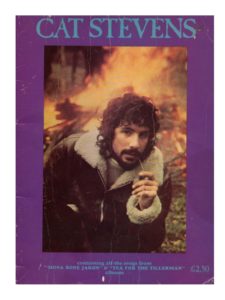
In 1963, the 15-year-old Stevens fell in love with the music of The Beatles. The band’s infectious energy and melodic sophistication ignited a passion for the guitar. He convinced his father to buy him his first guitar and quickly began writing his own songs. A year later, while attending Hammersmith Art College to study painting and cartooning (inspired by his uncle, a well-known Swedish painter), he made his folk music debut at the Black Horse, a local bar, performing under the stage name Steve Adams.
The 1960s: Teen Idol and Early Stardom
Stevens’ determination to succeed was immediate. After dropping out of art school to focus on music, he took a demo of his songs to Denmark Street, London’s legendary “Tin Pan Alley.” A publishing deal with Ardmore & Beechwood followed, and it was during this period that he wrote “The First Cut Is the Deepest,” a song he sold to soul singer P.P. Arnold for just $40.
Discovered by record producer Mike Hurst, Stevens was signed to Deram Records (a subsidiary of Decca). He adopted the stage name Cat Stevens—partly because a girlfriend thought he had eyes like a cat—and in 1966 released his first single, “I Love My Dog,” which became a UK Top 40 hit.
His debut album, Matthew and Son (1967), was a polished collection of baroque pop and rock, with the title track reaching No. 2 on the UK charts. The album also included “Here Comes My Baby,” which became a hit for The Tremeloes, further establishing Stevens as a gifted songwriter. A second album, New Masters, followed later that year, but the relentless pressure of touring, recording, and media commitments took its toll. Struggling with depression and using alcohol as a coping mechanism, the 19-year-old collapsed in 1968.
The Turning Point: Tuberculosis and Spiritual Awakening
Diagnosed with tuberculosis, Stevens spent three months in a hospital sanatorium and endured an extended period of convalescence. The experience became a pivotal turning point. Confined to bed and given time to think, he reflected on his fast-paced, hedonistic lifestyle and began questioning the meaning of his career. “I wasn’t too worried about what people thought, people would get to understand, gradually, I said to myself. After all, everybody knew I was ‘on the road to find out’,” he would later recall.
Upon his recovery, Stevens had written over 40 new songs. His perspective had deepened, and his musical approach had transformed. Shedding the polished pop sound of his first albums, he embraced a stripped-down, intimate folk-rock style that would define his mature work. Determined to regain creative control, he signed with Island Records and began working with producer Paul Samwell-Smith (formerly of The Yardbirds). The result was Mona Bone Jakon (1970), a raw and confessional album that introduced the world to the new Cat Stevens. The album’s lead single, “Lady D’Arbanville” —a stark, mournful ballad about his recent breakup with actress Patti D’Arbanville—signaled a profound artistic maturation.
The 1970s Golden Era: Mega-stardom
With his direction clarified, Stevens entered what would become his most commercially successful and critically celebrated period.
Tea for the Tillerman (1970)
This landmark album became the archetype of the early 1970s singer-songwriter style. Featuring classics such as “Wild World,” “Father and Son,” “Hard Headed Woman,” and “Where Do the Children Play?” , the album paired profound, often searching lyrics with Stevens’ signature fingerpicked acoustic guitar. “Wild World” became his first major US hit, climbing to No. 11 on the Billboard Hot 100, and the album earned gold certification.
Teaser and the Firecat (1971)
If Tillerman was Stevens’ artistic breakthrough, Teaser and the Firecat was his global coronation. The album was certified triple platinum in the US and produced some of his most beloved songs: “Moonshadow,” the spiritual anthem “Peace Train,” and a haunting rendition of the traditional hymn “Morning Has Broken,” which featured a now-legendary piano performance from Rick Wakeman. The album’s warm, layered production and Stevens’ increasingly confident songwriting made it an inescapable presence on 1970s radio.
Catch Bull at Four (1972)
Riding a wave of momentum, Stevens released Catch Bull at Four, an album that saw him experimenting with more rock-oriented arrangements. The album was an immediate phenomenon, selling half a million copies in its first two weeks and spending three weeks at No. 1 on the Billboard 200, making it his most successful American release.
Musical Expansion and Continued Success
In 1974, Stevens released Buddha and the Chocolate Box (featuring the hit “Oh Very Young” ), followed by Numbers (1975), a conceptual album based on a fantasy story he had written. His 1977 album, Izitso, showcased his willingness to evolve, updating his folk-rock foundation with extensive synthesizers, anticipating elements of electronic rock and synthpop.
During this period, Stevens also forged a deeply creative partnership with guitarist Alun Davies. Their intuitive interplay became a hallmark of his sound, with observers noting they played “like one brain with four hands” —a telepathic musical bond rarely seen.
Conversion to Islam and Retirement (1977–1979)
Despite his enormous success, Stevens’ spiritual search, which had begun during his tuberculosis recovery, intensified throughout the 1970s. He had explored Buddhism, transcendental meditation, and various mystical traditions.
The decisive moment came in 1975 while swimming off the coast of Malibu, California. A dangerous riptide began pulling him out to sea. Fearing for his life, he cried out to God, promising to dedicate his life to divine service if he were saved. A gentle wave delivered him to shore. Shortly thereafter, his brother David, who had converted to Islam, gave him a copy of the Qur’an. Deeply moved by what he read, Stevens formally converted to Islam on December 23, 1977.
The following year, he adopted the name Yusuf Islam—Yusuf being the Arabic equivalent of Joseph, a prophet for whom Stevens felt a powerful affinity. In 1979, he famously auctioned all his guitars for charity, publicly announcing that he would no longer perform secular music. He left behind a mansion, a superstar lifestyle, and a recording career at its absolute peak to devote himself to education and philanthropic causes within the Muslim community, including founding a Muslim primary school in North London and co-founding the charity Muslim Aid.
The Return to Music
For nearly three decades, Yusuf Islam performed only music that conformed to his religious beliefs, primarily releasing Islamic devotional albums. However, the 2004 Indian Ocean tsunami disaster inspired him to write a song of compassion, leading to a gradual return to the public eye.
In 2006, he made a full-fledged return to pop music with An Other Cup, his first new album of secular pop songs in 28 years. Subsequent albums, including Roadsinger (2009), Tell ‘Em I’m Gone (2014) , and The Laughing Apple (2017) , saw him gradually reconciling his two identities, often credited as Yusuf / Cat Stevens. In 2020, he released Tea for the Tillerman 2, a complete reimagining of his 1970 classic, rerecording the songs with a modern perspective while preserving their original spirit.
Notable Musical Collaborations and Relationships
Cat Stevens’ career has been marked by significant artistic relationships that have shaped his sound and legacy. His long-standing partnership with guitarist Alun Davies stands as one of rock’s most intuitive musical collaborations, with the pair developing an almost telepathic interplay on stage and in the studio. Stevens also shared a close working relationship with producer Paul Samwell-Smith, whose production on Mona Bone Jakon, Tea for the Tillerman, and Teaser and the Firecat helped define Stevens’ signature sound.
As a songwriter, Stevens made an indelible mark by penning hits for other artists. The Tremeloes scored a major hit with his “Here Comes My Baby” in 1967. P.P. Arnold’s recording of “The First Cut Is the Deepest” brought the song to prominence, and the tune has since been a hit for multiple artists, including Rod Stewart and Sheryl Crow. Jimmy Cliff gave “Wild World” a reggae reading, while Boyzone revived “Father and Son” for a new generation in the 1990s.
Stevens’ musical influences are diverse, ranging from early British Invasion bands to more eclectic sources. He has cited the Beatles, the Rolling Stones, the Kinks, Bob Dylan, Nina Simone, Lead Belly, Muddy Waters, Leo Kottke, and Paul Simon as inspirations. In turn, his folk-based palette—marked by intricate fingerpicked guitar, intimate delivery, and heart-on-sleeve lyrics—has influenced artists as varied as Stevie Nicks and James Blunt.
An Analysis of Musical Style
Cat Stevens’ music is built on a foundation of folk-rock but incorporates elements of pop, rock, and even medieval-inspired arrangements.
Harmonic and Chordal Approach
Stevens’ guitar playing is characterized by its rhythmic drive and inventive chord voicings. He often uses open tunings and fingerpicking techniques to create a rich, multi-layered sound. His chord progressions, while often simple on the surface, possess an unexpected sophistication that elevates his songs.
Consider “The First Cut Is the Deepest.” The song primarily uses three chords: G, D, and C. However, the verse progression is not a simple loop. It follows a G-D-C-D pattern before switching to G-C-D-C, creating a subtle variation that keeps the harmony fresh and engaging.
“Wild World” offers another fascinating harmonic study. The verse sequence centers on A minor, but the introduction of a D (or D7) chord creates a secondary dominant effect, briefly suggesting G major as a temporary tonic before returning to the minor key. As one analysis notes, “Although the verse is A minor in the end, overall, it begins as if in G major,” giving the song a unique harmonic ambiguity that contributes to its emotional depth. This kind of clever harmonic device—borrowing chords from related keys, using secondary dominants, and employing modal mixture—became a trademark of Stevens’ mature writing, allowing him to shift emotional registers within a single song.
Melodic and Rhythmic Signatures
Stevens’ melodies are often modal, drawing on folk traditions, and his phrasing is idiosyncratic. He has a tendency to place unexpected accents, creating syncopated rhythms that give his songs a lilt. His vocal delivery is gentle, clear, and emotionally direct—what one critic called a “sweetly soulful singing” style that became instantly recognizable. Lyrically, his work evolved from the simplistic romanticism of his early pop songs to deeply philosophical and spiritual themes. His songs grapple with existence, faith, love, loss, environmental consciousness, and the search for meaning, all delivered with a poetic, often allegorical touch.
His arrangements were equally distinctive. The core sound was built around two or three acoustic guitars (often with one tuned to an open chord), a piano, upright bass, and subtle percussion. Flutes, strings, and orchestral flourishes were used sparingly, adding color without overwhelming the intimate core of the music.
Influences
As a child, Stevens was drawn to the stirring Greek folk songs of his father’s homeland, but as a teenager, he fell under the spell of rock & roll and the burgeoning folk revival. He has named The Beatles as a primary inspiration—it was their music that prompted him to pick up the guitar. He also absorbed the rhythmic and lyrical directness of early Rolling Stones, the melodic unpredictability of The Kinks, and the confessional intimacy of Bob Dylan and Paul Simon.
Other key influences include the blues of Lead Belly and Muddy Waters, the soulful intensity of Nina Simone, and the virtuosic acoustic guitar playing of Leo Kottke. Additionally, the intricate fingerpicking and emotional vulnerability of Joni Mitchell and Ralph McTell shaped his own artistic development.
Legacy and Cultural Impact
Cat Stevens’ influence on popular music is profound. He is widely regarded as one of the quintessential singer-songwriters of his era, an artist who helped define the introspective, acoustic-driven sound that dominated the early 1970s. His songs have been covered by a staggering range of artists, from Dolly Parton to Rod Stewart, from Sheryl Crow to Boyzone, a testament to their enduring emotional power.
His legacy extends beyond commercial success. His music has been a source of solace and spiritual searching for generations. The themes he explored—peace, compassion, environmental stewardship, the search for truth—remain urgently relevant. In 2014, his contributions to music were officially recognized when he was inducted into the Rock and Roll Hall of Fame. He has also received the Ivor Novello Award for Outstanding Song Collection and multiple humanitarian awards, including the World Award and the Man for Peace Award.
Works in Film
While his songs have been featured in countless films and television shows, one cinematic collaboration stands above all others: Hal Ashby’s 1971 cult classic Harold and Maude. Director Hal Ashby fell in love with Tea for the Tillerman and Mona Bone Jakon during the film’s editing, using Stevens’ songs as a temporary score. He ultimately decided to make the music permanent. The film features nine Cat Stevens songs, including the specially written “If You Want to Sing Out, Sing Out” and “Don’t Be Shy,” both performed on-screen by actress Ruth Gordon. The soundtrack’s gentle, uplifting folk-pop served as a perfect counterpoint to the film’s darkly comedic and ultimately life-affirming story. A 50th-anniversary reissue of the soundtrack was released to celebrate the film’s enduring legacy.
Beyond Harold and Maude, Stevens’ music has appeared in films such as The Little Prince (1974), for which he contributed songs, and numerous documentaries and television programs.
Discography
Studio Albums
As Cat Stevens:
- Matthew and Son (1967)
- New Masters (1967)
- Mona Bone Jakon (1970)
- Tea for the Tillerman (1970)
- Teaser and the Firecat (1971)
- Catch Bull at Four (1972)
- Foreigner (1973)
- Buddha and the Chocolate Box (1974)
- Numbers (1975)
- Izitso (1977)
- Back to Earth (1978)
As Yusuf Islam / Yusuf / Yusuf / Cat Stevens:
- The Life of the Last Prophet (1995)
- I Have No Cannons That Roar (1998)
- Prayers of the Last Prophet (1999)
- A Is for Allah (2000)
- I Look, I See (2003)
- Indian Ocean (2005)
- An Other Cup (2006)
- Roadsinger (2009)
- Tell ‘Em I’m Gone (2014)
- The Laughing Apple (2017)
- Tea for the Tillerman 2 (2020)
- King of a Land (2023)
Most Known Compositions and Performances
Essential Songs
- “Wild World” – His breakthrough US hit, a bittersweet farewell to a lover.
- “Father and Son” – A poignant dialogue about generational conflict.
- “Peace Train” – An uplifting anthem for global harmony.
- “Moonshadow” – A whimsical, resilient meditation on fortune.
- “Morning Has Broken” – A reverent arrangement of a traditional hymn.
- “The First Cut Is the Deepest” – A standard covered by numerous artists.
- “Oh Very Young” – A beautiful reflection on innocence and growth.
- “Where Do the Children Play?” – An early ecological commentary.
- “Hard Headed Woman” – A rich, storytelling track.
- “Lady D’Arbanville” – A stark, poignant ballad from Mona Bone Jakon.
Key Live Performances
- Majikat: Earth Tour 1976 – A concert film capturing Stevens at the peak of his powers, featuring many of his biggest hits.
- Tea for the Tillerman Live (1971) – An intimate television performance at KCET Studios in Los Angeles, performing songs from his most celebrated album.
- Yusuf’s Café Session (2007) – A live DVD from his comeback era, blending new songs from An Other Cup with old favorites.
- Santa Monica Civic Auditorium (1971) – A widely bootlegged performance considered one of his finest live recordings.
Documentaries and Biographical Films
Several documentaries explore Cat Stevens’ remarkable life:
- Cat Stevens: A True Story (2005) – An ABC television documentary exploring Yusuf Islam’s humanitarian work, focusing on his campaigns for orphans and refugees in the Balkans.
- Yusuf’s Café Session – Live at the Porchester Hall (2007) – Part concert film, part documentary, offering insight into his return to music.
- Cat Stevens (2010) – A feature-length biography attempting to untangle the “real story” of Cat Stevens from the controversies surrounding his name.
- The Artist Formerly Known as Cat Stevens – A BBC documentary presented by Alan Yentob, telling the story of the singer who captured the hearts of a generation in the 1960s and 1970s.
- Island Records: The Allstar Story – Includes an exclusive interview with Yusuf Islam at an Islamic community in England, discussing his departure from stardom.
- The Life of the Last Prophet (1995) – A documentary short in which Yusuf Islam narrates the story of the Prophet Muhammad and reflects on his own life.
Philanthropy and Religious Life
Throughout his decades away from pop music, Stevens devoted himself entirely to his faith and charitable causes. He helped found Muslim Aid and participated in relief initiatives across Africa, Asia, and Europe. In 1983, he founded a Muslim primary school in North London; by 1998, the school became the first Muslim school in the UK to receive grant-maintained status. Alongside his wife Fauziah, he established Small Kindness, a charity focused on aiding orphans, widows, and families devastated by conflict in the Balkans. Today, Small Kindness continues its work with victims of humanitarian disasters around the world.
Cat Stevens—now Yusuf / Cat Stevens—has lived several lifetimes in one. He was a 1960s pop hitmaker, a 1970s folk-rock superstar, a spiritual seeker who walked away from fame at its apex, a devoted philanthropist and educator, and finally, a returning artist reconciling his past with his present. His music remains a cornerstone of popular culture: timeless, evocative, and deeply human. He stands as a testament to the transformative power of both art and faith, and to the possibility of a life lived in pursuit of a better world.