Table of Contents
The Best of Arvo Pärt: The Collection
Tracklist:
0:00:00 Spiegel im Spiegel for Violin & Piano played by Benjamin Hudson & Jürgen Kruse 0:10:22 Für Alina played by Jürgen Kruse 0:13:53 Spiegel im Spiegel for Cello & Piano played by Sebastian Klinger & Jürgen Kruse 0:23:26 Tabula Rasa: II. Silentium played by Hatfield Leslie, Hirsch Rebeccca, Ulster Orchestra & Yuasa Takuo 0:38:08 Fratres for String Quartet played by Hungarian State Opera Orchestra & Benedek Tamás 0:46:49 Cantus in Memory of Benjamin Britten played by Hungarian State Opera Orchestra & Benedek Tamás 0:54:29 Berliner Messe: VIII. Agnus dei played by Daniel Justin, Leeds Cathedral Choir & Benjamin Saunders 0:56:27 Bogoróditse Djévo played by Elora Festival Singers & Noel Edison 0:57:51 Für Anna Maria played by Jeroen van Veen 0:59:12 Partita Op. 2: IV. Ostinato played by Jeroen van Veen
Search Arvo Pärt’s best sheet music, books and transcriptions in the Library:
| Artist or Composer / Score name | Cover or sample | Contents (if available)* |
|---|---|---|
| Agnes Obel Broken Sleep From Myopia | Agnes Obel Broken Sleep From Myopia | |
| Agnes Obel Chord Left |  | |
| Agnes Obel Fuel To Fire |  | |
| Agnes Obel Island Of Doom From Myopia | Agnes Obel Island Of Doom From Myopia | |
| Agnes Obel Pass Them By | 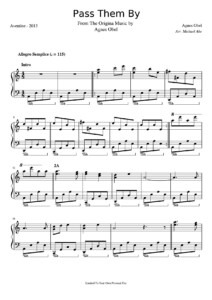 | |
| Agnes Obel – Riverside Piano | 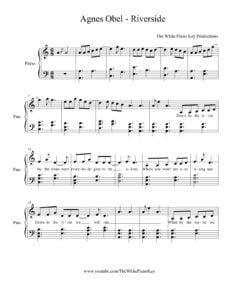 | |
| Agnes Obel – September Song |  | |
| Agnes Obel – Tokka |  | |
| Agnes Obel Citizen of Glass Songbook (piano solo) | 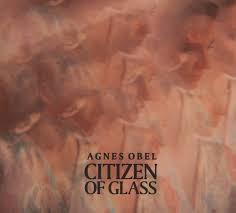 | Agnes Obel Citizen Of Glass |
| Agnes Obel Falling Catching | 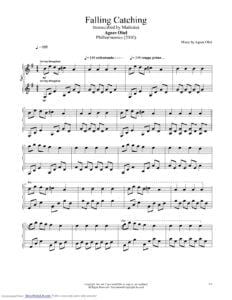 | |
| Agnes Obel Falling, Catching |  | |
| Agnes Obel Familiar |  | |
| Agnes Obel Fuel To Fire |  | |
| Agnes Obel It’s Happening Again |  | |
| Agnes Obel Just So | 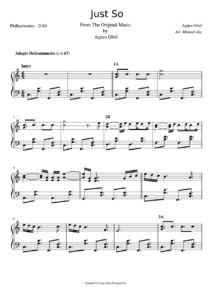 | |
| Agnes Obel Mary |  | |
| Agnes Obel Riverside | 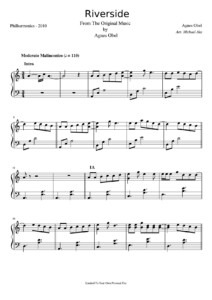 | |
| Agnes Obel September Song |  | |
| Agnes Obel Smoke And Mirrors |  | |
| Agnes Obel The Curse |  | |
| Agnes Obel Tokka |  | |
| Agnes Obel Words Are Dead |  |
Please, subscribe to our Sheet Music Library.
If you are already a subscriber, please, check our NEW SCORES’ page every month for new sheet music. THANK YOU!
Best Sheet Music download from our Library.
Come join us now, and enjoy playing your beloved music and browse through great scores of every level and styles!
Can’t find the songbook you’re looking for? Please, email us at: sheetmusiclibrarypdf@gmail.com We’d like to help you!
Arvo Pärt (b. 1935)
Who is Arvo Pärt?
Arvo Pärt: The Sound of Silence and the Sacred
In the tumultuous landscape of 20th-century music, filled with complexity, dissonance, and intellectualism, the voice of Estonian composer Arvo Pärt emerged as a profound and necessary counterweight. His music represents a radical return to first principles—to the purity of the triad, the resonance of a single note, and the immense weight of silence itself. With his独创的 “tintinnabuli” (from the Latin for “little bells”) style, Pärt has created a sonic world that functions not merely as an auditory experience but as a space for contemplation, a spiritual refuge for listeners navigating the noise of modern life. From 2011 to 2018, and again in 2022 and 2025, Pärt was the most performed living composer in the world, a testament to the universal appeal of his music, which transcends cultural and religious boundaries to touch something fundamentally human.

I. Biography: From Soviet Prodigy to Spiritual Pilgrim
Early Life and Education (1935-1956)
Arvo Pärt was born on September 11, 1935, in Paide, a small town in central Estonia . He spent his childhood in Rakvere, in the north of the country. A famous anecdote from his youth reveals much about his future path: the middle register of the family piano was damaged, leaving young Arvo to explore only the high and low ends of the keyboard, inadvertently immersing him in the world of extreme registers and spatial, open sounds from the very beginning . He began his formal music education at the age of seven at the Rakvere Music School.
In 1954, Pärt enrolled at the Tallinn Music Middle School, but his studies were interrupted less than a year later by conscription into the Soviet Army . He served in a military band, playing oboe and percussion, an experience that gave him practical familiarity with those instrument families. After his discharge, he entered the Tallinn Conservatory (now the Estonian Academy of Music and Theatre) in 1957, studying composition under the esteemed professor Heino Eller until his graduation in 1963 . Eller provided his students with immense creative freedom, laying the groundwork for Pärt’s future explorations. To support himself during and after his studies (1957-1967), Pärt worked as a sound engineer for Estonian Radio . This job was crucial, providing financial stability while also granting him intimate access, through recording equipment, to a wide range of music—from early polyphony to forbidden Western avant-garde scores and tapes that were smuggled into the Soviet Union .
Early Works and Creative Crisis (1960-1968)
Pärt’s early student works were neo-classical in style, clearly showing the influence of composers like Shostakovich, Prokofiev, and Bartók . His cantata Meie aed (“Our Garden”) for children’s choir and orchestra even won first prize in a competition for young Soviet composers .
However, Pärt quickly began to absorb and experiment with more radical modernist techniques. In 1960, he completed Nekrolog, the first twelve-tone composition in Estonian music history . This somber work for orchestra immediately drew the ire of the Soviet establishment, particularly Tikhon Khrennikov, the head of the Composers’ Union, who accused Pärt of being “susceptible to foreign influences” . Despite the official criticism, Pärt continued his avant-garde explorations throughout the 1960s, producing works like Perpetuum Mobile (1963), his First Symphony (1964), and the provocative Collage on B-A-C-H (1964), which juxtaposes fragments of Bach with dissonant modern sounds .
The year 1968 marked a definitive turning point with his work Credo for piano, chorus, and orchestra. The piece begins with a serene statement of Bach’s C-major prelude before erupting into chaotic avant-garde textures, only to return to a quiet, unwavering profession of faith: “Credo in Jesum Christum” (“I believe in Jesus Christ”) . Due to its overtly religious nature, the work was immediately banned by Soviet authorities after its premiere . This event plunged Pärt into a deep personal and creative crisis. He felt he had reached a “position of complete despair in which the composition of music appeared to be the most futile of gestures,” and he entered a period of creative silence that would last for nearly eight years .
Silence and Exploration (1968-1976)
During this period of outward silence, Pärt was inwardly more active than ever. He turned away from the avant-garde and embarked on a deep, scholarly study of the roots of Western music. He immersed himself in Gregorian chant, the Notre Dame school, and the polyphonic masters of the Renaissance—Josquin des Prez, Machaut, and Ockeghem . This self-imposed exile was as much a spiritual journey as an artistic one. In 1972, he converted from Lutheranism to the Russian Orthodox Church, a faith whose liturgy and theology of silence and inner prayer would profoundly shape his mature style . His only work from this transitional period, the Third Symphony (1971), serves as a bridge between the complexity of his early style and the stark simplicity to come.
The Tintinnabuli Period and International Fame (1976-1980)
In 1976, Pärt re-emerged with a completely new musical language. The short piano piece Für Alina (For Alina) was the first work to employ what he called the “tintinnabuli” style . It is deceptively simple: a slow descending B-minor scale in the right hand, accompanied by the notes of the B-minor triad (B, D, F#) in the left. This marked the birth of a new aesthetic.
The year 1977 was Pärt’s annus mirabilis (“miracle year”) . He composed three works that would become cornerstones of his international reputation: Cantus in Memoriam Benjamin Britten for string orchestra and bell, Tabula Rasa for two violins, string orchestra, and prepared piano, and Fratres (Brothers), which exists in numerous instrumental versions . These pieces, with their extreme simplicity, pure harmonies, and profound stillness, caused a sensation when they began to be heard in the West.
Emigration and Maturity (1980-Present)
Due to the increasingly oppressive atmosphere for religious artists in the Soviet Union, Pärt and his family were forced to emigrate in 1980 . After a brief stay in Vienna, they settled in West Berlin, where they lived for nearly 30 years. In the West, Pärt’s music found a perfect home with Manfred Eicher, the founder of the ECM record label. Their collaboration, beginning in 1984 with the release of the album Tabula Rasa, introduced Pärt’s music to a global audience .
After moving west, Pärt’s output increasingly focused on large-scale choral works. The Passio Domini nostri Jesu Christi secundum Joannem (The Passion of Our Lord Jesus Christ According to John, 1982) is considered the masterpiece of the tintinnabuli style, a monumental, hour-long setting of the Latin text. He followed this with a stream of profound sacred works, including the Berliner Messe (Berlin Mass, 1990), Te Deum (1984/1992), and the monumental Kanon Pokajanen (Canon of Repentance, 1997), a setting of the Orthodox canon in Church Slavonic .
Despite his fame, Pärt has remained a humble and reclusive figure. In 2010, he returned to Estonia, and in 2011, Pope Benedict XVI appointed him a member of the Pontifical Council for Culture . The Arvo Pärt Centre, designed by architects Fuensanta Nieto and Enrique Sobejano, opened in Laulasmaa, Estonia, in 2018, serving as an archive and research center for his life and work . On September 11, 2025, Arvo Pärt celebrated his 90th birthday, with concerts and tributes held around the world .
II. Musical Style and Compositional Technique
The Essence of Tintinnabuli
The tintinnabuli technique is the heart of Pärt’s mature music. It is not a complex system but a radical aesthetic of reduction. Pärt himself has described it: “I work with very few elements—with one voice, with two voices. I build with the most primitive materials—with the triad, with one specific tonality. The three notes of the triad are like bells. That is why I call it tintinnabulation” .
His wife, Nora Pärt, famously summarized the technique with a simple formula: 1+1=1 . This reveals the dualistic structure at its core:
- The first “1” (the M-voice) is the melodic voice. It is usually a diatonic melody that moves by step, note by note, like a slow scale. This voice is often seen as representing the earthly, the subjective, the human journey.
- The “+” (the T-voice) is the tintinnabuli voice. This voice strictly arpeggiates the notes of a single tonic triad (e.g., A, C, and E in A minor). It rings like the bells the name suggests, providing a constant, unwavering presence. This voice represents the eternal, the spiritual, the objective.
- The “= 1” signifies the seamless fusion of these two voices into a single, organic whole. They are bound together by strict mathematical rules, creating a music of profound unity .
This technique strips away the functional harmony of traditional tonality (the tension and release of dominant and tonic). Harmony in Pärt’s music is no longer a driving force but a static, resonant field—a glowing halo of sound.
Melody and Form: Gradual Progression in Silence
Pärt’s melodies are often strikingly simple, frequently taking the form of a slow ascending or descending scale, as heard most famously in the Cantus in Memoriam Benjamin Britten. This simplicity is not a lack of expression but its very source; it gives each individual note immense weight and significance. Rhythmically, his music often moves with a slow, “timeless” pulse.
In terms of form, Pärt favors variations and gradual processes. Unlike the American minimalists (such as Steve Reich or Philip Glass), whose music is based on repetitive cells creating a cyclical, trance-like effect, Pärt’s structures are more akin to a single, long breath or a slowly unfolding ritual. It is a “progressive” rather than a cyclic minimalism.
Harmony and Tonality: Purified Triads
In Pärt’s music, tonality returns, but in a “non-functional,” purified form. Triads no longer point to the next chord but anchor a sonic center, a specific color. His music sounds tonal, but it lacks the dramatic conflict of tension and resolution. This approach is directly linked to his study of Gregorian chant, where melodic lines flow according to the text’s rhythm, not the dictates of a harmonic progression.
III. Influences and Legacy
Primary Influences
Pärt’s influences are a unique blend of the ancient and the modern. His early work was shaped by the Russian-Soviet tradition of Shostakovich and Prokofiev. In the 1960s, he absorbed the techniques of the Second Viennese School and the European avant-garde . But the most profound influences on his mature style came from early music: the linear flow of Gregorian chant, the transparent structures of Josquin des Prez, and the deep spirituality of Russian Orthodox liturgical music. The music of J.S. Bach was a lifelong touchstone, evident in the contrapuntal purity of his late style.
Encounters and Relationships
Pärt’s collaboration with ECM’s Manfred Eicher was pivotal. Eicher heard Pärt’s music on the radio and immediately sought him out, beginning a decades-long partnership that shaped the sonic identity of his work for the world . His music has transcended the classical world, influencing artists in popular music, theater, and film. Icelandic singer Björk has spoken of her admiration for the “beauty and discipline” in his music. Theater director Robert Wilson has been drawn to the unique sense of time in Pärt’s compositions. Conductor Paul Hillier is not only a leading interpreter of his music but also wrote the first major scholarly book on it, Arvo Pärt (Oxford University Press, 1997). His recordings with the Hilliard Ensemble, especially the Passio, are considered definitive .
Legacy
Arvo Pärt is widely regarded as a leading figure of “holy minimalism” or “sacred minimalism,” alongside the Polish composer Henryk Górecki and the English composer John Tavener . However, Pärt himself has resisted the “minimalist” label, seeing his music’s spiritual core as distinct from a purely aesthetic movement. His legacy is not just in his vast and beloved catalog of works, but in his demonstration that music in the late 20th and 21st centuries could be both intellectually serious and spiritually accessible, offering a path back to simplicity, contemplation, and genuine feeling. The Arvo Pärt Centre stands as a guardian of his legacy, ensuring his archive is preserved for future generations of musicians and scholars .
IV. Analysis of Most Known Compositions
- Für Alina (1976): The “first cry” of the tintinnabuli style. Its profound simplicity—a single melodic line and a single triad—creates a vast and intimate space, a blank slate for the listener’s own emotions.
- Fratres (1977): Perhaps his most-performed work in its many versions. It is built on a recurring, hypnotic chord sequence (like a lament) that underpins a haunting, medieval-sounding melody. It balances constant motion with a feeling of eternal stillness .
- Tabula Rasa (1977): A double violin concerto in two movements. The first, “Ludus” (Play), is energetic and driving. The second, “Silentium” (Silence), is the opposite—a long, slow descent into complete stillness. The title means “clean slate,” suggesting a purification or a new beginning .
- Cantus in Memoriam Benjamin Britten (1977): Written upon the death of the English composer Pärt admired. It is built on a single, descending A-minor scale, played in canon by different sections of the string orchestra at different speeds, creating a massive, inexorable wave of sorrow. A single bell tolls the note A throughout, a constant, mournful light in the darkness .
- Spiegel im Spiegel (1978): Originally for violin and piano, this is the ultimate expression of tintinnabuli’s serenity. The piano articulates a simple, rising and falling triad pattern, while the violin sustains long, meditative notes. The music seems to reflect endlessly between the two instruments, like mirrors facing each other (“mirror in the mirror”), creating a sense of infinite, peaceful space .
- Passio Domini nostri Jesu Christi secundum Joannem (1982): The large-scale masterpiece. This setting of the St. John Passion is the most rigorous and profound application of the tintinnabuli technique. The music is austere, objective, and devoid of dramatic sentiment, allowing the ancient, sacred text to speak with overwhelming power.
V. List of Works (Selected)
- Symphonies: Symphony No. 1 (1963), Symphony No. 2 (1966), Symphony No. 3 (1971), Symphony No. 4 “Los Angeles” (2008) .
- Large Choral/Orchestral: Credo (1968), Passio (1982), Te Deum (1984/92), Berliner Messe (1990/2002), Kanon Pokajanen (1997), Adam’s Lament (2009) .
- Orchestral: Nekrolog (1960), Perpetuum Mobile (1963), Collage on B-A-C-H (1964), Cantus in Memoriam Benjamin Britten (1977), Pari intervallo (1976/80).
- Concertante/Ensemble: Tabula Rasa (1977), Fratres (1977).
- Chamber/Instrumental: Für Alina (1976), Spiegel im Spiegel (1978), Variationen zur Gesundung von Arinuschka (1977).
- A Cappella Choral: Da pacem Domine (2004), Salve Regina (2001), Magnificat (1989), Sieben Magnificat-Antiphonen (1988).
VI. Pärt’s Music in Film
The unique atmosphere and emotional depth of Pärt’s music have made it a favorite for film directors, often used to underscore themes of solitude, contemplation, tragedy, or transcendence .
- The Thin Red Line (1998): Uses Spiegel im Spiegel to create moments of profound stillness amidst the chaos of war.
- Wit (2001): The entire emotional core of this film about a dying professor is built around Spiegel im Spiegel.
- Gerry (2002): Features Spiegel im Spiegel.
- There Will Be Blood (2007): The film’s trailer famously uses the opening of Fratres.
- Shutter Island (2010): The trailer uses Spiegel im Spiegel.
- Melancholia (2011): The film’s prelude is set to the prelude of Tristan und Isolde, but Pärt’s music is used elsewhere in the score, and his aesthetic deeply permeates the film’s mood.
- Amour (2012): Uses Spiegel im Spiegel.
- Foxcatcher (2014): Features Pärt’s music.
- Arrival (2016): The trailer uses Spiegel im Spiegel.
- Call Me By Your Name (2017): Features a pivotal scene with a piano transcription of the aria “Vaga luna, che inargenti” by Bellini, but Pärt’s aesthetic is often discussed in connection with the film’s contemplative mood, and his works appear elsewhere on the soundtrack.
- A Hidden Life (2019): Terrence Malick’s film features Pärt’s Symphony No. 3 and Fratres extensively.
VII. Famous Performers and Ensembles
Many artists are celebrated for their interpretations of Pärt’s work:
- Conductors: Paul Hillier, Tõnu Kaljuste, Neeme Järvi, Paavo Järvi.
- Ensembles: The Hilliard Ensemble, Estonian Philharmonic Chamber Choir, Tallinn Chamber Orchestra, Vox Clamantis.
- Soloists: Violinist Gidon Kremer, cellist Anssi Karttunen, pianist Alexander Malter.
VIII. Recent Works and Continuing Output
Into his late eighties, Pärt continued to compose. Works like Adam’s Lament (2009) for choir and orchestra show a deepening exploration of human suffering and spirituality. And One of the Pharisees… (2018), written to mark the centenary of Nelson Mandela’s birth, demonstrates his ongoing engagement with themes of redemption and humanity. On the occasion of his 90th birthday in 2025, his music was performed and celebrated globally, a testament to a living composer whose work continues to speak with undiminished power to new generations .
Arvo Pärt’s music is an act of faith and an invitation to listen differently. In an age of speed and noise, he taught the world to listen again—to hear the resonance within a single bell-like note, and to feel the profound presence in silence. His “little bells” do not clamor for attention; they ring softly, touching a deep, universal chord within the listener, a yearning for stillness, beauty, and meaning. As Pärt himself said, “I could compare my music to white light which contains all colors. Only a prism can divide the colors and make them appear; this prism could be the spirit of the listener.”
Browse in the Library:
Or browse in the categories menus & download the Library Catalog PDF:
Please, subscribe to our Sheet Music Library.
If you are already a subscriber, please, check our NEW SCORES’ page every month for new sheet music. THANK YOU!