
Come join us now, and enjoy playing your beloved music and browse through great scores of every level and styles!
Can’t find the songbook you’re looking for? Please, email us at: sheetmusiclibrarypdf@gmail.com We’d like to help you!
Table of Contents
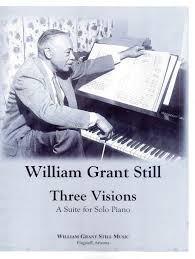
William Grant Still: Three Visions (Suite for piano solo)
Best Sheet Music download from our Library.

Please, subscribe to our Sheet Music Library.
If you are already a subscriber, please, check our NEW SCORES’ page every month for new sheet music. THANK YOU!
0:00 – Dark Horseman 1:30 – Summerland 6:00 – Radiant pinnacle
Browse in the Library:
Or browse in the categories menus & download the Library Catalog PDF:
William Grant Still
William Grant Still (1895 – 1978) was an American composer, arranger, conductor, and multi-instrumentalist, often called “the Dean of African American composers.” He was the first African American to have a symphony performed by a major orchestra in the United States, the first to conduct a major symphony orchestra, and the first to have an opera produced by a major opera company.

Early Life and Education
- Born on May 11, 1895, in Woodville, Mississippi, and raised in Little Rock, Arkansas.
- His father died when he was an infant, and his mother, a teacher, encouraged his musical interests.
- Studied at Wilberforce University, where he initially pursued medicine but shifted to music.
- Later trained at the Oberlin Conservatory of Music, then studied composition with George Whitefield Chadwick and later with avant-garde composer Edgard Varèse in New York.
Career and Achievements
- Worked as an arranger for popular and jazz bands in New York, including for W. C. Handy and Paul Whiteman.
- Became involved with the Harlem Renaissance, blending African American musical traditions with classical forms.
- His Symphony No. 1 “Afro-American” (1930) was the first symphony by an African American to be performed by a major U.S. orchestra (Rochester Philharmonic, 1931).
- Conducted the Los Angeles Philharmonic at the Hollywood Bowl in 1936, making him the first African American to lead a major orchestra in the U.S.
- His opera Troubled Island (1939, libretto by Langston Hughes and Verna Arvey) was the first by an African American staged by a major company (New York City Opera, 1949).
Musical Style
- Fused classical European traditions with African American idioms: blues, spirituals, jazz, and folk tunes.
- Emphasized lyricism, accessibility, and cultural expression rather than strict modernist abstraction.
- Advocated for a distinctly American classical music rooted in Black cultural traditions.
Notable Works
- Symphonies: Afro-American Symphony (No. 1), Song of a New Race (No. 2), The Sunday Symphony (No. 3), Autochthonous Symphony (No. 4), Western Hemisphere Symphony (No. 5).
- Operas: Troubled Island, A Bayou Legend, Highway 1, U.S.A.
- Chamber & Vocal Music: Lyric Quartette, Danzas de Panama, many art songs.
- Also wrote for radio, film, and popular ensembles.
Legacy
- Broke multiple racial barriers in American classical music.
- Opened doors for later generations of African American composers and performers.
- His works are increasingly studied and performed, recognized as cornerstones of 20th-century American music.
- Died in Los Angeles, California, on December 3, 1978.
William Grant Still’s music stands out for celebrating African American heritage within the classical tradition, offering a unique and dignified voice at a time when systemic racism excluded many Black composers from mainstream recognition.
Three Visions (1935) is one of William Grant Still’s most powerful works for solo piano. It is a short suite in three movements, deeply symbolic, written during the Harlem Renaissance period when Still was developing a distinctive African American voice within classical idioms. The suite is often regarded as a spiritual and philosophical statement on the human soul’s journey after death.
Three Visions (1935) Overview and Musical Analysis
- Title: Three Visions (for solo piano)
- Date: 1935
- Movements:
- Dark Horsemen
- Summerland
- Radiant Pinnacle
- Theme: The cycle represents the progression of the human soul: confrontation with death, passage to spiritual peace, and ultimate ascension.
1. Dark Horsemen
- Character: Turbulent, dissonant, and rhythmically urgent.
- Musical features:
- Rapid ostinati and syncopations drive the texture.
- Dense chords, sharp dynamics, and angular melodies suggest violence and inevitability — the soul’s confrontation with mortality.
- Harmonic language: rooted in tonal centers but heavily chromatic, with influences from early modernism (Still studied with Varèse).
- Strong percussive writing evokes imagery of galloping horses (possibly a reference to the biblical Four Horsemen of the Apocalypse).
Interpretation: This movement symbolizes the struggle and chaos of death, the breaking away of the soul from earthly ties.
2. Summerland
- Character: Gentle, lyrical, and serene — the most frequently performed movement.
- Musical features:
- Lush, hymn-like melody in the middle register, often played with a singing legato.
- Rich Romantic harmonies, influenced by Chopin and Debussy but colored with blues-inflected lines.
- Transparent texture, long sustained chords, and rubato create a meditative atmosphere.
- Tonal stability (often interpreted in D♭ major) provides calmness.
Interpretation: Summerland represents the spiritual paradise the soul reaches after death — peaceful rest and eternal beauty.
This movement is sometimes performed alone as an independent concert piece or even arranged for orchestra.
3. Radiant Pinnacle
- Character: Triumphant, luminous, and ascending.
- Musical features:
- Energetic rhythms, sweeping arpeggios, and brighter harmonies than in the previous movements.
- Builds momentum with a sense of striving upward, often through sequences and rising melodic gestures.
- Tonal clarity, major sonorities, and climactic chords express transcendence.
- Harmonically more consonant than Dark Horsemen, but with modern chromatic coloring.
Interpretation: This final movement depicts the soul’s union with the divine, ascending to its highest state — ultimate illumination.
Stylistic Significance
- Still fuses African American spiritual aesthetics (hymn-like phrasing, blues shadings, and rhythmic vitality) with Romantic piano traditions and 20th-century modernism.
- The three movements form a narrative arc: struggle → peace → transcendence.
- Philosophically, the suite echoes African American religious culture, yet framed in a universal human story of death and renewal.
In short, Three Visions is both a musical poem and a spiritual statement. It demonstrates Still’s ability to merge classical craft with African American cultural expression, creating a deeply humanistic and uplifting work.
Perfect — let’s dive into a harmonic walkthrough of “Summerland” from William Grant Still’s Three Visions. Since this movement is often performed alone and is the most tonal of the suite, it lends itself beautifully to harmonic analysis.
(Note: Exact bar numbers vary depending on the edition, but I’ll give the progression in sections. The piece is most often read in D♭ major.)
“Summerland” — Harmonic Analysis
Opening (mm. 1–4)
- Key: D♭ major
- Chords:
- I (D♭ major) — tonic established gently, hymn-like.
- IV (G♭ major) with added 6th/9th sonorities.
- I again, enriched by suspensions and inner voice motion.
The effect is calm, hymn-like stability. Still avoids strong cadences, instead sustaining a floating atmosphere.
First Phrase (mm. 5–12)
- Melody enters in the middle register, supported by soft chords.
- Progression:
- I → V/vi → vi (B♭ minor) → ii (E♭ minor) → V (A♭ major).
- Resolves back to I (D♭).
This is a classical diatonic motion but with added-color tones (6ths, 9ths), giving a Debussy-like lushness. The move to vi and ii emphasizes a spiritual, tender quality rather than dramatic tension.
Second Phrase (mm. 13–20)
- More chromaticism enters.
- Chords:
- I → ♭VII (C♭ major) → IV (G♭) → ii7 (E♭m7) → V7 (A♭7).
- Resolution: cadences softly back to I.
The use of ♭VII (C♭) is borrowed from folk/blues progressions. It enriches the harmony with a distinctly African American inflection inside an otherwise classical framework.
Climactic Middle Section (mm. 21–32)
- Harmonically more adventurous:
- Alternation between vi (B♭ minor) and IV (G♭ major).
- Sequence through chromatic mediants: I (D♭) → iii (F minor) → V/ii (F7) → ii (E♭ minor).
- Approaches V7 (A♭7) with stronger rhythm and dynamics.
The chromatic mediant shifts (D♭ → Fm → A♭) give the impression of warmth and expansion — the soul ascending in vision.
Return (mm. 33–40)
- Recapitulation of the opening theme.
- Progression largely tonic (I), with embellishments:
- I → IV → ii7 → V7 → I.
- Still decorates the chords with added 9ths and 11ths, keeping the sound lush and modern.
Coda (mm. 41–end)
- Gentle descent, cadencing finally on a pure I (D♭ major).
- Chords sustain with long fermatas, creating timeless stillness.
The coda is essentially a plagal cadence (IV → I), which resonates with the feeling of a hymn or spiritual.
Summary of Harmonic Style in “Summerland”
- Foundation: Firmly tonal, centered in D♭ major.
- Coloration: Use of added 6ths, 9ths, 11ths for lush textures.
- African American inflection:
- Borrowed ♭VII (C♭ major) → I.
- Blues-like coloring of melodic lines (flattened 3rd, 7th inflections).
- Narrative arc: Gentle tonic → chromatic expansion → luminous return.
- Effect: A meditative vision of paradise — serenity, lyricism, timeless rest.
So, harmonically, Summerland balances European Romanticism (Chopin, Debussy) with African American idioms (bluesy modal borrowing, plagal cadences). This is why it feels both “classical” and “soulful.”
| Artist or Composer / Score name | Cover | List of Contents |
|---|---|---|
| Vangelis – Conquest Of Paradise | Vangelis – Conquest Of Paradise | |
| Vangelis – Conquest Of Paradise (Musescore File).mscz | ||
| Vangelis – Five Circles from Chariots of Fire (Guitar arr. with Tablature) | Vangelis – Five Circles from Chariots of Fire (Guitar arr. with Tablature) | |
| Vangelis – L’enfant (from The Year of Living Dangerously) (Guitar with TABs) | Vangelis – L’enfant (from The Year of Living Dangerously) (Guitar with TABs) | |
| Vangelis – La Petite Fille De La Mere (from L’Apocalypse des Animaux) (Guitar with TABs) | Vangelis – La Petite Fille De La Mere (from L’Apocalypse des Animaux) (Guitar with TABs) | |
| Vangelis – La Petite Fille De La Mere (Guitar TABs) |
 |
|
| Vangelis – Missing Main Theme From the film Missing (Guitar TABs) | Vangelis – Missing Main Theme From the film Missing (Guitar TABs) | |
| Vangelis – Missing Main Theme From the film Missing (Piano) | Vangelis – Missing Main Theme From the film Missing (Piano) | |
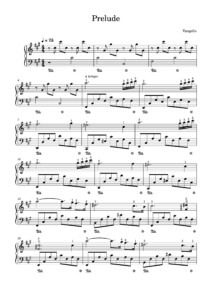
| Vangelis – Prelude |
 |
|
| Vangelis – The Best Of (piano songbook) |
 |
Vangelis – The Best Of (piano songbook) contents |
| Vangelis Aphrodite’s Child Rain And Tears Guitar |
 |
|
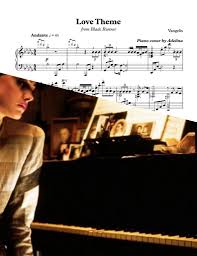
| Vangelis Blade Runner – Love Theme (piano, keyboard arr.) |
 |
Blade_Runner_-_Love_Theme 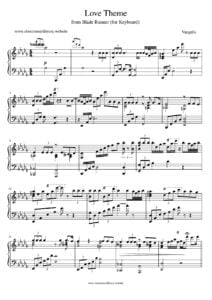 |
| Vangelis Chariots Of Fire Piano Solo |
 |
|
| Vangelis Heaven and Hell Piano Solo |
 |
|
| Vangelis Hymne Piano Solo |
 |
|
| Vangelis La Petite Fille De La Mer piano solo |
 |
|
| Variations In Merry Go Round Of Life – Joe Hisaishi | Variations In Merry Go Round Of Life – Joe Hisaishi | |
| Vassiliev Konstantin Three Forest Painting Guitar |
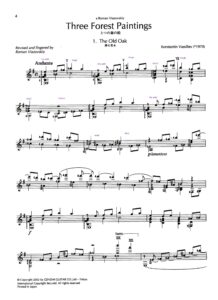 |
|
| Vassiliev, Konstatin Alba (1996) Guitar Sheet Music With Tabs |
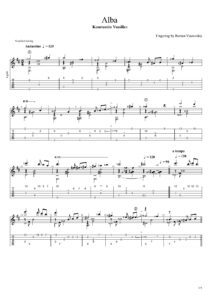 |
|
| Vaughan Williams The Lark Ascending (Violin and Piano Reduction) |
 |
|
| Vaughan Williams – Fantasia On A Theme By Thomas Tallis (Musescore File).mscz | ||
| Vaughan Williams Lark Ascending Piano violin arr. by J. Godderis |
 |
|
| Vaughan Williams On Music Oxford Un. by David Manning (Book) |
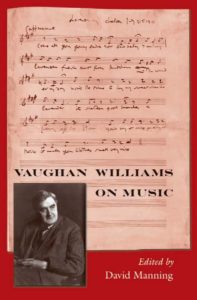 |
|
| Vavilov Vladimir Ave Maria (Wrongly Attributed To G.Caccini) Piano And Two Voices |
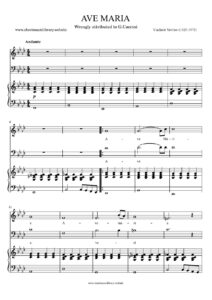 |
|
| Vavilov Vladimir – Ave Maria (Wrongly Attributed To G.Caccini) Piano And Two Voices (Musescore File).mscz | ||
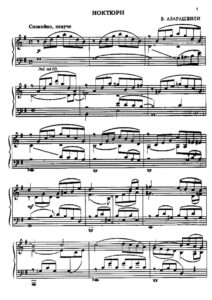
| Vazha Azarashvili – Nocturne |
 |
|
| Vazha Azarashvili – Nostalgia |
 |
|
| Vazha Azarashvili Sentimental Tango (4 hands piano sheet music) | Vazha Azarashvili Sentimental Tango (4 hands piano sheet music) first page | |
| Vazha Azarashvili Sentimental Tango (piano solo sheet music) | Vazha Azarashvili Sentimental Tango (piano solo sheet music) | |
| Vedrai vedrai (Luigi Tenco) | ||
| Velazquez, Consuelo Amar Y Vivir (Guitarra, Guitar) |
 |
|
| Vengaboys – Boom Boom Boom | ||
| Venice (Only You OST) Rachel Portman | ||
| Verdi Il Trovatore – Anvil Chorus Piano Solo |
 |
|
| Verdi Va Pensiero Piano Solo Arr. Nabucco Acte III Choeur Des Ésclaves Hébreux | Verdi Va Pensiero Piano Solo Arr. Nabucco Acte III Choeur Des Ésclaves Hébreux | |
| Verdi – La Donna è Mobile |
 |
|
| Verdi – La Donna È Mobile (Musescore File).mscz | ||
| Verdi – La Traviatta – Piano Solo arr. |
 |
|
| Verdi – Libiamo Ne Lieti Calici (La Traviata) (Musescore File).mscz | ||
| Verdi – Va pensiero Piano Solo arr. NABUCCO ACTE III Choeur des ésclaves hébreux.mscz | ||
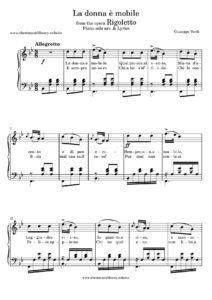
| Verdi La dona e mobile Rigoletto Piano Solo with lyrics |
 |
|
| Verdi La Dona E Mobile Rigoletto Piano Solo With Lyrics Musescore File.mscz | ||
| Verdi Libiamo Ne’ Lieti Calici La Traviata Easy Piano Solo Musescore File.mscz | ||
| Verdi Paul Mauriat La Traviata Piano Solo Musescore File.mscz | ||
| Verdi Requiem Cambridge Music Handbooks (Book) |
 |
|
| Vernon Duke Autumn In New York |
 |
|
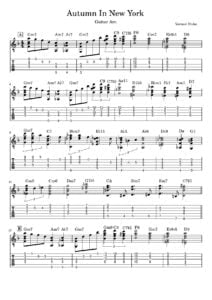
| Vernon Duke – Autumn In New York (guitar arr. with TABs) |
 |
|
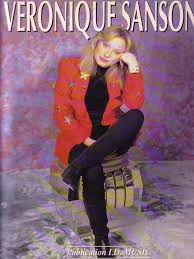
| Veronique Sanson Songbook Piano Vocal |
 |
Veronique Sanson Songbook |
| Veronique Sanson Top Songbook Piano Vocal Guitar Chords |
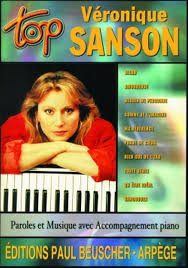 |
Veronique Sanson Top Songbook |
| Vertical Horizon – Best I Ever Had | ||
| Via con me (Paolo Conte) | ||
| Via del Campo (Fabrizio De Andrè) | ||
| Vianne Sets Up Shop (Chocolat OST) Rachel Portman | ||
| Vicente Amigo Ciudad De Las Ideas (Guitar TAB) |
 |
|
| Victor Herbert’s masterpiece Ah Sweet Mystery Of Life |
 |
|
| Victor Jara Un Canto Truncado Joan Jara (Book) Español – Spanish Biography – Biografía |
 |
|
| Victor Labenske Piano Miniatures 24 Short Solos In All Major And Minor Keys (Intermediate Piano) |
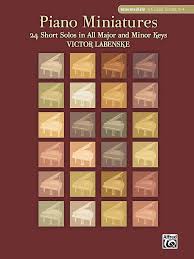 |
Victor Labenske Piano Miniatures 24 Short Solos In All Major And Minor Keys (Intermediate Piano) |
| Victor Wooten Best of – transcribed by Victor Wooten Guitar Tabs |
 |
Victor Wooten Best of – transcribed by Victor Wooten Guitar Tabs |
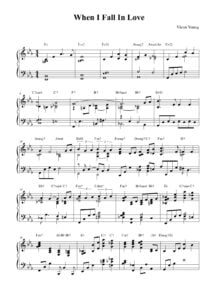
| Victor Young When I Fall In Love |
 |
|
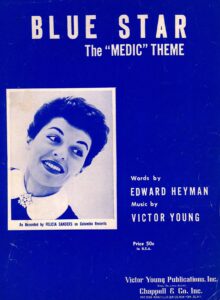
| Victor Young – Blue Star The Medic Theme |
 |
|
| Victor Young – Stella By Starlight Jazz Standard |
 |
|
| Victor Young – When I Fall In Love |
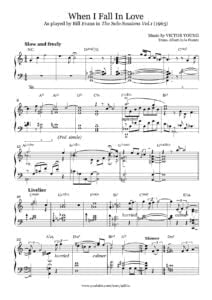 |
|
| Victor Young – When I Fall In Love Sheet Music as recorded by Celine Dion and Clive Griffin (fromm Sleepless in Seate) |
 |
|
| Victor Young (Bill Evans) – When I Fall In Love (Musescore File).mscz | ||
| Victor Young And Peggy Lee Johnny Guitar |
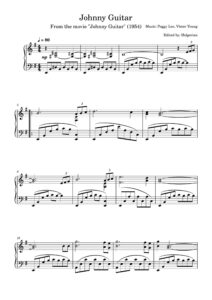 |
|
| Victor Young Around the World (piano solo sheet music) | Victor Young Around the World (piano solo sheet music) | |
| Victor Young Around The World In 80 Days Easy Piano Solo |
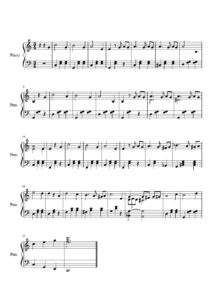 |
|
| Victor Young Love Letters (Piano Solo arr.) |
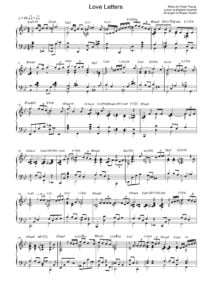 |
|
| Victor Young Stella by Starlight | Stella-By-Starlight-Victor-Young | |
| Victor Young Stella By Starlight Easy Piano Solo |
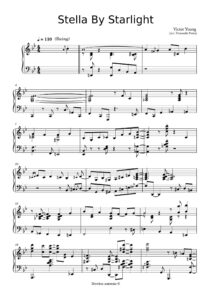 |
|
| Victor Young Stella By Starlight Victor Young & Ned Washington Sheet Music 1946 Jazz Standard (Vintage sheet music) |
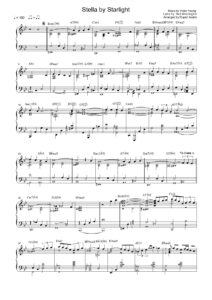 |
|
| Vida Y Arte De Glenn Gould – by Bazzana Kevin (Español Spanish) |
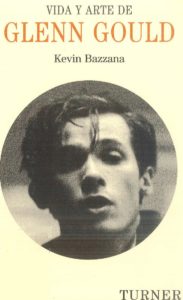 |
|
| Video Game Music The Greatest Video Game Music Piano Solo |
 |
Video Game Music The Greatest Video Game Music Piano Solo |
| Viktor Semenuita Suite The Spring Awakening for Guitar quartet |
 |
|
| Villa-Lobos – 12 Guitar Etudes (Doze Estudios para Violao) |
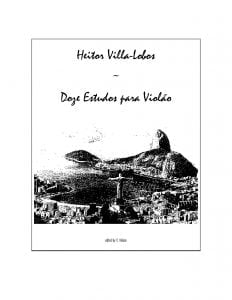 |
|
| Villa-Lobos – Bachiana Brasileira no. 4 | ||
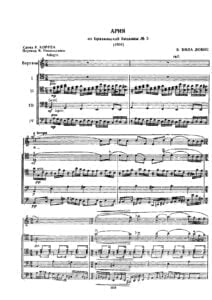
| Villa-Lobos – Bachianas Brasileiras No. 5 – Aria (Cantilena) partitura |
 |
|
| Villa-Lobos – Choros (N°1) Guitar Sheet Music (Musescore File).mscz | ||
| Villa-Lobos – Prelude N° 3 (Musescore File).mscz | ||
| Villa-Lobos -Etude №1 (Musescore File).mscz | ||
| Villa-Lobos A Lenda do Caboclo | Villa-Lobos Lenda do Caboclo | |
| Villa-Lobos Bachiana 4 Preludio for Classical guitar arr. by Andre Lavor |
 |
|
| Villa-Lobos Bachianas Brasileiras No 4 for Piano Solo arr. | Villa-Lobos Bachianas Brasileiras No 4 for Piano Solo arr. | |
| Villa-Lobos Five Preludes for Guitar, W419 |
 |
|
| Villa-Lobos Guia Patrico Album 2 | Villa-Lobos-GP-Album-2 | |
| Villa-Lobos Guia Patrico Album 3 | Villa-Lobos Guia Patrico Album 3 | |
| Villa-Lobos O Piano E As Bachianas |
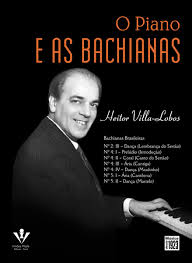 |
Villa-Lobos O Piano E As Bachianas |
| Villa-Lobos Prelude 1 for Guitar | Villa-Lobos prelude 1 | |
| Villa-Lobos Prelude No 1 (Musescore File).mscz | ||
| Villa-Lobos Tristorosa Guitar arr. by Gorbunov |
 |
|
| Villa-Lobos, Heitor – Obras Completas (complete works for GUITAR) |
 |
Villa-Lobos obra completa guitarra |
| Villa-Lobos, Heitor – Aria (Cantilena) arr. for voice and guitar | Villa-Lobos, Heitor – Aria (Cantilena) arr. for voice and guitar | |
| Villa-Lobos, Heitor – Bachianas Brasileiras No 4 No 2 – Choral Song Of The Jungle | ||
| Villa-Lobos, Heitor – Saudades das selvas brasileras (pour piano) | Villa-Lobos – Saudades das selvas brasileras | |
| Villa-Lobos, Heitor Suite Populaire Bresilienne (Guitar) |
 |
|
| Vince Guaraldi A Charlie Brown Christmas |
 |
Vince Guaraldi A Charlie Brown Christmas |
| Vince Guaraldi Christmas Time Is Here |
 |
|
| Vince Guaraldi Linus And Lucy (Piano Solo) Peanuts Theme | Vince Guaraldi Linus And Lucy (Piano Solo) Peanuts Theme | |
| Vince Guaraldi – Cast Your Fate To The Wind | Vince Guaraldi – Cast Your Fate To The Wind | |
| Vince Guaraldi – Linus And Lucy (Piano Solo) Peanuts Theme (Musescore File).mscz | ||
| Vince Guaraldi A Charlie Brown Christmas For Solo Jazz Guitar with TAB |
 |
Vince Guaraldi A Charlie Brown Christmas For Solo Jazz Guitar with TAB |
| Vince Guaraldi A Charlie Brown Christmast Beginning Piano Solos |
 |
Vince Guaraldi A Charlie Brown Christmast Beginning Piano Solos |
| Vince Guaraldi At The Piano Biography Book By Derrick Bang |
 |
|
| Vince Guaraldi Charlie Browns Greatest Hits Piano Solos arr. by Lee Evans |
 |
Vince Guaraldi Charlie Browns Greatest Hits Piano Solos arr. by Lee Evans |
| Vince Guaraldi Collection 9 transcriptions |
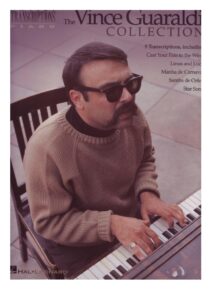 |
Vince Guaraldi Collection 9 transcriptions |
| Vince Guaraldi The Christmas Song |
 |
|
| Vince Guaraldi The Christmas Song (Mel Tormé and Robert Wells) Piano Solo | Vince Guaraldi The Christmas Song (Mel Tormé and Robert Wells) Piano Solo | |
| Vince Guaraldi The Definitive Vince Guaraldi Artist Transcriptions For Piano |
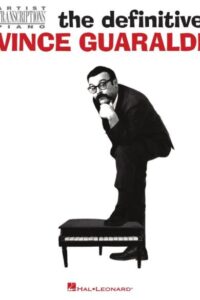 |
Vince Guaraldi The Definitive Vince Guaraldi Artist Transcriptions For Piano |
| Vince Guaraldi The Peanuts Illustrated Songbook Piano Solo |
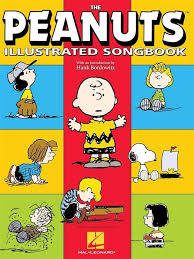 |
Vince Guaraldi The Peanuts Illustrated Songbook Piano Solo |
| Vineyard Songbook (2011) Guitar Songchords |
 |
Vineyard Songbook (2011) Guitar Songchords |
| Vinicius De Moraes Vols 1,2 & 3 Guitar Songbook (Almir Chediak) |
 |
Vinicius de Moraes 1,2 & 3 books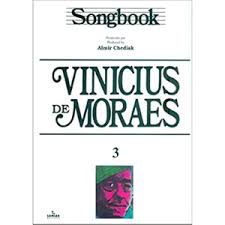 |
| Vinnie Moore Masterclass (audio Mp3 Tab And Backing Track) GUITAR TABS |
 |
|
| Violet Vocal Selections Jeanine Tesori and Brian Crawley (The Broadway Musical) |
 |
Violet Vocal Selections Jeanine Tesori and Brian Crawley |
| Violin Songs Big Book Of (Songbook) 130 songs |
 |
Violin Songs Big Book Of (Songbook) 130 songs |
| Virtuosity And The Musical Work The Transcendental Studies Of Liszt By Jim Samson Book |
 |
|
| Vittorio Monti Czardas (Piano Solo arr.) |
 |
|
| Vittorio Monti Czardas Piano violin arr. by J. Godderis |
 |
|
| Viva Italia Songbook A Travelogue In Song Piano Vocal Chordsby Curt Appelgren |
 |
Viva Italia Songbook A Travelogue In Song Piano Vocal Chordsby Curt Appelgren |
| Viva La Vida – Coldplay (Musescore File).mscz | ||
| Vivaldi Largo Concerto D Guitar Arr |
 |
|
| Vivaldi Summer The Four Seasons Piano Solo Arr. | Vivaldi Summer The Four Seasons Piano Solo Arr. | |
| Vivaldi The Four Seasons (Piano Solo Arrangement) |
 |
|
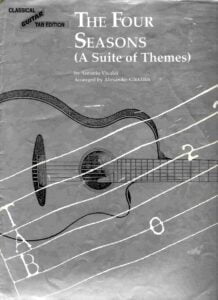
| Vivaldi The Four Seasons Guitar arr. (A Suite of Themes) by Alxander Glüklikh |
 |
|
| Vivaldi Violin Concerto In F Major Op. 8 No. 3 Rv. 293 Autumn For Solo Piano | Vivaldi Violin Concerto In F Major Op. 8 No. 3 Rv. 293 Autumn For Solo Piano | |
| Vivaldi – Concert in G minor Summer arr. violin and piano |
 |
|
| Vivaldi – Concerto No. 2 In G Minor Op. 8 Rv 315mov. 3 Presto Summer L’estate Piano Solo Arr. (Musescore File).mscz | ||
| Vivaldi – Concerto No. 2 in G minor, Op. 8, RV 315 mov. 3 Presto Summer L’estate Piano Solo arr. sheet music | Vivaldi – Concerto No. 2 in G minor, Op. 8, RV 315 mov. 3 Presto Summer L’estate Piano Solo arr. sheet music | |
| Vivaldi – Summer The Four Seasons Piano Solo arr..mscz | ||
| Vivaldi – Winter Guitar Arr. Based On Violin Concerto In F Minor Rv 297 L’inverno (Sheet Music) (Musescore File).mscz | ||
| Vivaldi – Winter Guitar arr. based on Violin Concerto in F minor, RV 297 L’inverno (sheet music) | Vivaldi – Winter Guitar arr. based on Violin Concerto in F minor, RV 297 L’inverno (sheet music) | |
| Vivaldi Gloria Piano Reduction |
 |
|
| Vivaldi Master Musicians Series (Book) Biography by Michael Talbot |
 |
|
| Vivaldi Winter Piano Solo Arr. As Played By Rousseau (The Four Seasons) | Vivaldi Winter Piano Solo Arr. As Played By Rousseau | |
| Vivo Per Lei – Bocelli | ||
| Vivo per lei (Bocelli – Giorgia) | ||
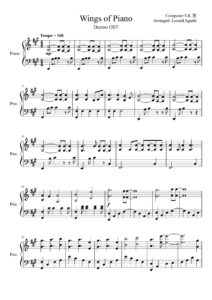
| VK Vanros Kloud Wings Of Piano |
 |
|
| Vladimir Cosma Les Musiques De Films Vol 2 |
 |
Vladimir Cosma Les Musiques De Films Vol 2 |
| Vladimir Cosma Les Plus Belles Chansons Vol 1 |
 |
Cosma, Vladimir – Les Plus Belles Chansons Vol 1 |
| Vladimir Cosma Musique De Film Cosma, Vladimir Musique De Film Les Plus Belles Chansons. Vol. 2 |
 |
Cosma, Vladimir Musique De Film Vol 2 |
| Vladimir’s Blues (Musescore File).mscz | ||
| Voez Hope Piano Solo | Voez Hope Piano Solo | |
| Voice Leading Jazz Guitar John Thomas |
 |
|
| Voicings For Jazz Keyboard By Frank Mantooth |
 |
Voicings For Jazz Keyboard By Frank Mantooth |
| Volker Bertelmann – Lion Main Theme sheet music |
 |
|
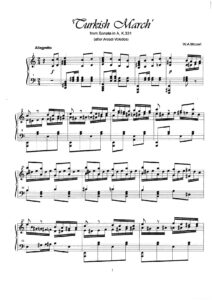
| Volodos Mozart’s Turkish March From Sonata No. 11 |
 |
|
| Volodos – Rachmaninoff Where Beauty Dwells Melodiya Op. 21 No. 7 Version Putsmeiser Piano Solo |
 |
|
| Volumia – Afscheid | ||
| Volumia – Hou Me Vast | ||
| Voormolen Scene et Danse Erotique pour piano score | Voormolen Scene et Danse Erotique pour piano score | |
| Vorrei (Lunapop) |